SAEDNEWS: Have you ever heard of something called a water clock? How did this remarkable invention serve people in their daily lives? In this section, we explore some fascinating facts about water clocks and discover how they helped people measure and keep track of time throughout history.
According to Saednews, In ancient times, people used various tools to organize their daily activities and make better use of their time. Unlike modern clocks, these devices were relatively simple and relied on ingenious techniques. One of the most widespread examples was the water clock.
Throughout history, human societies developed different methods of measuring time according to their knowledge and experience. The sun and water were among the most important natural resources used for this purpose. Although the modern 24-hour clock began to take shape in the fifteenth century, it only became widely used during the last century.
The Persian water clock was a simple yet remarkably accurate, practical, and durable device. It played an especially important role in agricultural communities, particularly in Iran's dry and desert regions, where water was essential to both survival and social life.
Studies of water clocks in different parts of the world suggest that nowhere was this technology used as continuously and practically as it was in Iran. Even when modern clocks became available around the middle of the twentieth century, many Iranian farmers continued to rely on the traditional water clock rather than abandon a system they considered reliable and familiar.
The Greek historian Callisthenes, who accompanied Alexander the Great during his campaign in Iran, recorded events and observations from the region. In a report later identified through calendar calculations as dating to September 328 BCE, he described how water was distributed among farmers according to turns.
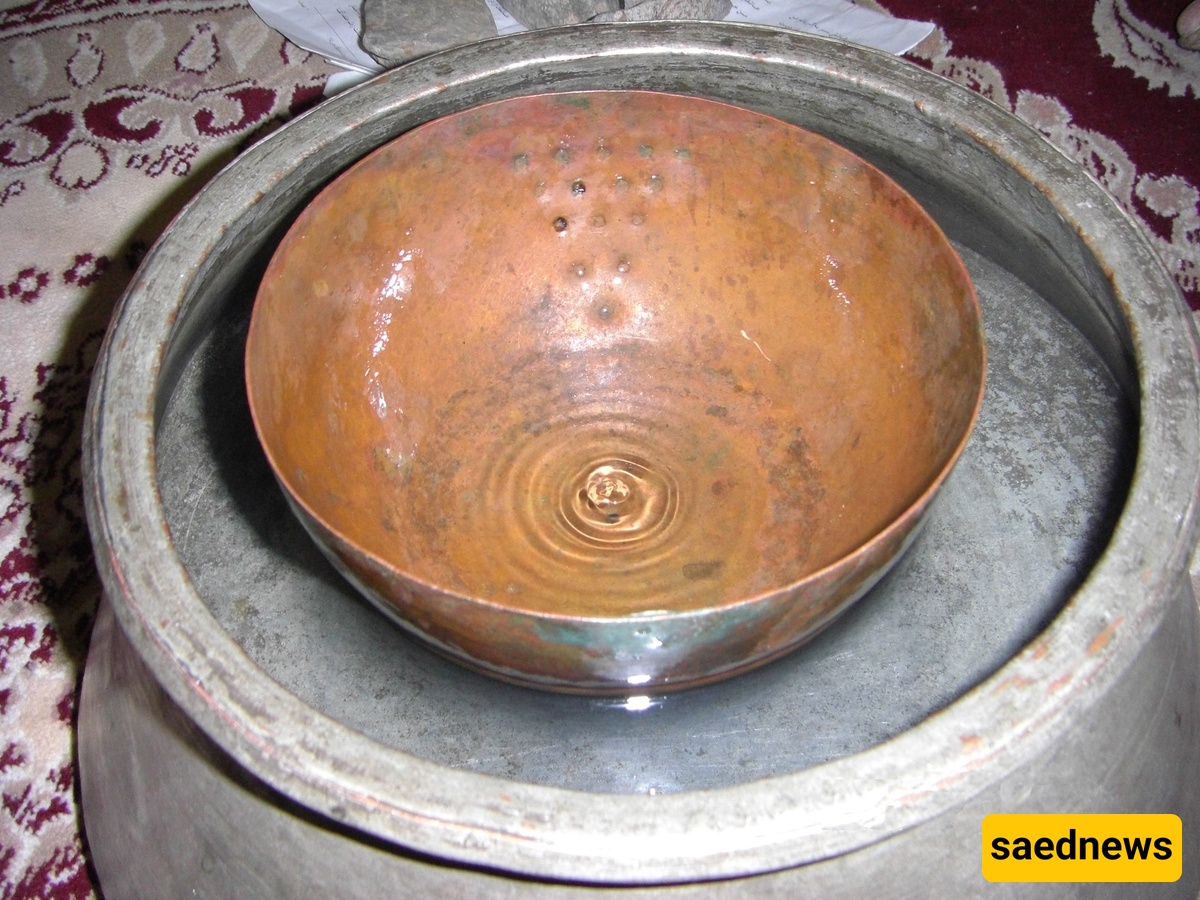
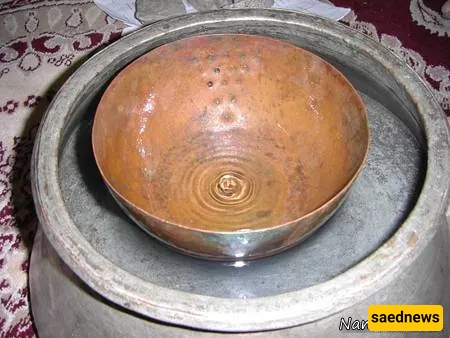
According to his account, the villagers selected a person to supervise the allocation of water and determine the length of each farmer's share. This person sat beside the main water channel and its distribution point. A small metal container with a very small opening was placed inside a larger vessel filled with water.
As water slowly entered the small container, it eventually became full and sank. The size of the opening had been carefully calculated in advance so that each sinking represented a specific period of time. The water was then diverted from one farmer's irrigation channel to another's.
This process was repeated continuously. The system provided an effective means of distributing water fairly and helped prevent disputes among farmers.
Callisthenes' description indicates that water clocks were already widely used in Iran before the time of Alexander the Great. Their invention therefore probably dates back several centuries earlier.
Water clocks existed in several forms, but one of the simplest and most accurate Persian versions was known as the pengan or fengan. It consisted of two vessels, a human timekeeper, and a number of small stones or counters.
During the Islamic period, the device was also referred to by other names, including bankam and fengan. In the classification of Islamic sciences, the construction and use of water clocks belonged to a field known as al-Bankamat, which was regarded as a branch of geometry.
The science of al-Bankamat was described as the knowledge of measuring time through the understanding and use of specialized instruments. Its purposes included determining the times of prayer and night worship, as well as organizing governmental and social affairs that depended on accurate timekeeping.
People who specialized in operating the pengan and studying this science were known as fanjamiyyin.
Historical and archaeological evidence indicates that the use of water clocks in Iran has been documented for at least 2,400 years.
From the earliest development of qanats, water managers, known as mirabs, used water clocks to determine the amount of time each shareholder was entitled to receive water.
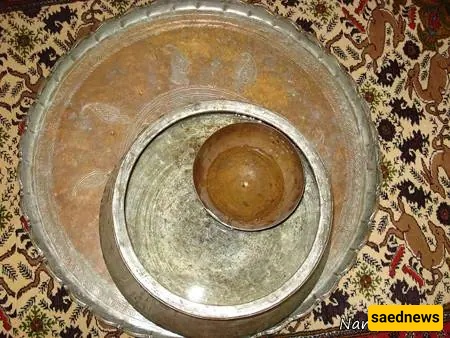
A traditional Persian water-clock system consisted of five main elements:
A small bowl or cup (fengan) – the time-measuring device.
A large vessel filled with water.
Small stones or counters, known as teshleh.
A human timekeeper or mirab.
A designated building or station, known as the Fengan House or Pengan House, where the mirab worked.
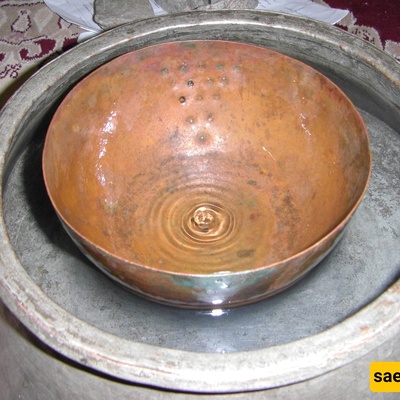
The fengan was a small bowl with a tiny hole in its bottom and, in some versions, markings or numerical divisions on its inner surface. It floated on the water inside a larger vessel.
As water entered through the small opening, the bowl gradually filled and eventually sank. Each time it sank, the mirab counted one fengan and placed a small stone into a container. In this way, the stones served as a record of the total amount of water supplied to each farmer.
The water clock used in the Zeibad qanat near Gonabad is an important example of this traditional technology.
It was originally used to determine the exact amount of time each shareholder could use qanat water. Over time, the system also found other applications, including determining the longest day of the year, the longest night, the equinox, and religious times.
The Zeibad system was operated by at least one person during the day and another during the night. The passage of time was calculated by counting how many times the bowl filled and sank.
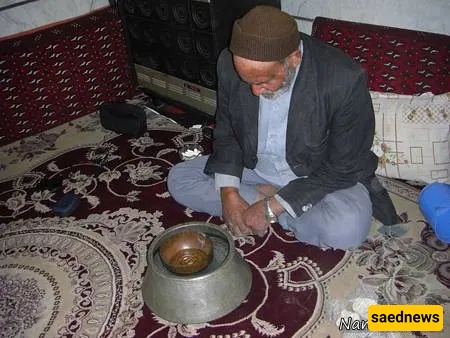
The water clock remained in continuous use in many Iranian regions for thousands of years and, in some places, survived until roughly the middle of the twentieth century.
People did not normally express time in terms of seconds, minutes, and hours. Instead, the fengan served as the basic unit of time.
For example, someone might ask:
"When will our turn come?"
The answer could be:
"In ten fengan."
"Five fengan after sunset."
"Fifteen fengan after sunrise."
At Zeibad, the period from sunrise to sunset could be expressed as a certain number of fengan. Historical records indicate that one fengan at Zeibad was equivalent to approximately 7.5 modern minutes.
Thus, a farmer entitled to ten fengan of water would receive approximately 75 minutes of irrigation time.
When the farmer's allotted time ended, the mirab would announce the transfer of water to the next farmer, sometimes using a call, a horn, or another agreed signal.
The number of stones collected in the mirab's container provided a record of how many fengan had been used. Ten stones, for example, represented ten fengan, or approximately 75 minutes of water.
The system allowed the amount of water allocated to each farmer to be calculated with considerable consistency.
The main advantage of the water clock over sundials and hourglasses was that it could be used continuously, both during the day and at night.
The mirab could determine the number of fengan between sunset and sunrise and use these calculations to identify important dates and seasonal changes.
For example, when the number of fengan in the daytime became equal to the number during the night, this could be used to identify the spring equinox and Nowruz, the traditional Iranian New Year.
The system was also used to identify the longest summer day, around the beginning of July, and the longest winter night associated with Yalda.
A mirab named Mohammad reportedly managed the Zeibad water clock for approximately sixty years and performed these calculations with considerable precision.
The Zeibad qanat water clock remained operational until approximately 1975 (1354 in the Iranian calendar). Modern clocks were subsequently introduced to calculate water shares and irrigation rights.
Comparisons with modern timekeeping showed that one traditional Zeibad fengan corresponded to approximately 7.5 minutes.
Nevertheless, the fengan remains part of the traditional terminology used for qanat water rights. Even today, a person's water share may be described as a certain number of fengan.
The traditional system consisted of:
A small bowl or fengan used to measure time.
A large vessel filled with water.
Small stones or teshleh used as counters.
A mirab who monitored and recorded the passage of time.
A permanent station known as the Fengan House or Pengan House.
In some systems, one person was responsible for daytime operation and another for nighttime operation.
During the summer, the water clock could sometimes be moved to the main water-distribution point.
Until the Middle Ages, water clocks were among the most advanced devices available for measuring time.
In its simplest form, the device consisted of a small bowl with a tiny hole in its bottom. The bowl floated on the surface of water contained in a larger vessel.
Water slowly entered through the hole. After a predetermined period, the bowl became full and sank to the bottom of the larger vessel.
The time required for the bowl to sink depended on factors such as the size of the opening, the weight of the bowl, and the design of the device. The vessel and system were known by names such as tas-e saat, pengan, or fengan.
The period required for the bowl to fill became a unit of time and was itself called a fengan or pengan.
Until several decades ago, some Iranian villages continued to use similar devices to distribute water from springs and qanats.
The mirab watched the bowl carefully. Whenever it filled and sank, he counted one fengan and placed a small stone into a bag or container.
When a farmer's irrigation period ended, the stones were counted to determine the total amount of water time the farmer had received.
For example, if ten stones had accumulated, the farmer had used ten fengan, equivalent in the Zeibad system to approximately 75 minutes.
If a farmer owned ten fengan of water rights, the qanat water would be directed toward that person's field or garden for the corresponding period. Once the allotted time ended, the water would be transferred to the next farmer.
The Fengan House was normally the permanent workplace of the mirab, although during the summer the device could sometimes be taken to the main distribution point.
The length of a fengan was not identical throughout Iran. Different regions developed their own standards.
For example:
In Naein, every four fengan formed a larger unit called a qolleh, and a full day and night consisted of 240 fengan.
In South Khorasan, every six fengan formed a unit called a garde, while a full day and night consisted of 324 fengan.
In Ferdows, the number was approximately 450 fengan per day and night.
In Gonabad, it was approximately 171 fengan.
Another larger unit was known as a taq. The number of fengan making up one taq varied from region to region according to the local length of a fengan. In Ardakan and Neyriz, for example, 72 pengan formed one taq, while in Qom, 135 fengan constituted a taq.
The duration of a fengan differed from one region to another and did not necessarily follow a particular climatic or geographical pattern.
Several factors influenced the length of the unit. One was the number of water shareholders: generally, the greater the number of shareholders, the shorter the time represented by each fengan.
The characteristics of the agricultural soil also mattered, since lighter and heavier soils required different amounts of irrigation.
Another important factor was the flow rate of the qanat. A qanat with a higher water output could supply a farmer's needs within a shorter period, resulting in a shorter fengan.
In many places, however, the length of the fengan had been established by previous generations and became part of local agricultural tradition. As a result, it served as a stable and trusted measure for determining water shares.
Water clocks were also known in other civilizations.
In India, archaeologists have suggested that a vessel discovered at Mohenjo-daro may have been used as a water clock. Water clocks were also employed in India for certain religious ceremonies.
Another traditional method of measuring time was the candle clock.
In Iran, this type of device was known as a pih-suz. The body of the candle was marked with graduated divisions. As the candle burned down, the markings indicated the passage of time.
As scientific and technological knowledge advanced, increasingly accurate mechanical, weight-driven, spring-driven, electric, battery-powered, and electronic clocks gradually replaced water clocks, sundials, and hourglasses.
The development of springs and precision gears made it possible to construct clocks with separate hour, minute, and eventually second hands. This made accurate timekeeping much more convenient and accessible.
During the early sixteenth century, one of the first iron wristwatches was reportedly produced in Germany. It was relatively large and crude compared with modern watches.
By the late eighteenth century, advances in springs and miniature gears made it possible to manufacture smaller and more sophisticated watches. Switzerland subsequently became one of the leading centers of watchmaking, producing wristwatches resembling modern designs from around the 1790s onward.
Between 1865 and 1868, one of the world's largest and most massive clocks was installed in the Church of Saint-Pierre in France. The clock reportedly stood about 12.1 meters high, was approximately 6.09 meters wide, and 2.7 meters thick, consisting of around 90,000 individual components.
At the opposite extreme, some of the world's smallest clocks have measured less than one millimeter in diameter.
Modern technology has ultimately enabled humanity to produce extremely small and precise mechanical watches as well as fully electronic, computerized, and even atomic clocks.
The Persian water clock was far more than a simple device for measuring time. It was an essential agricultural technology that helped communities manage one of their most valuable resources: water.
For centuries, the pengan provided a practical and relatively precise method for dividing qanat water fairly among farmers. Its continued use for thousands of years demonstrates the ingenuity of traditional Iranian engineering and the important relationship between timekeeping, agriculture, and water management.
Although modern clocks eventually replaced the traditional system, the fengan remains an important part of Iran's technological and agricultural heritage.