SAEDNEWS: Behind the entrances of Tabriz Bazaar lies a connected urban world of trade halls, caravanserais, mosques, schools, workshops, courtyards, and social spaces. Its importance comes from the way commerce was woven into the everyday life of a city.
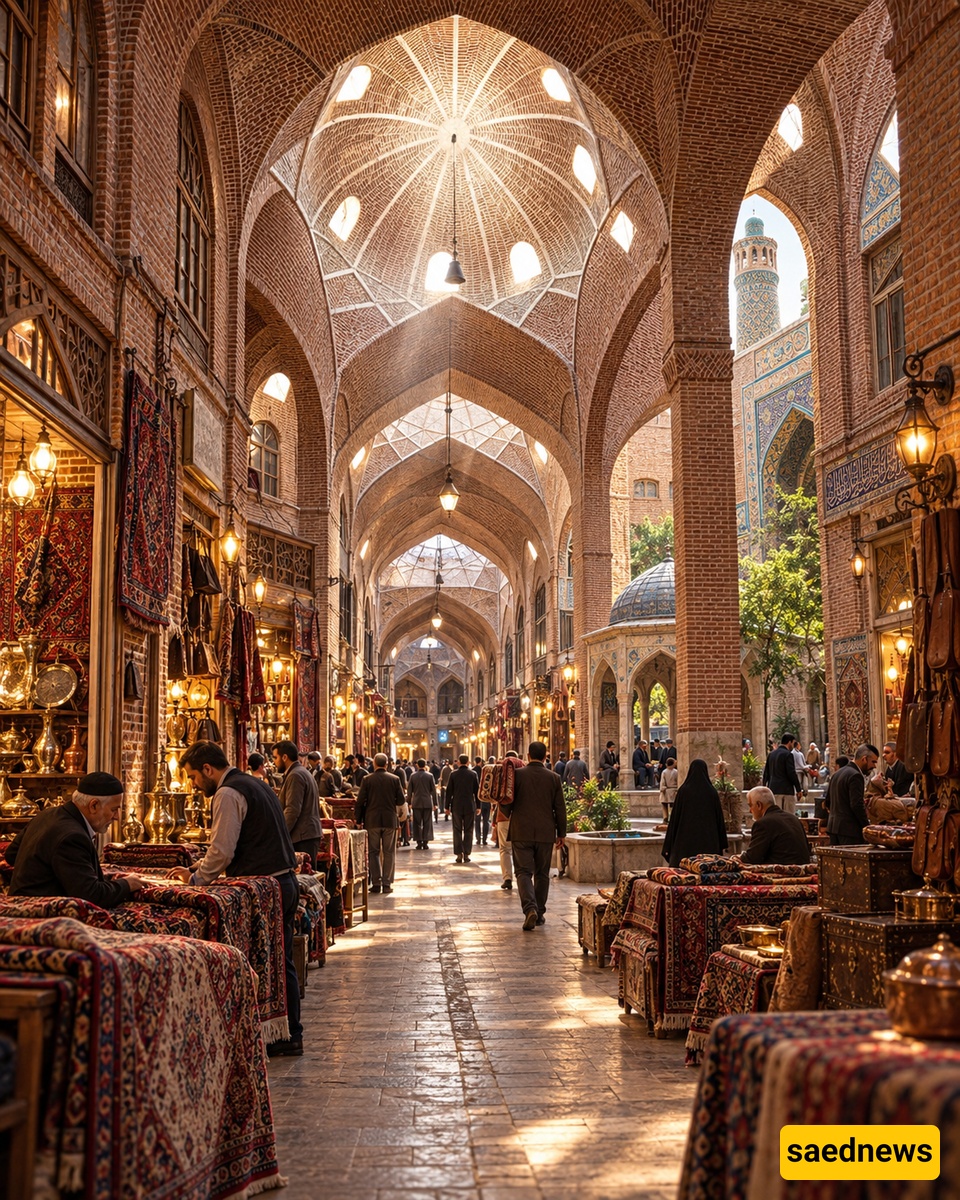
According to SAEDNEWS, Calling the Historic Bazaar Complex of Tabriz a “market” is technically correct, but it hardly prepares a visitor for what is inside. This is not one hall lined with shops. It is a dense, covered urban network where brick corridors open into domed chambers, courtyards, caravanserais, religious spaces, workshops, and specialized trading areas. Walking through it can feel less like entering a commercial building and more like entering another city nested inside Tabriz.
Its scale makes sense when seen through history. Tabriz occupied an important position on major east-west routes, and UNESCO describes the city as a long-standing center of cultural exchange whose bazaar became one of the great commercial hubs of the Silk Road. By the thirteenth century, Tabriz had become especially prosperous, and in later centuries it also gained political importance, including a period as a Safavid capital.
Trade here was never only about objects changing hands. Merchants brought textiles, spices, metals, leather, food, information, credit, and news. Craftspeople learned from one another. Travelers arrived from distant regions. Religious institutions and schools stood close to commercial spaces. The bazaar therefore operated as an economic system, a meeting place, an information network, and a social institution at the same time.
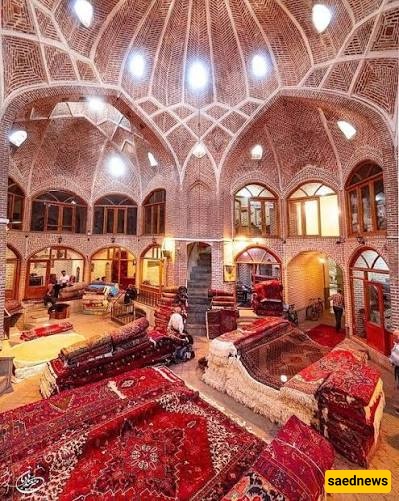
Its architecture made that complexity manageable. Different sections became associated with particular trades, helping buyers and sellers find one another. Caravanserais provided space for merchants, animals, and goods arriving from outside the city. Timchehs created more enclosed commercial courts, often with beautifully engineered brick vaults and domes. Changes in light, ceiling height, decoration, and spatial rhythm helped distinguish one area from another without breaking the overall continuity of the complex.
The covered form also offered practical protection. Brick passages shielded people and goods from rain, snow, intense sun, and wind. Yet the bazaar is not visually repetitive. Small turns reveal changing proportions, patterned brickwork, shafts of light, busy shopfronts, quiet courtyards, and sudden domed spaces. Its beauty comes from accumulation rather than one monumental façade.
What makes Tabriz Bazaar especially significant today is that it remains a living place of commerce. That creates a difficult balance. A bazaar preserved only as a museum would lose the social activity that gives it meaning, while uncontrolled modernization could damage the architecture and spatial relationships that make it exceptional. Fire safety, utilities, access, maintenance, tourism, and changing retail needs all have to coexist with conservation.
It is tempting to describe historic places through superlatives—“the oldest,” “the biggest,” “the greatest.” Tabriz does not need them. Its stronger claim is also more interesting: it is one of the world’s most important surviving examples of a commercial complex that functions as urban fabric rather than a single building.
Walk through it slowly and the distinction becomes obvious. Tabriz Bazaar does not merely preserve the memory of a trading city. In many ways, it still behaves like one.