SAEDNEWS: The Temple of Horus is located in Edfu, on the west bank of the Nile River, between Luxor and Aswan. It is one of the best-preserved ancient temples in Egypt and a popular historical attraction for visitors from around the world.
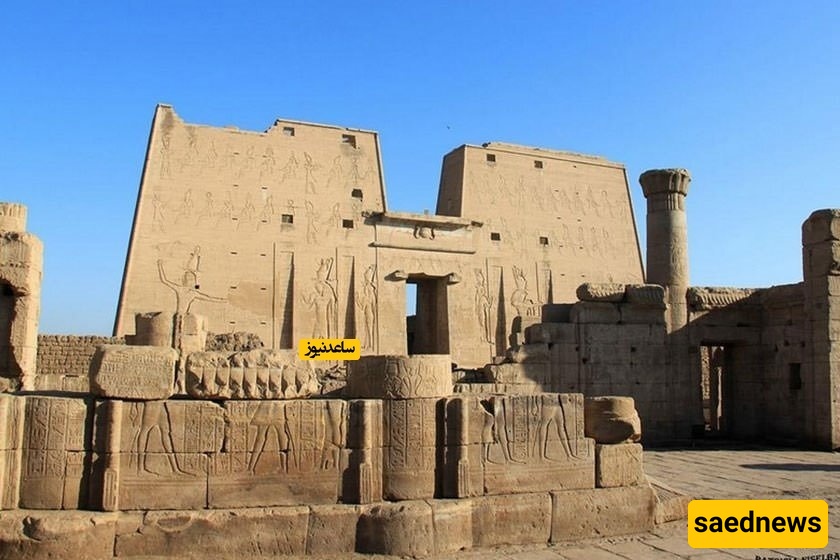
According to Saednews, The Temple of Horus at Edfu is one of the most remarkable and well-preserved ancient temples in Egypt. Located on the west bank of the Nile River in the historic city of Edfu, it stands approximately halfway between Luxor and Aswan. Built during the Ptolemaic period, the temple was dedicated to Horus, the falcon-headed god of the sky and protector of the pharaohs.
Inside the temple's dark inner sanctuary lies a sacred shrine with polished granite stones. According to ancient Egyptian beliefs, the carvings surrounding the sanctuary represented the mythical Hill of Creation, making it one of the holiest places in the temple.
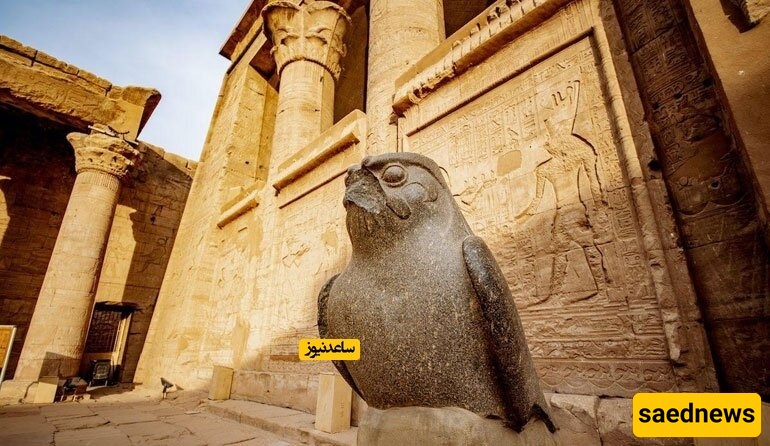
Unlike many ancient Egyptian monuments, the Temple of Horus has survived in exceptional condition for two primary reasons:
It was built later than most of Egypt's famous pharaonic temples.
For centuries, it remained buried beneath desert sand and Nile silt, protecting it from weathering and human destruction.
Its excavation during the 19th century revealed an almost intact monument, making it one of Egypt's finest archaeological treasures today.
Before the current structure was built, an earlier sanctuary dedicated to Horus occupied the same site. Horus, the falcon-headed god of the sky, was regarded as the divine protector of Egypt's rulers, leading to the construction of many temples in his honor.
Construction of the present temple began in 237 BC under Ptolemy III Euergetes and was completed in 57 BC during the reign of Ptolemy XII Auletes, father of Cleopatra VII.
The Ptolemaic Dynasty, established in 305 BC by one of Alexander the Great's generals, became the final ruling dynasty of ancient Egypt. During this period, the Temple of Horus became the country's largest sanctuary dedicated to Horus and hosted numerous religious festivals and ceremonial processions.
The extensive inscriptions throughout the temple also provide valuable insight into the religious practices, architecture, language, and political history of Hellenistic Egypt.
The Temple of Horus remained an active religious center until 391 AD, when Roman Emperor Theodosius I banned pagan worship throughout the Roman Empire.
Early Christian communities attempted to destroy many of the temple's carvings and sacred images. Burn marks on the stone indicate that parts of the temple were even set on fire.
Fortunately, these efforts failed. Over time, the temple became buried beneath layers of sand and Nile mud, leaving only portions of its entrance visible.
French explorers recognized the site during Napoleon's Egyptian campaign in 1798, but the major excavation began in 1860 under the French Egyptologist Auguste Mariette, whose restoration work returned the temple to much of its original grandeur.
Constructed from massive limestone blocks, the Temple of Horus follows traditional pharaonic architectural styles despite being built during the Greek-influenced Ptolemaic era. Because of its remarkable preservation, it provides scholars with invaluable information about ancient temple design once seen in places like Luxor and Karnak.
Visitors enter through an enormous 118-foot (36-meter) high pylon guarded by two magnificent granite statues of Horus depicted as falcons.
The walls of the gateway display dramatic reliefs showing Ptolemy XII defeating Egypt's enemies before the god Horus—a classic image symbolizing the divine power of the pharaoh.
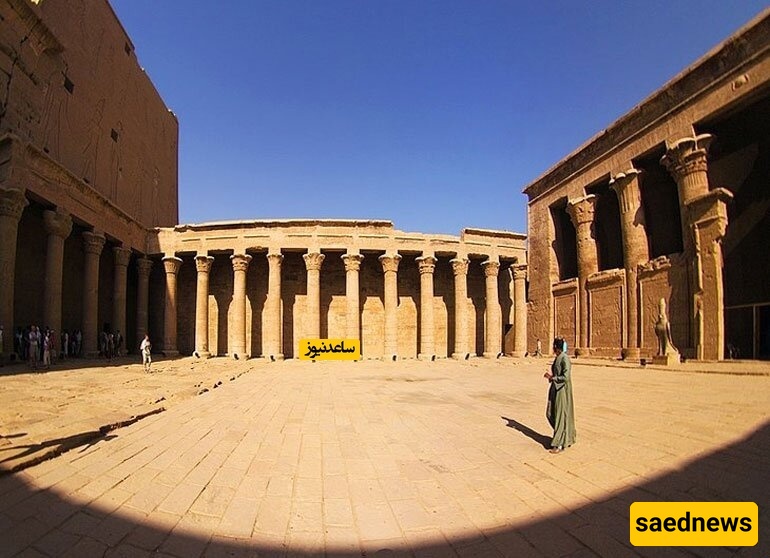
Beyond the entrance lies a spacious open courtyard surrounded on three sides by 32 beautifully decorated columns, each topped with unique floral capitals.
The walls feature detailed reliefs depicting religious ceremonies, including the famous Beautiful Feast of Reunion, celebrating the annual meeting of Horus and his consort Hathor from Dendera. This sacred festival symbolized fertility, renewal, and divine unity.
Beyond the courtyard stand two magnificent hypostyle halls whose original stone roofs remain intact—a rare feature among Egyptian temples.
Each hall is supported by twelve massive columns decorated with colorful inscriptions and scenes illustrating temple rituals.
Several smaller chambers branch from these halls:
A library where sacred religious manuscripts were preserved.
A vestment room for ceremonial garments.
A laboratory where priests prepared incense, perfumes, and ritual oils according to recipes carved directly into the temple walls.
The most sacred part of the temple is the inner sanctuary.
Here visitors can still see:
A polished granite shrine.
The sacred pedestal that once supported the golden statue of Horus.
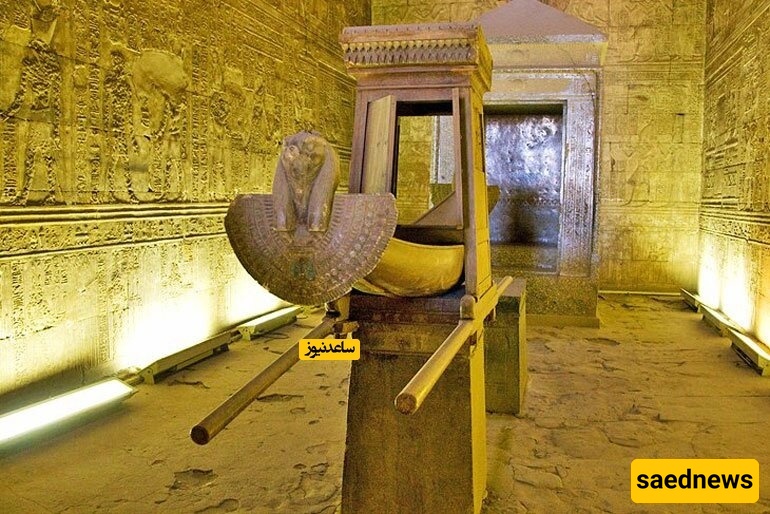
A ceremonial wooden barque used to carry the god's statue during religious festivals (the original is now housed in the Louvre Museum in Paris).
This sanctuary represented the spiritual heart of the temple and was accessible only to high-ranking priests.
Another fascinating feature is the Nilometer, an ancient device used to measure the Nile's water level.
Its readings helped priests predict:
Agricultural harvests
Flood levels
Tax assessments
Economic prosperity for the coming year
The Temple of Horus served as one of ancient Egypt's greatest religious centers.
Annual festivals celebrated the symbolic reunion of Horus and Hathor, drawing pilgrims from across Egypt. Priests performed elaborate rituals, offered sacrifices, burned sacred incense, and conducted ceremonies believed to maintain harmony between the gods and humanity.
The temple also reinforced the belief that the reigning pharaoh ruled under the divine protection of Horus.
Visitors to the Temple of Horus can experience:
The towering entrance pylon
Giant granite falcon statues
Intricately carved hieroglyphic reliefs
The grand colonnaded courtyard
Exceptionally preserved hypostyle halls
Ancient library and perfume laboratory
Sacred granite sanctuary
The historic Nilometer
Detailed inscriptions illustrating Egyptian mythology and religious ceremonies
Today, the Temple of Horus at Edfu is widely recognized as one of the best-preserved temples in all of ancient Egypt. Its remarkable state of conservation offers historians, archaeologists, and travelers an extraordinary opportunity to explore authentic ancient Egyptian religious architecture almost exactly as it appeared more than two thousand years ago.
Its towering falcon statues, beautifully carved reliefs, intact ceremonial halls, and sacred sanctuary continue to make it one of Egypt's most important archaeological landmarks and one of the country's most impressive historical attractions.
The Temple of Horus at Edfu stands as a masterpiece of ancient Egyptian architecture and religious devotion. Built during the Ptolemaic era yet preserving the traditions of earlier pharaohs, it combines monumental architecture, exceptional preservation, and rich historical significance. From its massive entrance guarded by falcon statues to its sacred sanctuary and remarkable inscriptions, the temple remains one of the finest surviving monuments of ancient Egypt, offering an unparalleled glimpse into the spiritual and cultural life of one of history's greatest civilizations.