Saed News: A rare Bronze Age mace, estimated to be around 3,000 years old, has been discovered near the town of Dukla in southeastern Poland. The historical artifact was found during a legal metal-detecting excavation in a farm field.
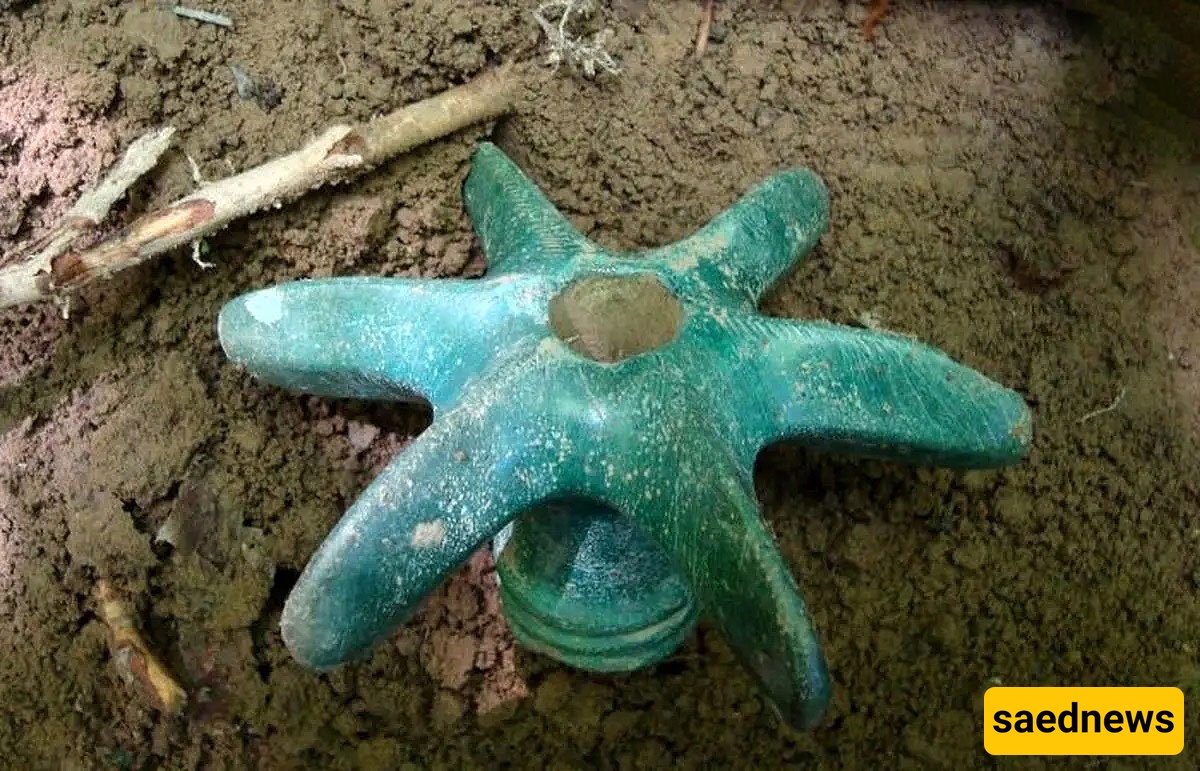
According to SAEDNEWS, researchers believe the mace likely originated in the Middle East. This discovery may provide valuable new evidence about cultural connections and trade and knowledge exchange networks during the Bronze Age.
The find was made by Krzysztof Wiśniewski, a member of the Galicia Exploration and History Association, while surveying farmland around Dukla.
Members of the association stated: “This was our second return to this small area. Our main goal was to search for World War II-related artifacts, especially relics from September 1939.”
During the survey, the team discovered several historical objects, including military buttons, medals, and a belt buckle from the Austro-Hungarian army from World War I. However, Wiśniewski later came across an unusual bronze object covered in a striking green patina that immediately attracted attention.
After realizing the potential importance of the find, the team contacted Dr. Pasternkiewicz, who visited the site for examination. Even experienced experts were initially unable to identify the object, and specialists from outside Poland were later consulted.
Eventually, it was confirmed that the object is a bronze mace, a type of weapon dating back to the late Bronze Age. Experts believe it was likely manufactured in the Middle East and brought to the region around 3,000 years ago.
After the discovery, the case was reported to the Provincial Heritage Protection Office in Krosno. Cultural heritage experts visited the site and conducted further investigations, but no additional related artifacts were found.
Archaeologists say the isolated nature of the find raises important questions. Researchers are now trying to determine who brought the mace to the area, why it was transported there, and under what circumstances it was lost.
The discovery received wide media attention and was presented at a press conference at the private Subcarpathian Battlefield Museum in Krosno, where heritage officials, archaeologists, and members of the excavation team discussed its significance.
Experts note that similar maces have been found in other parts of Eastern Europe, including Ukraine, suggesting that Bronze Age societies were connected across a wide geographical area.
Further scientific analysis is expected to shed new light on prehistoric links between Central Europe and the ancient Middle East.