Saed News: Archaeologists working in the Jiankou section of the Great Wall of China near Beijing have discovered a remarkable collection of military remains and everyday life artifacts from the Ming Dynasty, including a massive 17th-century cannon, heated brick beds, inscribed bricks.food remains, animal bones.

According to SAEDNEWS, these discoveries were announced during the Beijing Archaeological Research Conference in December 2025, as part of a preservation and restoration project in the rugged mountainous Jiankou section in Huairou District. Researchers examined watchtowers 117, 118, and 119, as well as connecting wall sections, and recovered more than 300 artifacts related to weapons, architecture, and daily life.
According to Faradid, the most significant find is a cast-iron cannon dating back to the fifth year of the Chongzhen Emperor’s reign, meaning 1632 AD, in the final decades of the Ming Dynasty. The cannon is 89.2 cm long, has a bore diameter of 8.5 cm, and weighs about 112 kilograms. It is the largest cannon ever discovered in the Jiankou section of the Great Wall.
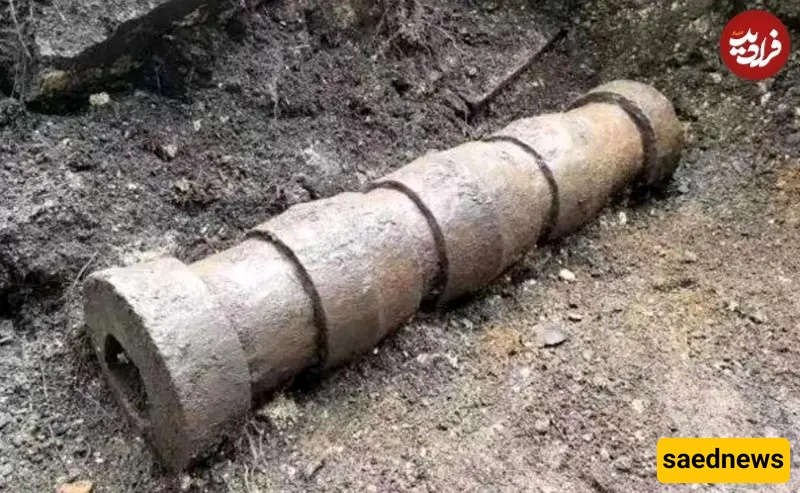
Shang Heng, a researcher at the Beijing Institute of Archaeology, described the artifact as the first major firearm discovered in Jiankou. Despite erosion, inscriptions on the cannon remain partially legible and provide valuable information about Ming-era firearms production, military supply systems, and the transfer of artillery technology between China and the West.
Researchers say the weapon shares characteristics with the “Hongyi Cannon” or “Red Barbarian Cannon,” a type of European artillery introduced to China in the late Ming period and later adapted and localized. Its relatively small muzzle and larger body suggest that Jiankou was not merely a symbolic defensive line but a fortified border equipped with heavy weaponry.
The cannon was not an isolated object. Its size matches previously identified artillery platforms, indicating that such weapons were likely part of the standard defensive equipment of major watchtowers. This provides a clearer picture of how the Ming military organized firepower in the mountainous sections of the wall.
In Watchtower No. 117, a blue stone inscription was discovered indicating that this section of the wall dates back to 1573. This provides a precise chronological reference for comparing surrounding structures and understanding the expansion of the Jiankou defense system during the Ming era.
Watchtower No. 118 revealed different evidence. Inside it, archaeologists found the largest heated brick bed, or “kang,” ever discovered in Jiankou, along with a stove. These findings directly illustrate the living conditions of soldiers stationed in the cold, high-altitude region. The Great Wall here was not only a defensive structure; it was a place where soldiers slept, cooked, repaired equipment, and endured long periods of isolation.