SAEDNEWS: The New York Times highlights five warning signs—from the interconnected crises in Ukraine, the Middle East, Taiwan and North Korea to growing divisions in the West and the fragility of the global economy—warning that the accumulation of regional conflicts could gradually push the world toward the brink of a broader war.
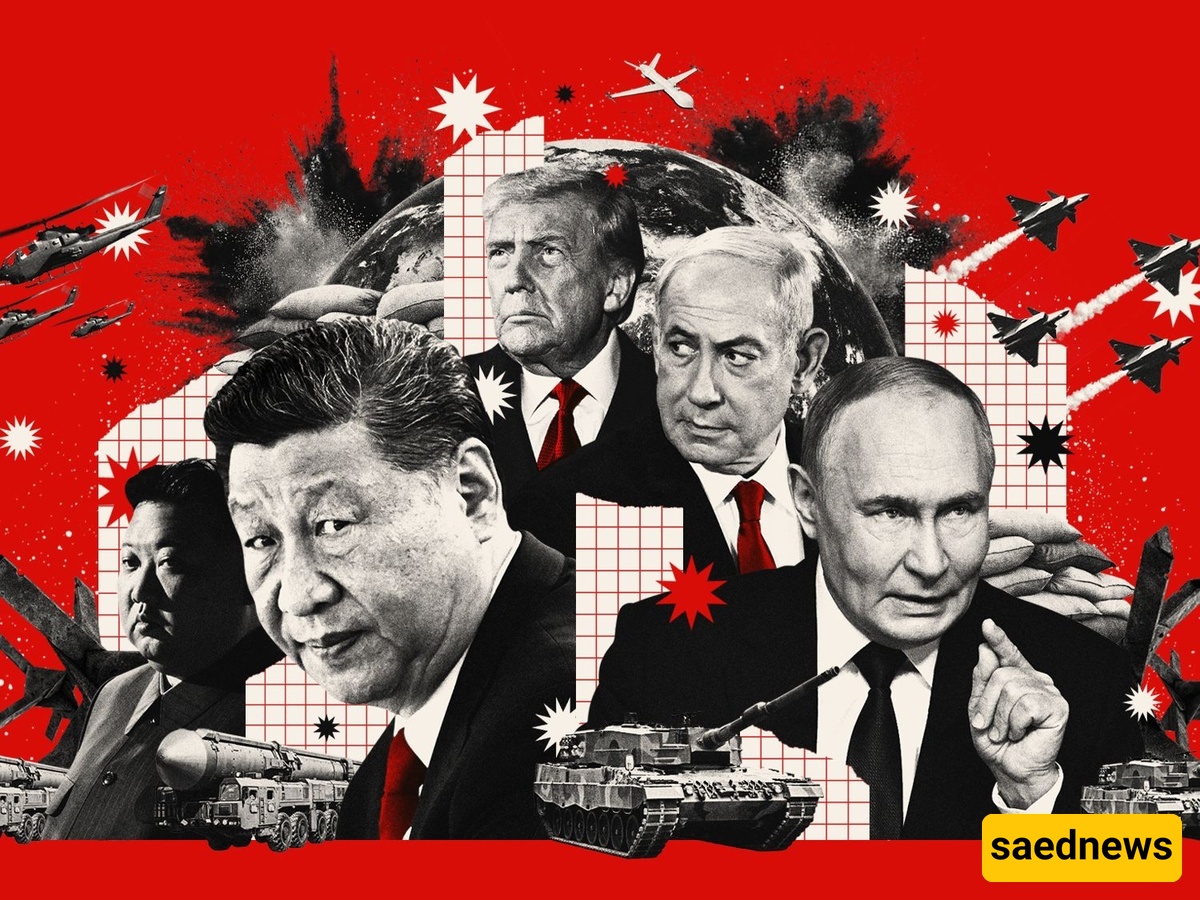
According to the political desk of Saed News, World War III would not necessarily begin with one massive explosion. Like World War II, it could emerge from an accumulation of regional conflicts that gradually become interconnected. At present, there are five serious warning signs pointing to the possibility of a third world war.
The New York Times, opening a report with this premise, wrote that the world has now been facing a series of conflicts and wars for several years, ranging from the war in Ukraine and China’s territorial claims over Taiwan to the war against Iran and North Korea’s military activities. These developments, along with turmoil in the West, military unpreparedness, and growing proximity to an economic precipice, have raised serious concerns. The question is not whether war has already begun, but how far away we are from the final storm.
Bret Stephens wrote in the article: “My argument is based on the roots of World War II—a war that did not simply begin with Germany’s invasion of Poland on September 1, 1939. Instead, it resulted from an accumulation of regional wars and crises that began with Japan’s invasion of Manchuria in China in 1931 and gradually developed into a single global conflict. This situation, reinforced by the growing ambitions of authoritarian governments as well as divisions and doubts among democracies, ultimately led to catastrophe. Added to this were revolutions in military technology and tactics that initially gave dictatorships an advantage in offensive warfare. Another advantage was their willingness to impose and endure levels of brutality and suffering that their opponents were initially unwilling to match.”
Stephens identifies five issues in the article as warnings of a possible World War III.
First, the conflicts in Ukraine and the Middle East have become interconnected. Russia has expanded its threats toward Moldova, Poland, and Germany. Hamas has fought against Israel, and the conflict has expanded into confrontations involving Hezbollah, Yemen’s Ansarullah movement, and Iran. Meanwhile, the consumption of interceptor missiles in the Middle East has reduced Ukraine’s stockpiles.
Stephens makes the claim that Russia, China, North Korea, and Iran have effectively formed a full military alliance. North Korea provides Russia with ammunition and troops, China supplies electronic components for drones, Russia provides Iran with targeting intelligence, and if China attacks Taiwan, Russia could potentially assist with its submarines.
Second, deep disagreements between Donald Trump and America’s European allies have exposed divisions within the West. Unreasonable tariffs on Canada, combined with Canada’s defense weaknesses and its strategic partnership with China, are further signs of Western disunity. Trump complains about the weakness of America’s allies, while the allies accuse him of bullying, unilateralism, immaturity, dishonesty, and incompetence. Both sides have a point. The new U.S. tariffs on Canada are a clear example because, according to Stephens, they are politically ill-considered, economically self-defeating, and strategically weak.
Third, the war against Iran has exposed America’s sensitivity to military casualties and economic hardship. This, Stephens argues, has given Iran an advantage. The war in Ukraine has also demonstrated that advanced U.S. military equipment is becoming obsolete in the face of AI-driven drone warfare, leaving tanks supplied to Ukraine largely ineffective. Pete Hegseth, the U.S. secretary of war, has suddenly decided to eliminate the drone unit, while the U.S. naval fleet is shrinking and its shipbuilding industry is deteriorating. Democrats have also blocked a military budget bill. Furthermore, the U.S.-Israeli war against Iran has not only revealed ammunition shortages but has also demonstrated America’s strong sensitivity to military casualties.
Fourth, the global economy is under growing pressure, a situation worsened by the war against Iran. Stephens writes that although the world is not experiencing another Great Depression like that of the 1930s, there are warning signs, including the possible bursting of the AI bubble, the Japanese yen crisis, Treasury bond sell-offs, America’s $40 trillion debt, and the potential failure of bond buybacks. During periods of economic pressure, democracies tend to become more risk-averse while dictatorships become more willing to take risks, which can further intensify conflicts.
Finally, the combination of these developments could turn existing conflicts into a full-scale global war. The New York Times writer concludes that the West is moving toward a storm while failing to recognize the danger, and that the combination of these factors is increasing the possibility that today’s conflicts could eventually escalate into an all-out world war.