SAEDNEWS: Small clusters of pink and white Daphne flowers release a captivating, uplifting fragrance. Their leaves may be either simple or compound, and sometimes appear variegated or richly colored.
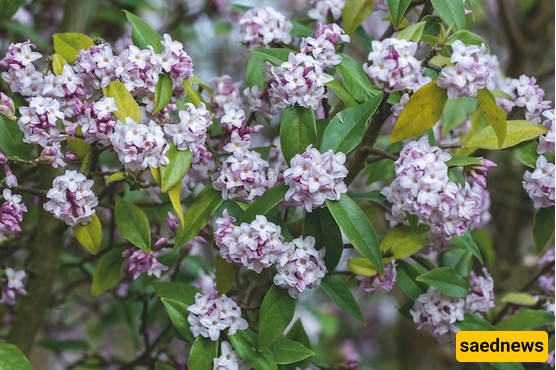
According to Saednews, Daphne, also known as “Indian carnation” in Persian gardening references, is an evergreen, ornamental shrub with thick, glossy dark-green leaves that are narrow and about 5–7 cm long. It produces fragrant white flowers that bloom in early spring (early May). Among gardeners, it is often referred to as “Indian carnation.”
This plant typically grows to a height of 1–1.5 meters and spreads about 1–2 meters. The species Daphne mezereum is a deciduous shrub with highly fragrant pink flowers that appear on bare branches in late winter or early spring. It reaches about 1–1.2 meters in height and spread. Its branches grow upright, so during the growing season (spring), the lower part of the plant may appear bare. For better visual effect, it is recommended to plant surrounding flowers such as stock, carnation, or dianthus.
Daphne originates from China and Japan and is cultivated in gardens in northern Iran. A shaded location, such as a rock garden where most plants struggle to grow, is suitable for it.
It grows well in northern Iran and in the climates of Tehran and Karaj. Due to its sensitivity to prolonged cold and dryness, it is kept in greenhouses in other parts of the country.
A semi-shaded environment, especially with afternoon shade (such as the eastern side of a wall), is ideal. It can also grow in full sun, but if direct sunlight is combined with heat reflected from nearby walls, the plant may be damaged. In regions with cool summers, it is planted in warm, sunny, and wind-protected areas.
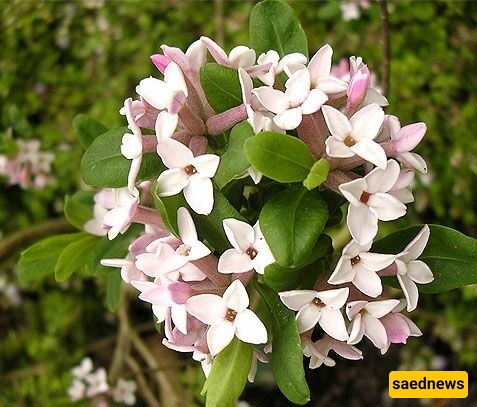
The Daphne genus includes around 70–95 species. It belongs to the family Thymelaeaceae and is native to Asia, Europe, and North Africa. It is an evergreen shrub with fragrant flowers that later develop into colorful, grape-like fruits.
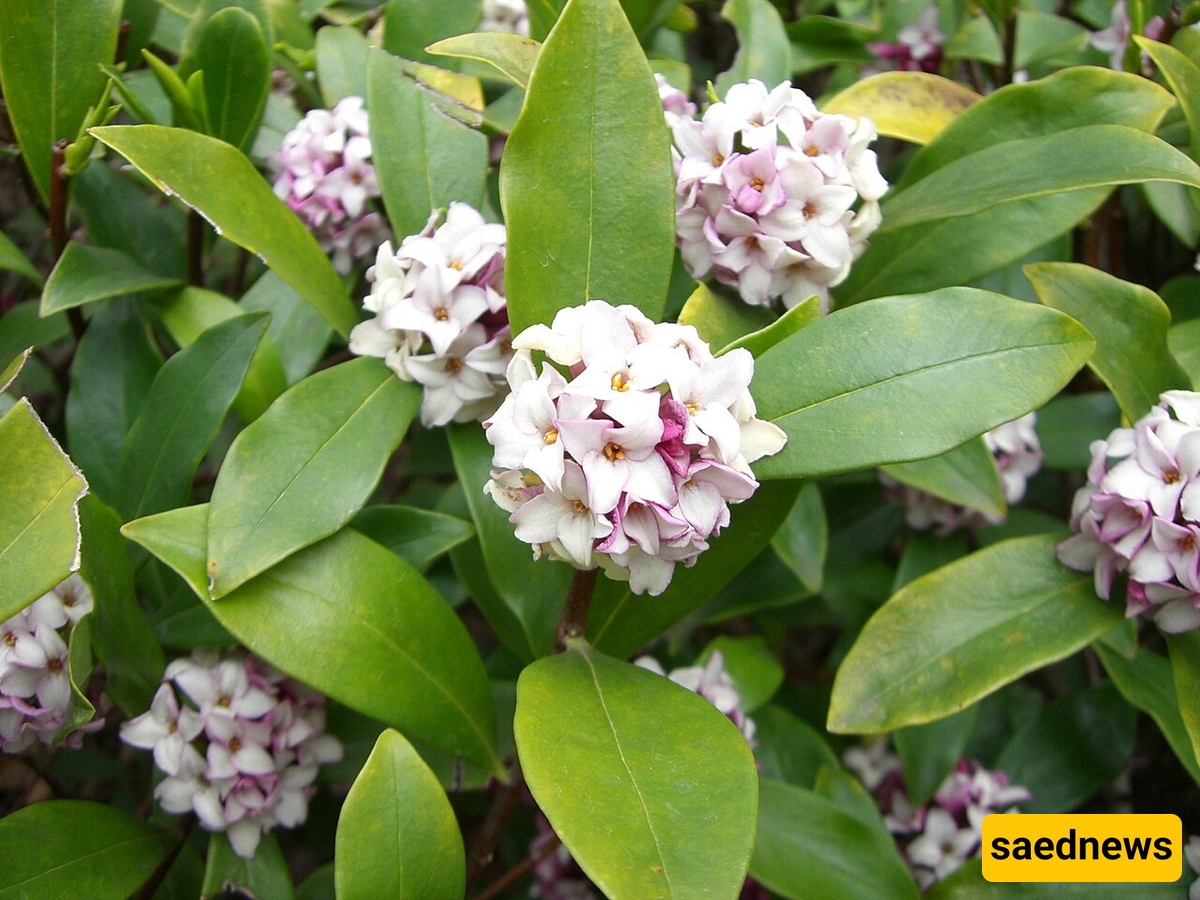
Daphne has leathery, soft-green leaves and relatively large flower clusters in pink to purplish tones, which cover the plant from mid-winter to early spring. The flowers have a strong, sweet fragrance that remains noticeable even in cold winter days.
An upright evergreen shrub with oval leathery leaves in soft green. It produces fragrant pink flowers in late winter. It is ideal for small gardens due to its slow growth.
A deciduous variety with narrow light-green leaves and highly fragrant white flowers that bloom before leaf emergence in late winter or early spring. It later produces small yellow fruits.
Also known as winter daphne, this compact evergreen shrub grows up to about 1.5 meters. It has dark green leaves and fragrant pale purple-pink flowers that emerge in winter and early autumn from reddish-pink buds.
A semi-evergreen variety with dark green lance-shaped leaves and strongly fragrant flowers.
A medium-sized, dense shrub with glossy evergreen leaves. It produces terminal clusters of pale pink to white fragrant flowers in late winter, followed by small black fruits.
A less evergreen, medium-sized upright shrub with long leathery leaves. It produces highly fragrant pink flower clusters at the ends of branches in late winter, followed by small black fruits.
Root cuttings in winter-flowering daphnes (both hybrid and non-hybrid types) give good results. Semi-hardwood cuttings taken in early summer also root well, especially with rooting hormones.
Cuttings often require misting and consistent humidity. They usually root after about six weeks. However, they are sensitive and must be kept out of direct sunlight. They should be placed in a shaded environment, and sometimes covered with dark plastic until rooting occurs.
Not suitable for tropical regions. Species such as D. bholua and D. genkwa prefer cold climates, while D. odora prefers warmer conditions.
Prefers morning sun and afternoon shade under partial cover. It should be protected from strong drying winds. Filtered light through trees is ideal.
Requires well-drained soil rich in organic matter. Roots should be protected from heat using mulch or well-rotted organic compost. Mulch should not be placed directly against the plant base.
During warm months, regular and deep watering is needed. However, the soil must never remain waterlogged, as even short periods of excessive moisture can cause root rot.
In early spring, use bone meal or fertilizer suitable for azaleas and camellias.
Sudden death of daphne plants is usually caused by root rot. They may also be attacked by scale insects, which can be removed manually with a damp cloth or controlled with horticultural oil.
Daphnes can suffer from viral diseases with no cure. Symptoms include leaf curling, stunted growth, yellow spotting on leaves, and blackening of buds.
Species such as Daphne odora may bloom throughout winter and into early spring, while D. bholua and D. genkwa typically flower from early to mid-spring.
In general, minimal pruning is required. Removing spent flowers for indoor decoration is often the only necessary maintenance.
Daphne is suitable for borders and rock gardens. It is also grown in public parks and grows well in Tehran, including Park-e Shahr.
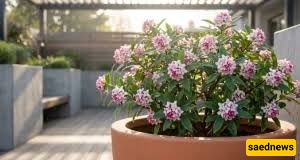
It is valued for its strong fragrance, especially in winter gardens, where it spreads a pleasant scent across the landscape. It can also be grown in containers. Its single star-shaped flowers are usually pink or white and highly decorative.