SAEDNEWS: The almond tree, also known locally as Garum Zangi, is a tropical fruit-bearing tree that grows in the coastal provinces of southern Iran, such as Hormozgan and Bushehr.
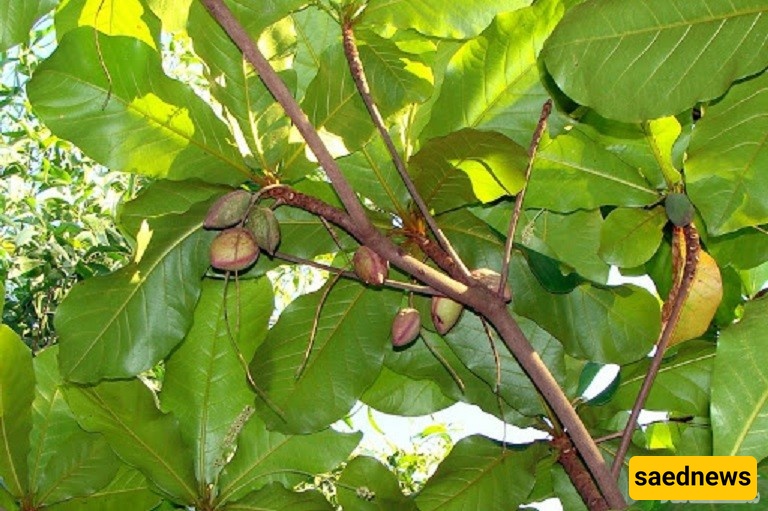
According to Saednews, The tree known in Hormozgan Province as Garum Zangi and in Sistan and Baluchestan Province as Bidam is called in English by several names, including Indian almond, sea almond, tropical almond, country almond, and Malabar almond. Its scientific name is Terminalia catappa, belonging to the flowering plant group of dicotyledons, order Myrtales, family Combretaceae, and genus Terminalia.
The word “luz” has Arabic roots meaning “almond.” In regions where this tree grows, it is commonly referred to as “almond” due to the resemblance of its fruit to almonds, both in appearance and in the edible kernel, which is similar in taste and form. In Telugu (one of the major languages of India), it is called Badam chettu, and in French it is known as Badamier—both names derived from Persian.
Terminalia catappa thrives in full sunlight. It can grow in a wide variety of soils, including clay, sandy, loamy, acidic, and alkaline types, though it prefers well-drained, nutrient-rich soils. The tree is highly tolerant of wind, drought, and salinity.
The tropical almond is a large tree native to tropical regions of Asia, Africa, and Australia. It has an upright growth habit with horizontally spreading branches and can reach heights of up to 35 meters. As it matures, the crown becomes broader and develops a vase-like shape.
The leaves are large, measuring 15–25 cm in length and 10–14 cm in width, ovate in shape, dark green, glossy, and leathery. The tree is deciduous during the dry season, and before shedding, the leaves change color to shades of reddish-pink or yellow-brown due to pigments such as violaxanthin, lutein, and zeaxanthin.
It is a monoecious species, producing separate male and female flowers on the same tree. The flowers are small (about 1 cm in diameter), white to pale yellow, inconspicuous, and lack petals. They appear in lateral or terminal clusters.
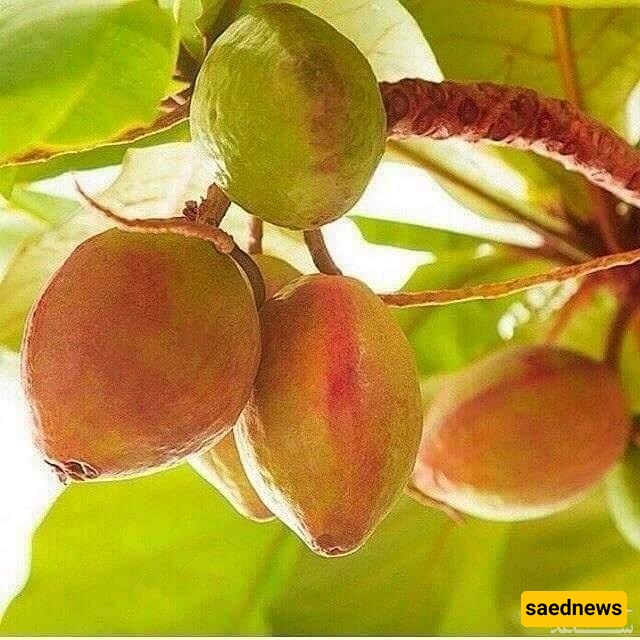
The fruit is a drupe, 5–7 cm long and 3–5.5 cm wide. It starts green, turns yellow as it matures, and becomes red when fully ripe. Each fruit contains a single seed.
The leaves contain various flavonoids such as kaempferol and quercetin, as well as tannins including punicalin, punicalagin, and tercatin. They also contain saponins and phytosterols. Due to their rich phytochemical composition, different parts of the plant are used in traditional medicine.
For example, in Taiwan, fallen leaves are used in herbal remedies for liver-related conditions. In Suriname, leaf infusions are traditionally consumed to treat diarrhea and dysentery.
The leaves also have natural antifungal properties and are used in aquariums to inhibit fungal growth and control pathogens such as Saprolegnia. They help protect fish mucous membranes and support tissue repair. Additionally, they can reduce water pH and heavy metal content, which is why aquarists commonly use them to maintain healthier aquatic environments.
The tree is propagated mainly through seeds extracted from its fruit.
The fruit is oval-shaped, similar in size to an almond, and may appear in red or yellow tones when ripe. It has a sweet and slightly tangy flavor.
In some regions, the tree is cultivated sparsely, and there are no precise statistics on cultivation area. Harvesting typically begins in mid-August and continues until late September.
Due to its broad canopy and ornamental appearance, the tree is also widely planted in urban areas for shade and landscaping purposes.