SAEDNEWS: The persimmon tree grows to a height of 4 to 5 meters. Its leaves are broad, elongated, and egg-shaped, with a smooth and glossy surface. Stay with us for more information.
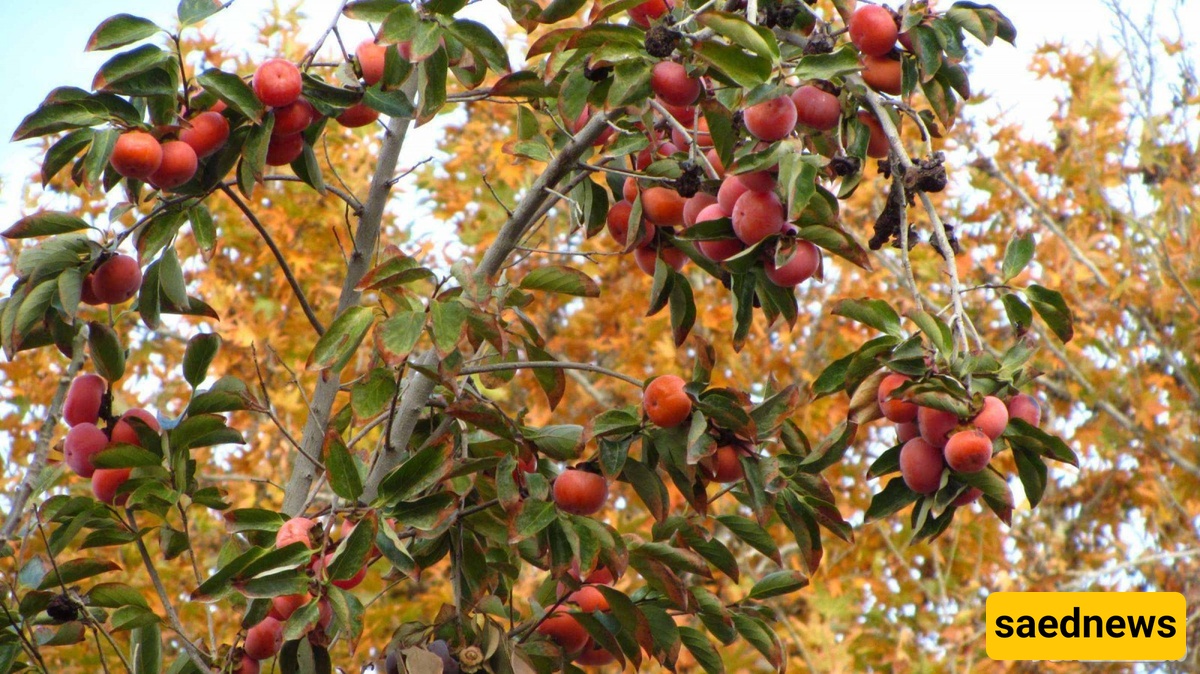
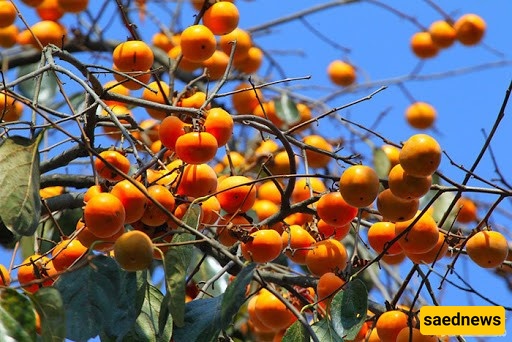
According to Saednews, Persimmon is a tree that is mainly cultivated in warm climate regions. Its fruit is edible and varies in color from light yellow-orange to dark orange-red. Persimmon contains significant amounts of vitamins B1, B2, B3, and C. It also provides essential minerals for the human body such as calcium, sulfur, iron, phosphorus, and potassium, along with some cellulose.
In Iran, persimmon is often grafted onto its wild rootstock known as Khormandi, and it can also be propagated through cuttings. For planting seedlings, they are placed about one meter above ground level, typically when the seedling has 4–5 buds. Before spring, about 30–50% of the branches are pruned. The tree can reach a height of 8 to 12 meters.
Persimmon cultivation and production as a horticultural crop is relatively recent in Iran and worldwide. In 1970, Iran produced about 25 tons of persimmon. Over the past 40 years, its production has remained very limited compared to major producing countries. Iran has genetic diversity in 22 kakis (Diospyros kaki) and 7 samples belonging to the species lotus and virginiana. The fruits vary in shape—round, oval, and heart-shaped. One of the main commercial varieties in Iran is Fuyu (Fuyukaki), which produces relatively large, round fruits with high-quality taste.
To grow persimmon from seeds in a pot, first select a ripe and healthy fruit. Carefully extract the seeds and wash them thoroughly with lukewarm water to remove all fruit pulp.
Place the seeds in a container of water and keep it in a warm, dim location. If the water becomes cloudy, replace it. After a few days, small sprouts will emerge from the seeds. At this stage, transfer the seedlings into a prepared pot with suitable soil.
Be careful during transplanting to avoid damaging the sprouts, and gently firm the surrounding soil. After planting, water thoroughly until excess water drains from the bottom of the pot. Place the pot in an area with appropriate temperature and light conditions.
Persimmon grows best in light, well-drained, and fertile soil. The ideal soil is cool and moist, often found in older orchards with rich fertility. For home cultivation, using soil from old garden areas is recommended, as soils from natural grasslands are less suitable.
The tree requires substantial organic fertilizer, but only well-decomposed manure should be used—not fresh manure. In small gardens, semi-organic fertilizers (locally known as “Vorz”) are recommended. In March, after winter cold ends, about 4–5 kg of fertilizer per tree is spread and lightly tilled. Deep plowing is not recommended because persimmon roots are sensitive and slow to recover from damage.
Persimmon has relatively high water requirements and is sensitive to drought, especially in hot weather. Regular irrigation is necessary. However, overwatering can lead to oxygen deficiency in the roots, causing fruit drop as a common symptom of waterlogging.
Persimmon requires relatively low nutrient input. In areas where organic fertilizers are available, chemical fertilizers may not be necessary. Otherwise, an NPK 10-10-10 fertilizer can be used. Fertilization should be applied in late winter or early spring around the base of the tree.
When planting persimmon trees, the following points should be considered:
The best planting time for grafted seedlings is around March 15. Early planting increases the risk of frost damage.
The grafted seedling should be planted at the same soil depth as it was in the nursery. Both shallow and deep planting are harmful.
No fertilizers (organic or chemical) should be applied at planting time; feeding begins from the second year using organic compost.
After planting, irrigate once and avoid further watering until new growth appears.
From the second year, pruning and shaping should be carried out over 2–3 years.
In later years, fertilization and maintenance should continue. Since persimmon fruits develop on one-year-old branches, pruning must avoid removing these productive shoots.
In spring, persimmon trees require less water, while in summer they need more frequent irrigation. Poor nutrition can lead to significant fruit drop (up to 50%) after flowering, which is a natural response when the tree cannot support all developing fruits.
Persimmon fruit is not fully ripe when it turns red; it still contains high levels of tannins and may taste astringent. The fruit should remain on the tree until full ripening occurs. However, if early frost occurs, fruits may be harvested slightly unripe and ripened in storage.
Whiteflies and thrips can damage the skin of persimmon fruit and cause discoloration. Excessive irrigation may lead to root rot. Rodents such as mice can also damage the root system.
Other issues include early flowering, fruit drop, fruit cracking around the calyx, and sunburn. Fruit drop is a natural phenomenon in persimmon trees, but proper nutrition with well-decomposed manure can significantly reduce it.