SAEDNEWS: “Towel weaving” is considered one of Iran’s traditional handicrafts, with a history dating back thousands of years to the millennia before Christ. In the following, we will introduce you to this beautiful and distinctive Iranian art.

According to Saednews, Traditional towel weaving is a form of handmade textile production carried out on a four-shaft loom. One of the distinctive characteristics of this craft is that all three essential stages of weaving—shed formation, weft insertion, and beating—are performed through coordinated hand and foot movements. Another notable feature is the ability to use an unlimited range of colored weft threads and to create diverse woven patterns by controlling and coordinating the movement of the shafts.
This type of weaving was traditionally practiced exclusively in this city. In the past, each tribe or clan generally had one person engaged in this craft. These artisans not only produced textiles to meet the needs of their own households, but also made a significant contribution to the family economy.
The craft is commonly referred to as “towel weaving,” although this name is somewhat misleading. In addition to being used as highly absorbent bath towels, the woven textiles have traditionally served many other purposes, including tablecloths, clothing, night coverings, shawls, and other household items.
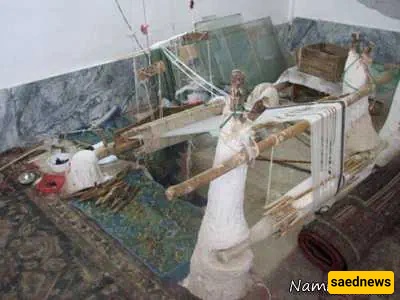
The weaving process begins with the preparation of cotton yarn using a spinning wheel and a bobbin wheel. The yarn is then arranged in an open space using a number of thin, equally sized wooden sticks. Locally, this process is known as arranging or “running the warp.”
The yarn wound around these sticks, which are positioned approximately one meter apart, is subsequently transferred and wound around a large, firmly fixed wooden beam known as the Nouvard.
During weaving, the yarn is passed through the shed using a shuttle (Maku). After each passage of the weft, the woven yarn is beaten into place using the reed or beater (Daftin), which is moved back and forth. This repeated process gradually forms the fabric.
When the shuttle passes from the right side, the left Patelak is operated by the weaver's foot, and vice versa. This movement changes the position of the shafts and creates the required shed for the next weft insertion.
As the fabric is woven, the Matti and gloves are manipulated by the artisan so that the completed fabric is gathered and gradually wound around a thick wooden rod known as the Balin.
The artistic character of towel weaving is achieved through the creative combination of colors throughout the fabric and along its borders. Traditional patterns from earlier periods may also be used as references when designing a new woven piece.
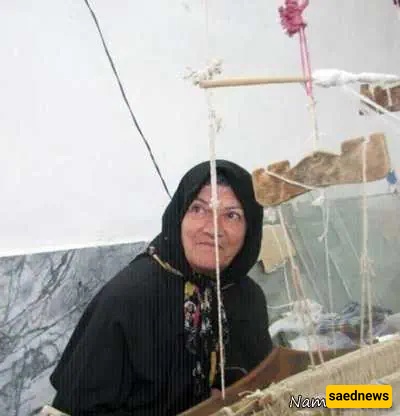
Today, this valuable handwoven product and intangible cultural heritage has been preserved by Mrs. Ghasabi, who continues to practice the craft. It remains one of the distinctive traditional and cultural symbols of the city.
The main tools and equipment used in the traditional towel-weaving loom include:
Bobbin Wheel: Used for spinning and preparing yarn.
Spinning Wheel (Harzeh-Gar): Used to wind spun yarn into skeins around the wheel.
Gevaste: Refers to the individual wooden sticks fixed in the ground around which the warp threads are wound.
Vejarak: Two relatively thick wooden sticks positioned in the middle of the weaving setup to prevent the threads from becoming tangled during weaving.
Middle Stick: A wooden stick positioned slightly above the Nouvard to help keep the warp threads properly aligned.
Herastow: The complete set of four shafts on the weaving loom.
Salam-Aleik: Two wooden pieces connected to the Herastow by threads, allowing the shafts to move up and down.
Hava Kar: Threads connecting the Herastow and Salam-Aleik to a metal rod near the ceiling, helping keep them elevated.
Matti: Two equally sized wooden sticks placed over the woven fabric to prevent it from gathering or bunching.
Shuttle (Maku): A device containing the weft yarn that is passed through the warp threads.
Reed/Beater (Dande or Daftin): Used to press and compact the weft threads after they have been inserted by the shuttle.
Glove: Traditionally made from deer antler and used to secure the Balin.
Balin: A wooden rod around which the completed woven fabric is rolled.
Bobbin (Masoureh): A device around which the yarn required for weaving is wound.
Patelak: Wooden pieces pierced at one end and suspended beneath the loom by threads connected to the Herastow. They are operated by the weaver's feet to control the shafts.
Hamayel: A wooden piece positioned on the left side of the loom to secure the warp-supporting sticks.
Nouvard: The wooden beam around which the warp threads are wound.
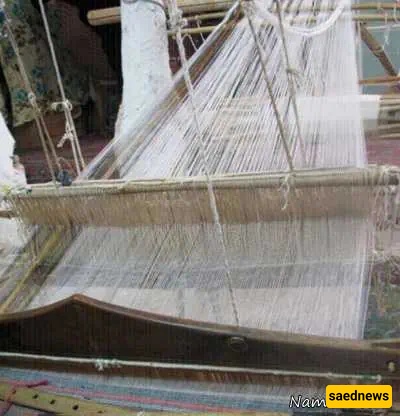
The traditional materials used in this craft include:
Cotton yarn
Silk yarn
Wool yarn
Synthetic yarn, particularly acrylic, used exclusively for weft insertion
Knitting yarn, also used exclusively as weft yarn