SAEDNEWS: This genus includes around six species of climbing plants native to East Asia and North America. It is considered one of the most beautiful plants among climbing vines.
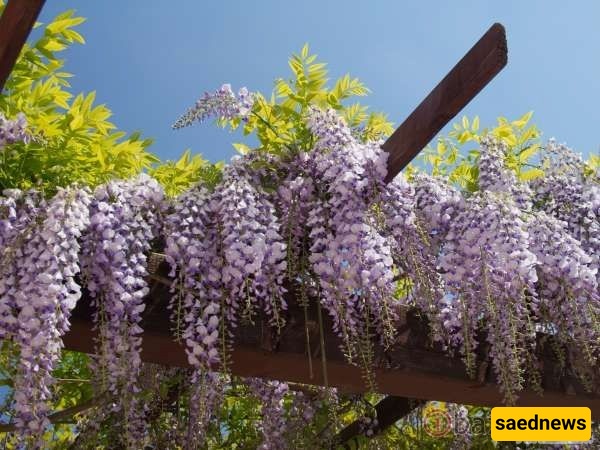
Accoring to Saednews:
Scientific Name: Wisteria sinensis
Family: Fabaceae
Native Region: East Asia
Wisteria is a member of the legume family and belongs to the Papilionoideae subfamily. Native to East Asia, it is a long-lived deciduous woody climber with alternate compound leaves and spectacular hanging flower clusters. The flowers are usually blue, violet, purple, pink, or white and are arranged in long racemes that make this plant one of the most admired ornamental climbers. Different species vary in leaflet number, flower color, and cluster length.
Japanese wisteria is native to Japan and can grow between 9 and 30 meters long. Its flower clusters are longer than those of other wisteria species and may reach up to 50 cm in length. Flowering occurs from early to mid-spring, producing fragrant blooms in white, pink, violet, and blue shades. The leaves are 10–30 cm long and each compound leaf contains 9–13 leaflets measuring 2–6 cm.
Another form of Japanese wisteria grows 4 meters or more and bears fragrant bluish-purple flowers in clusters 13–25 cm long. The flowers appear together with the leaves in spring and open gradually from the base of the cluster toward the tip. Its stems twine clockwise around supports.
American wisteria grows up to 15 meters in length. Its flower clusters are shorter, usually 5–15 cm long, with blue-violet flowers blooming in late spring to early summer.
Chinese wisteria is native to China and is considered one of the finest climbing plants. It can reach 18–30 meters in height and has compound leaves with 9–13 oval leaflets. The fragrant flowers are white, lavender, blue, or light purple and appear in clusters 15–30 cm long before the leaves emerge in spring. Unlike Japanese wisteria, the flowers open simultaneously. The plant later produces soft, velvety seed pods. Its stems twine counterclockwise around supports and often produce a second light flush of flowers during summer.
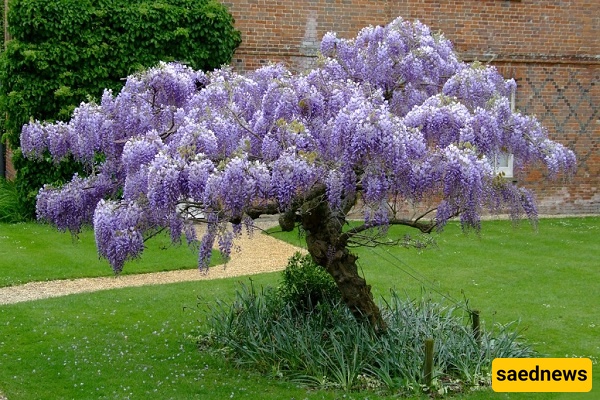
Wisteria is among the most beautiful flowering climbers. Its long, pendulous flower clusters create a dramatic display in late spring or early summer. The foliage is equally attractive, turning golden yellow in autumn. When grown around trees or structures, its powerful stems gradually thicken and may distort or restrict the growth of the support plant.
Wisteria thrives best in full sun and requires at least 6–8 hours of direct sunlight daily for abundant flowering. Although it can survive in partial shade, flowering will be greatly reduced.
The plant prefers consistently moist soil but does not tolerate waterlogged conditions. Excessive watering may cause yellowing leaves, leaf drop, crown rot, and eventual plant decline. Insufficient watering, especially during hot weather or in young plants, can lead to leaf scorch, bud drop, and poor flowering.
Wisteria tolerates winter temperatures as low as -29°C. In severe cold, young shoots and branch tips may be damaged, though mature stems usually survive.
Well-drained soil enriched with organic matter such as leaf mold or well-rotted manure promotes healthy growth. When planting, a hole approximately 1 meter wide and 60 cm deep is recommended. Fill the hole with a mixture of garden soil, leaf compost, and 10% coarse sand. Avoid planting the crown deeper than it was previously growing.
Excessive nitrogen fertilization encourages leafy growth at the expense of flowers. Young plants may benefit from fertilization during their early years, while mature plants only require feeding if nutrient deficiencies appear. A 5 cm layer of leaf mulch around the base in spring helps keep the roots cool and gradually enriches the soil.
Wisteria requires fertile soil rich in organic and mineral nutrients. Feeding before flowering encourages abundant blooms. Fertilization is usually carried out during spring and summer. Superphosphate and potassium sulfate are commonly applied to stimulate flowering and improve bloom quality.
Wisteria can be propagated through several techniques:
Cuttings: Hardwood or semi-hardwood cuttings are taken from lateral shoots in early or mid-summer.
Layering: Tip layering is usually performed in autumn.
Grafting: The most common commercial propagation method, carried out in early spring.
Seeds: Seeds germinate readily and may be sown in April or May. Soaking the seeds in water for 24 hours before sowing improves germination. Fresh seeds provide the best results, as viability decreases rapidly over time.
Because seedlings may not produce flowers quickly or maintain the desired flower color, grafting is generally preferred.
Due to its vigorous growth habit, wisteria requires regular pruning. Proper pruning encourages stronger growth and more prolific flowering during the following season.
Wisteria may occasionally suffer from leaf spot diseases. Aphids, scale insects, and honey fungus can also damage the plant. The species is sensitive to chalky or highly alkaline soils. Deficiencies of iron, phosphorus, or potassium reduce flowering performance, while late spring frosts may damage blossoms.