Saednews: A new study shows that infants in their first year of life read meaning and social cues in human eyes but do not experience the same perception from humanoid robots.
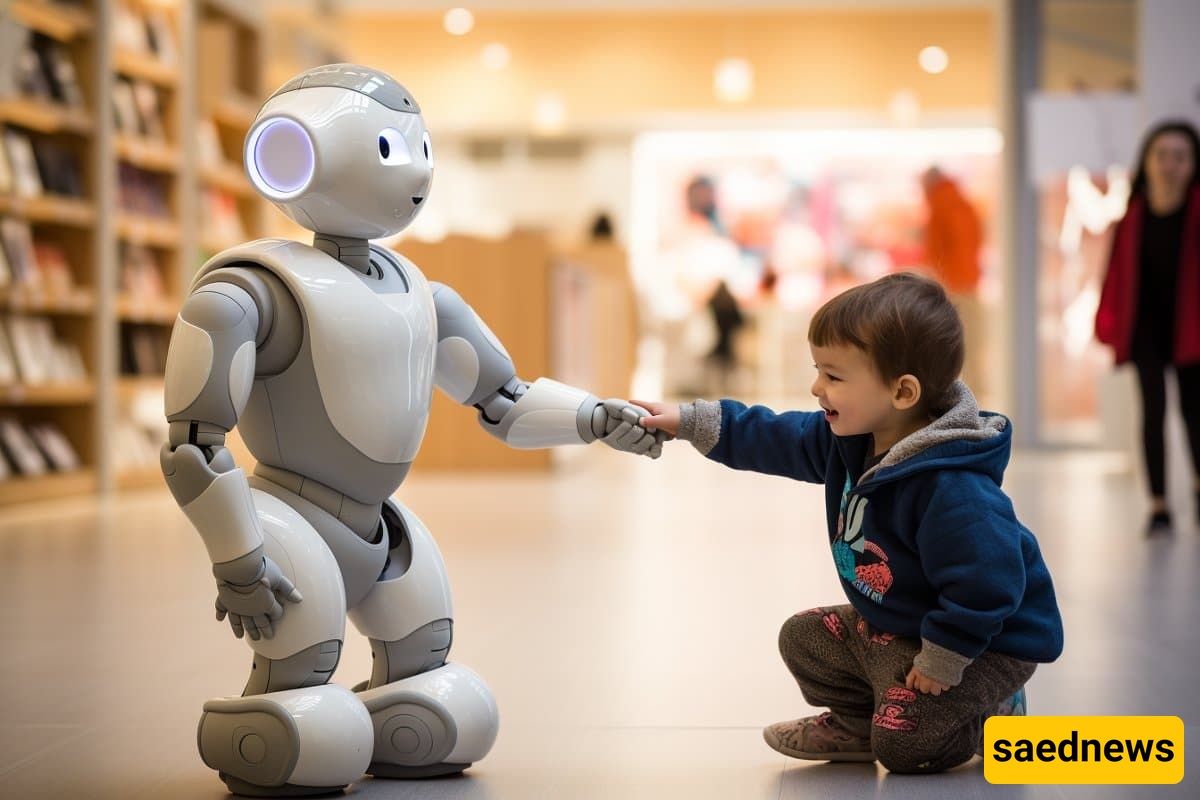
According to SAEDNEWS, and Interesting Engineering, while humanoid robots are increasingly replacing humans in many economic, service, and social activities, research shows that even the most advanced humanoid robots have not yet succeeded in establishing meaningful communication with infants and are not a good option for childcare.
Researchers examined whether infants interpret a robot’s gaze in the same way as a human gaze, as carrying information and meaning. Previous studies had shown that young children can follow the direction of both human and robot gaze, but it was unclear whether they also use these cues to infer intention and attention.
To test this, researchers studied 64 infants aged 10 and 12 months. Half of the infants watched videos of a human, while the other half watched videos of a humanoid robot. The robot had a human-like face and movable eyes and could simulate gaze behavior.
During the experiment, both the human and the robot looked at one of two locations on a screen. Shortly afterward, an object appeared in one of those locations. Eye-tracking technology was used to determine whether infants shifted their gaze to the expected location before the object appeared.
The results showed that 12-month-old infants who watched the human video often looked at the correct location before the object appeared. This indicates that they understood human gaze as pointing to something in the environment and used it to anticipate events. However, in the case of the robot, the situation was different. The infants still followed the robot’s gaze direction, but did not expect anything to appear there. In other words, they observed the robot’s eye movement but did not interpret it as a signal of intention, attention, or awareness.
In contrast, 10-month-old infants showed no such predictive behavior in either condition, suggesting that understanding the social meaning of gaze likely develops toward the end of the first year of life.
Researchers believe these findings show that the human brain is specifically tuned from early infancy to detect and interpret human social cues. For infants, human eyes carry information about intention, attention, and communication, whereas robot eyes—even when highly realistic—do not yet hold the same social meaning.
These results help improve understanding of how social cognition develops in early life and suggest that even advanced humanoid robots have not yet achieved the same social status in infants’ minds as humans.
The study comes at a time when the use of social robots and artificial intelligence in childcare and education is increasing. It suggests that there remains a gap between mimicking human behavior and being perceived as a true social agent, a gap that technology has not yet fully bridged.