Saed News: NASA has published its Astronomy Picture of the Day, showing a cosmic view that covers a field of view more than twice the width of a full Moon within the constellation Cygnus.
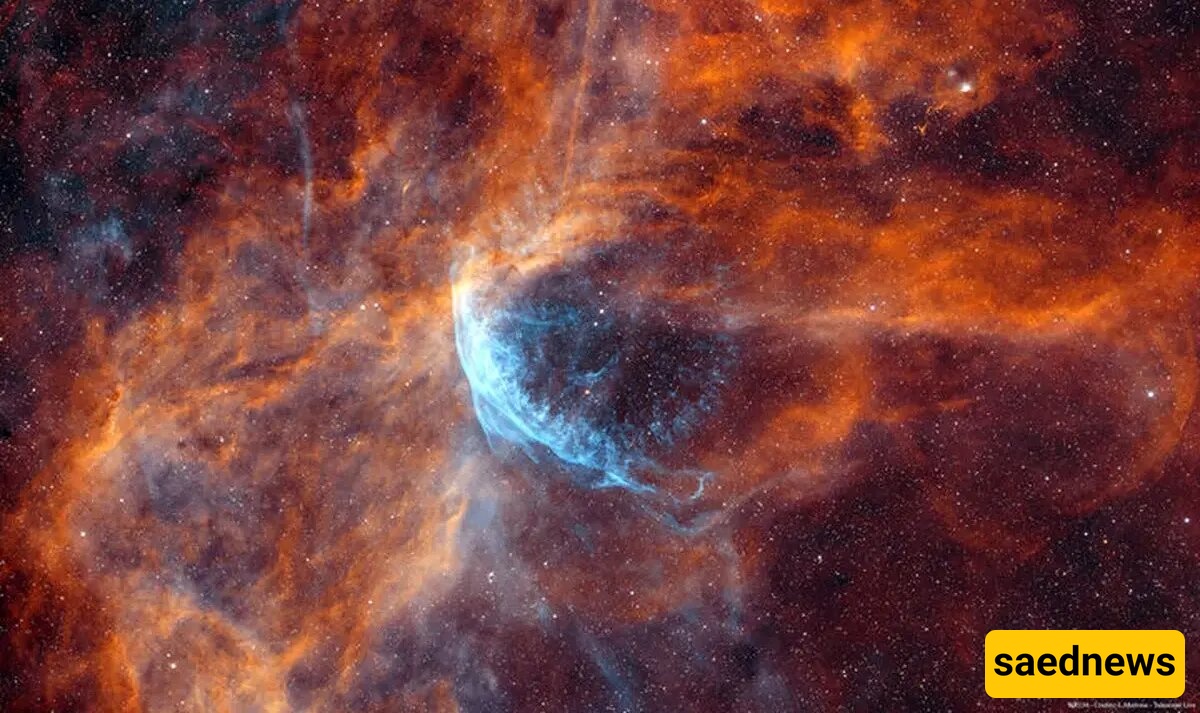
According to SAEDNEWS, the new and stunning telescopic image of the Cygnus constellation depicts bright cosmic arcs formed by the violent storms of the giant star “WR 134,” a dying star that, by ejecting its material into space, is paving the way for the birth of future generations of stars.
NASA released in its Astronomy Picture of the Day a cosmic scene covering a field of view more than twice the width of a full Moon in the region of the ambitious constellation Cygnus.
This image, captured using narrowband astronomical filters, reveals the glowing edge of a ring-shaped nebula filled with ionized hydrogen and oxygen gases.
These bright and complex arcs, embedded within the interstellar clouds of this region, are parts of shells of material swept and pushed forward by the winds of a Wolf–Rayet star, namely “WR 134,” which is the brightest star near the center of the image.
Distance estimates show that “WR 134” is located about 6,000 light-years away from us, and this telescopic frame covers a region more than 100 light-years wide.
Massive Wolf–Rayet stars, which lose their outer layers through powerful stellar winds, burn their nuclear fuel at an astonishing rate and end the final stage of their evolution in a spectacular supernova explosion.
Their stellar winds and final supernova explosions enrich the interstellar medium with heavy elements, which are then used in the formation of future generations of stars.