Saed News: Officials at NASA’s Jet Propulsion Laboratory (JPL), which manages this mission, wrote that the discovery of these molecules confirms that ancient Mars had the appropriate chemistry to support life.
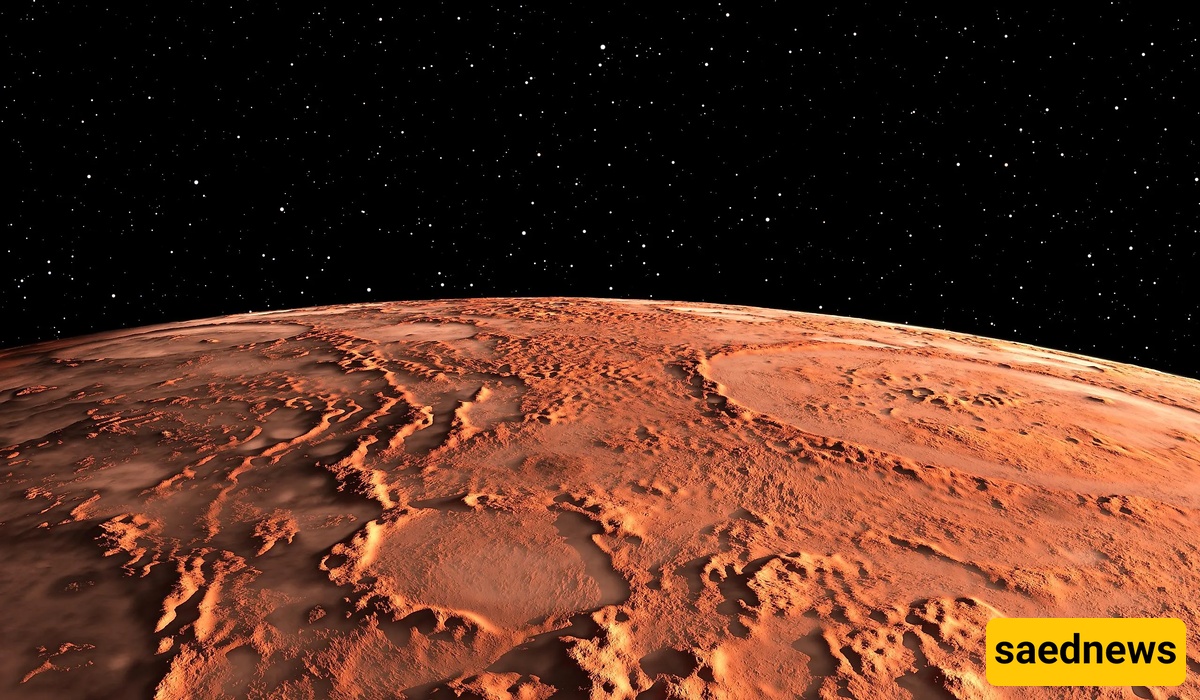
According to SAEDNEWS, a rock discovered by NASA’s Curiosity Mars rover contains the “most diverse set” of building blocks of life ever seen on the Red Planet, including seven that had never previously been found there. A new study confirms this.
Curiosity is the most complete vehicle sent to Mars and is studying microbial life in the past or perhaps even the present. This rover has a laser on its top that can target and vaporize a subject and analyze the elements resulting from vaporization. It also contains a highly equipped laboratory inside its body.
In 2020, the Curiosity rover discovered this rock and drilled into it. It is now confirmed that this rock contains organic molecules that include the element carbon—which is suitable for life. Although scientists still cannot prove whether these molecules formed through biological or geological processes, their findings add new evidence to the theory that ancient Mars could have been suitable for life.
Officials at NASA’s Jet Propulsion Laboratory (JPL), which manages this mission, wrote that the discovery of these molecules confirms that ancient Mars had the chemistry suitable to support life. They also explained that these molecules are added to a growing list of compounds that have remained preserved in Martian rocks even after billions of years of exposure to radiation, while this radiation can gradually break down these molecules.
The new analysis, published on April 21 in the journal Nature Communications, shows that the rock sample contained 21 carbon-containing molecules, including seven molecules that had never previously been seen on the Red Planet. These new molecules include nitrogen heterocycles, which are considered precursors to RNA and DNA, as well as benzothiophene, which may play an important role in transferring life-supporting chemistry to planets in the solar system via meteorites.
This sample was named “Mary Anning 3,” named after the English geologist Mary Anning, who is famous for discovering the first ichthyosaur and plesiosaur fossils. Similar to the aquatic fossil environments she studied, Martian organic compounds were found in a region of Mars that billions of years ago contained lakes and flowing water.
This region was repeatedly wet and then dry in the past, and was eventually enriched with clay minerals that are very suitable for preserving organic compounds.
Last year, the Curiosity rover also identified the largest organic molecules ever discovered on Mars. These molecules were long-chain hydrocarbons such as decane, undecane, and dodecane.
These findings were obtained using an instrument on Curiosity called Sample Analysis at Mars (SAM). Curiosity first drills rocks using its robotic arm, then turns them into powder and feeds the sample into SAM. This instrument contains a high-temperature furnace that heats the powder and measures the composition of gases inside the rover.
SAM also includes chambers containing solvent that can perform wet chemistry. The Mary Anning 3 sample was the first to use tetramethylammonium hydroxide (TMAH), a substance that breaks down organic molecules. Curiosity has only two chambers of this material, and this sample was selected due to its high value.
The findings of Curiosity were tested and confirmed using a meteorite known as Murchison, which is 4 billion years old on Earth. This meteorite contains organic molecules.
Researchers wrote that the Murchison sample, when exposed to TMAH, showed that larger molecules can break down into compounds similar to those seen in Mary Anning 3, including benzothiophene. This result suggests that Martian molecules may have formed from the breakdown of more complex compounds related to life.
The Curiosity rover, which has been active on Mars since 2012, recently used its last TMAH chamber to examine network-like rock structures formed from ancient groundwater. The results of this study will be published in the future.