SAEDNEWS: Medieval towns depended on a surprising workforce whose jobs have almost vanished from modern life. From men who emptied cesspits to officials who tested ale and officers responsible for filthy streets and waterways, these occupations reveal how medieval cities solved problems that modern infrastructure now hides from us.

According to SaedNews, Imagine walking through a busy European city in the 14th century.
The streets are crowded with merchants, craftsmen, animals, carts and pedestrians. Markets are operating, workshops are producing goods, and taverns are serving drink. But beneath this apparently ordinary urban life is a problem that every growing city has to solve: who keeps everything from becoming unbearably dirty, dangerous or chaotic?
The answer was a collection of occupations that can sound almost unbelievable today.
There were men who emptied cesspits, workers who scraped rubbish from streets, officials who tested the quality and price of ale, and civic officers whose responsibilities included keeping channels and streets clear. Some were highly regulated municipal positions; others were specialized trades created by the practical problems of dense urban life.
These were not merely “weird jobs.” They were evidence of something important: medieval cities had sophisticated problems because they had sophisticated urban economies.
Oxford historians describe medieval towns as complex communities in which crafts, guilds, markets, municipal government and religious institutions interacted closely. In prosperous cities, occupational specialization could become extensive, with guilds regulating many trades and urban authorities creating offices to deal with specifically civic problems.
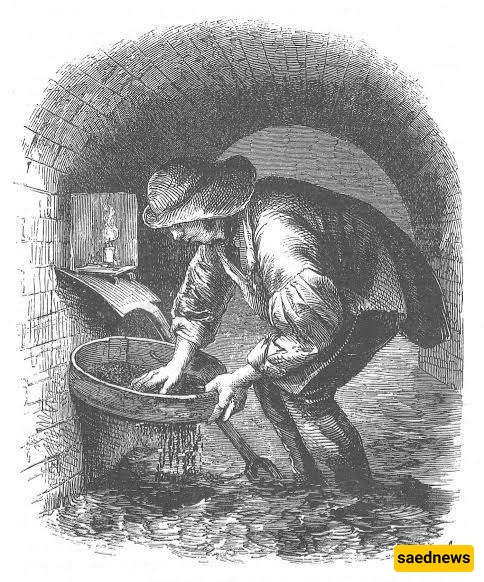
Few medieval occupations have a name more memorable than the gong farmer.
The term referred to workers who emptied cesspits and privies. In cities without modern sewer systems, human waste accumulated in pits that eventually had to be cleared.
The work could be extremely unpleasant, but it was also a genuine urban service. Evidence from medieval London shows that specialized workers cleaned latrines and cesspits, including royal facilities. A documented example from 1406 records Thomas Watergate receiving 40 shillings for cleaning a royal latrine at Westminster.
That figure should not be casually converted into a modern salary, because medieval wages and purchasing power are difficult to compare directly. But the surviving payment makes one point clear: cleaning human waste could be a recognized and sometimes well-paid service.
The job also reveals something about medieval cities that is easy to forget.
Urban sanitation did exist. It simply worked very differently from ours.
Cities had privies, cesspits, drains and public latrines. What they lacked was the extensive underground infrastructure that allows modern residents to flush waste away without seeing the people and systems responsible for dealing with it.
If the gong farmer dealt with waste in pits, another group dealt with what accumulated on the streets.
In medieval London, scavengers were municipal ward officers responsible for tasks including street cleaning, pavement maintenance and fire precautions. The Historical Association notes that scavengers and rakers worked to remove rubbish from streets and gutters, while later medieval reforms attempted to organize more systematic cleaning.
The distinction mattered.
A raker's work involved scraping or raking rubbish from the street, particularly from gutters and channels. Scavengers had broader responsibilities in the civic system.
This was not simply a matter of making streets look pleasant.
Rubbish, animal waste and human waste could obstruct drainage, create foul conditions and interfere with movement. The city therefore needed people whose job was to deal with the physical consequences of urban density.
In other words, the medieval equivalent of a sanitation department was beginning to emerge — even if it consisted of men with carts, tools and very little protection from what they were handling.
One of the strangest titles in medieval London was Sergeant of the Channel.
Despite sounding like a military position, it was connected with urban cleanliness and the maintenance of streets and channels.
The Historical Association records that London elected a Sergeant of the Channel in 1385 as part of its efforts to improve street cleanliness. Other historical research describes the officer as responsible for ensuring that lanes and streets were kept clear.
The title illustrates how medieval cities created specialized civic offices as urban problems became harder to manage.
A city was not just a collection of houses. It had roads, drains, markets, waterways, bridges and public spaces, all of which needed supervision.
The more complicated the city became, the more specialized its officials became.
Perhaps the most surprising job was the ale-conner.
The name sounds like something from a fantasy novel, but the office was real — and it was connected to a serious economic problem.
Ale was an everyday drink, and its quality and price mattered. Under the medieval Assize of Bread and Ale, traditionally associated with legislation from the reign of Henry III around 1266–1267, officials known as ale-conners were responsible for examining ale and enforcing regulations concerning its sale.
In the City of London, records from the late 14th century indicate that wards elected multiple ale-conners. Their responsibilities included checking that ale was wholesome, sold in proper measures and offered at regulated prices.
So the medieval city had something surprisingly familiar:
a public official checking whether sellers were giving customers what they were supposed to receive.
The ale-conner was not simply a professional beer enthusiast. It was a regulatory office.
And the position survived long after the Middle Ages, gradually losing its practical regulatory function as other forms of government oversight emerged.
Another occupation that sounds ordinary until its historical context is considered was the pavier, or pavior — a specialist in laying pavement.
Medieval urban streets were not uniformly paved, and maintaining surfaces was a persistent civic problem. Historical records preserve the occupation as early as the 13th century, while documentary evidence from medieval London records payments to paviers for paving work.
The survival of the occupation tells us something important about urban development.
Once cities became busy enough for carts, animals and large numbers of pedestrians to move through the same streets, the condition of those streets became an economic issue.
A damaged or muddy route was not merely inconvenient. It could interfere with trade, transport and access to important buildings.
Paviers therefore belonged to the growing infrastructure of medieval urban life.
The medieval city also generated occupations that were specialized not because they were disgusting, but because urban construction demanded increasingly specific skills.
Archaeological and historical evidence from England shows specialized workers producing and transporting roof and floor tiles, while paviers laid them. Records from Penn in Buckinghamshire, for example, document paviers and tilers in the 14th and 15th centuries and show their products being supplied to major royal and religious buildings, including Westminster and the Tower of London.
Guilds made this specialization even more visible.
The Metropolitan Museum of Art notes that guilds for many medieval crafts appeared in European towns from roughly the 11th through the 14th centuries. They could regulate prices, wages, quality and working practices, turning occupations into structured professional communities.
That means the medieval city was not simply full of generic “craftsmen.”
It could contain highly specialized workers whose occupations were defined by exactly what they made, repaired, inspected or maintained.
The strangest occupations share a common explanation: urban density.
A farmer living on a small rural holding did not face exactly the same problems as thousands of people living, working and trading close together.
A city concentrated waste, animals, food production, workshops, traffic and commerce in a relatively small area. That created problems that required dedicated labor.
This is why occupations associated with sanitation and regulation were particularly important in urban centers.
The growth of medieval towns also encouraged specialized economic organizations. Oxford research describes guilds as important institutions in medieval urban economies, while studies of London show how occupational organizations and civic government interacted within the city's social and economic structure.
The result was a kind of occupational ecosystem.
Someone made the pavement.
Someone repaired it.
Someone cleared the rubbish.
Someone removed waste from cesspits.
Someone regulated the sale of ale.
Someone supervised channels and streets.
None of these workers necessarily appears in the romantic image of the Middle Ages dominated by knights and castles. Yet without them, the medieval city would have been much harder to operate.
There is another reason these occupations are worth examining carefully: popular lists about medieval jobs often mix together periods, places and professions.
The plague doctor, for example, is frequently presented as a quintessential medieval occupation. But the familiar image of a specialized plague doctor belongs primarily to later epidemic history, especially the early modern period, rather than representing an ordinary occupation throughout the Middle Ages.
Likewise, the sin eater is often included in lists of strange medieval professions, even though the evidence for the practice is geographically and chronologically more complicated than popular summaries suggest.
The same caution applies to the idea of a medieval “rat catcher” as a standard municipal profession everywhere.
Historical occupational titles were local, and their duties could change over time.
That is why surviving civic records are more valuable than colorful internet lists. Medieval London, for example, left documentary evidence for scavengers, rakers, ale-conners, paviers and other officials, allowing historians to reconstruct what these people actually did rather than simply repeating a modern legend.
The strangest medieval jobs were not strange because medieval people were eccentric.
They were strange because modern infrastructure has made their functions almost invisible.
Today, a person flushes a toilet and rarely thinks about the workers who maintain sewage networks. A customer buys a drink without imagining a municipal officer testing its measure. A pedestrian walks over a paved street without wondering who repaired it. Household rubbish disappears into a collection system that most people never see.
Medieval residents had to live much closer to these processes.
The people performing them therefore occupied a strange position in society: their work was essential, but the work itself could be dirty, dangerous or socially undesirable.
And that may be the most revealing lesson of all.
A city is never sustained only by the people who are most visible.
Behind the merchants, officials, priests and craftsmen stood a hidden workforce dealing with waste, streets, food standards, drainage and infrastructure.
The jobs may have disappeared or changed names.
The problems they solved have not.