SAEDNEWS: Behind their stern and masculine appearances were women whose lives tell fascinating stories of influence, intelligence, and political skill in governing the kingdom. The most prominent among them was Anis al-Dowleh, who earned the distinction of being the favorite consort of Naser al-Din Shah Qajar.
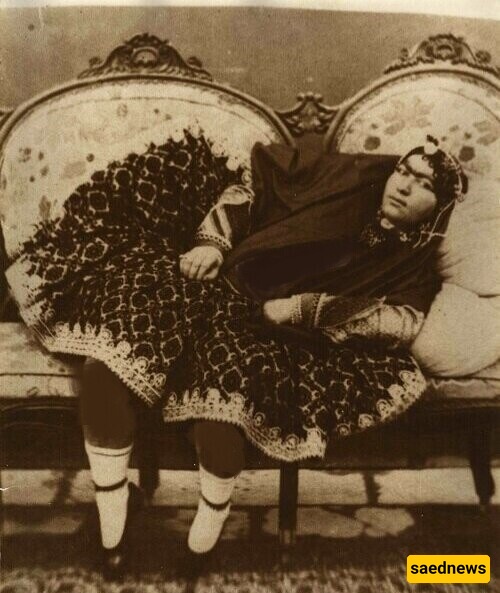
According to Saednews historical sources, Anis al-Dowleh was one of the most influential women in the history of Qajar Iran. She was the first royal consort to receive the prestigious Portrait of the Shah Medal and the Order of the Sun, honors that reflected her exceptional status within the royal court. More than simply being the favorite wife of Naser al-Din Shah Qajar, she was widely recognized for her intelligence, political insight, administrative ability, and influence over state affairs.
Anis al-Dowleh was born Fatemeh, the daughter of Nur Mohammad, whose family descended from Georgians relocated to Mazandaran during the Safavid era. After her father's early death, she was raised by her aunt, who eventually brought her into the royal harem of Naser al-Din Shah.
Initially, she served under Jeyran Khanum Forough al-Saltaneh, the Shah's favorite wife at the time. Following Jeyran's death, responsibility for her estate was entrusted to Fatemeh.
Determined to improve herself, Fatemeh pursued literacy and education with the assistance of female tutors from the royal household. During the Shah's visit to Soltaniyeh, he married her as a temporary wife, bestowed upon her the title Anis al-Dowleh, and granted her the tax revenues of Kashan and its surrounding villages. This marked the beginning of her remarkable rise to power.
Although contemporary accounts described her as having ordinary or even unattractive features, nearly all historical observers praised her exceptional character and intelligence.
Princess Taj al-Saltaneh, daughter of Naser al-Din Shah, wrote that Anis al-Dowleh was a wise, dignified, modest, and morally upright woman. Despite lacking conventional beauty, she became the most respected woman in the royal court. Foreign diplomats' wives, noblewomen, and the spouses of ministers regularly visited her residence, and many official petitions reached the Shah through her influence.
Anis al-Dowleh possessed remarkable writing and literary skills, making her one of the most educated women of the Qajar court. Her abilities elevated her above the Shah's other wives until she effectively became Queen of Iran.
Her household was managed by a minister, and notably, she employed a female secretary, an extraordinary innovation rarely seen in royal courts of the era.
Foreign ambassadors visiting the Shah often signed the guest register at her residence as well, and rulers from other countries sent valuable gifts and decorations addressed specifically to "Anis al-Dowleh, Queen of Iran."
One of her primary responsibilities was managing the royal harem, home to numerous wives, concubines, servants, and attendants. Maintaining harmony within this complex institution was considered politically important.
The historian Etemad al-Saltaneh emphasized her indispensable role, writing that the royal harem depended almost entirely upon her leadership and warning that her death would throw the entire household into disorder.
Historical accounts describe an event that further elevated Anis al-Dowleh's standing.
Queen Victoria reportedly sent an elaborate diamond necklace to Tehran as a gift for the Shah's favorite wife. When the British envoy asked which consort should receive it, the Shah instructed that it be presented to Anis al-Dowleh.
The British envoy's wife formally placed the necklace around her neck in the royal palace. In return, Anis al-Dowleh sent luxurious Persian gifts—including fine turquoise tableware and silk carpets—along with a letter written in French for Queen Victoria.
Anis al-Dowleh became known for her charitable works and religious endowments. Among her notable donations were:
A diamond ornament dedicated to the Shrine of Imam Ali.
A pearl curtain presented to the Shrine of Imam Husayn.
A silver shrine for the martyrs of Karbala.
A diamond half-crown donated to the Shrine of Imam Reza.
Restoration of the gilded silver doors of Goharshad Mosque.
Donation of the village of Kashanak as a religious endowment.
Construction of a bridge in Naserabad near Lavasan.
These projects reflected both her wealth and her religious devotion.
One surviving letter written by Anis al-Dowleh demonstrates her political influence.
When Naser al-Din Shah considered dismissing the newly appointed governor of Shiraz after only a few months in office, she urged him to reconsider. She argued that frequent changes in government harmed ordinary people because governors sought to recover their financial losses through excessive taxation.
Her appeal highlighted concern for public welfare as well as political stability.
Anis al-Dowleh hosted the wives of foreign diplomats during official ceremonies, royal birthdays, and national celebrations.
She organized receptions, welcomed European women to the palace, explained Persian religious ceremonies through interpreters, and introduced foreign guests to traditional Ta'zieh performances.
Italian traveler Carla Serena, who knew the royal court, wrote that Naser al-Din Shah frequently consulted Anis al-Dowleh before making important decisions, considering her judgment exceptionally valuable.
She also maintained close relations with military leaders.
One famous story recounts that she embroidered soldiers carrying rifles around the hem of her dress. When the Shah asked why, she replied that these soldiers protected the honor and dignity of the kingdom. Her answer deeply impressed him.
Perhaps Anis al-Dowleh's most famous contribution came during the Tobacco Protest of 1891–1892, one of the defining political movements of modern Iranian history.
After the leading Shi'a religious authority declared tobacco use forbidden in protest against the British tobacco concession, servants in the royal palace began collecting and dismantling the royal water pipes.
When the Shah asked why this was happening, Anis al-Dowleh answered:
"Because tobacco has been declared forbidden."
The Shah asked who had issued such an order.
She famously replied:
"The same person who made me lawful for you."
Her response referred to the religious authority whose rulings governed Islamic marriage. The Shah reportedly made no further objection, and smoking ceased throughout the royal palace. Her actions significantly strengthened the effectiveness of the nationwide boycott.
Anis al-Dowleh accompanied Naser al-Din Shah on one of his European journeys, traveling as far as Moscow before returning to Iran.
Historians differ regarding the reason for her return. Some attribute it to religious objections against Muslim women traveling in Europe, while others suggest diplomatic concerns arising from the extraordinary attention she received from Russian officials.
As head of the royal household, Anis al-Dowleh greatly influenced women's fashion in Iran.
She encouraged replacing heavy traditional cosmetics with lighter European-inspired styles and introduced new hairstyles and clothing designs. Contemporary memoirs credit her with modernizing women's appearance while preserving elegance and refinement.
Following the assassination of Naser al-Din Shah on May 1, 1896, Anis al-Dowleh's health rapidly declined.
One traditional account claims that she suffered a fatal stroke after seeing her pension paid in banknotes bearing the late Shah's portrait, which overwhelmed her with grief.
More recently discovered documents, however, indicate that she died from jaundice, passing away at the age of 42.
Anis al-Dowleh remains one of the most remarkable women of nineteenth-century Iran. Rising from humble origins, she became the most influential woman in the Qajar court, exercised significant political and diplomatic influence, promoted charitable works, modernized aspects of women's culture, and played a pivotal role in the Tobacco Protest—an event that helped shape Iran's constitutional and political awakening. Her life stands as an extraordinary example of how intelligence, education, and leadership enabled a royal consort to leave a lasting mark on Iranian history.