SAEDNEWS: The final moments of Socrates before drinking the cup of hemlock have inspired many artists. The most famous depiction is The Death of Socrates by the French Neoclassical painter Jacques-Louis David, now housed in the Metropolitan Museum of Art in New York.
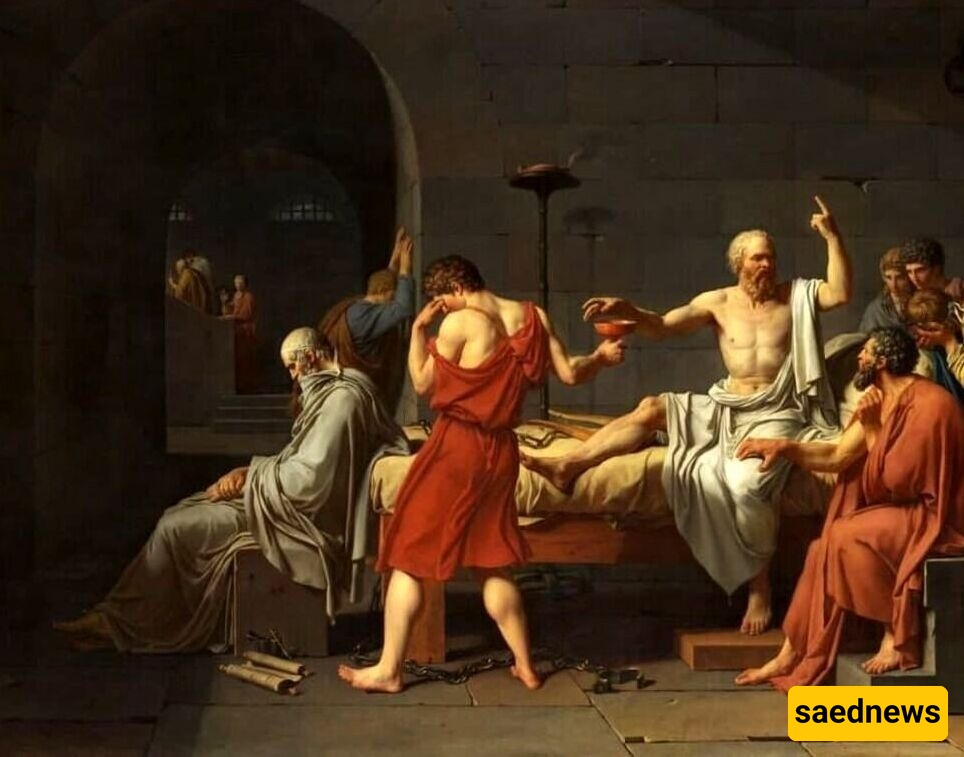
According to Saednews, The final moments of the ancient Greek philosopher Socrates have inspired countless artists throughout history. Among the many interpretations, the most celebrated is The Death of Socrates, the masterpiece by the French Neoclassical painter Jacques-Louis David, now housed in the Metropolitan Museum of Art in New York.
According to Plato’s dialogue Phaedo, Socrates spent his final hours calmly discussing philosophy with his disciples after delivering his defense before the Athenian court, which had sentenced him to death. Rather than lament his fate, he reassured his followers, telling them not to grieve for him because only his body would remain behind. Surrounded by sorrowful students and even a grieving jailer, he accepted the cup of hemlock from his faithful disciple Crito and drank it without hesitation. The deadly poison gradually weakened his body, his eyes became still, and he embraced death with remarkable serenity, leaving behind a lasting lesson in courage and integrity.
Socrates' relentless philosophical questioning challenged the traditional beliefs of Athenian society. He encouraged citizens to critically examine the gods of the Greek pantheon and reconsider accepted moral values. These teachings led to accusations of impiety and corrupting the youth of Athens. As punishment, he was sentenced to death, a sentence traditionally carried out by drinking poisonous hemlock. Although his followers urged him to seek mercy or escape from Athens, Socrates firmly rejected both options, insisting that respecting the law was more important than preserving his own life.
These unforgettable final moments have been portrayed by many artists, but none has achieved the enduring influence of Jacques-Louis David’s The Death of Socrates. Painted with admiration rather than strict historical accuracy, David transformed the philosopher’s execution into a powerful symbol of moral strength and unwavering conviction.
Measuring approximately 130 by 196 centimeters, the painting presents Socrates as a heroic figure seated upright on his bed, dressed in brilliant white robes. His right hand reaches confidently toward the cup of hemlock while his left hand points upward toward the heavens, symbolizing his belief in the immortality of the soul and the existence of a life beyond death. Even in his final moments, Socrates continues to teach, choosing death over abandoning his principles. His last lesson is directed toward the grieving students gathered around him.
At the foot of the bed sits Plato, portrayed as an elderly man lost in quiet reflection, his head bowed in sorrow. The young man offering the cup of poison turns his face away, unable to witness the philosopher drink the fatal potion. Another figure gently places a hand on Socrates' knee, as though making one final attempt to dissuade him. In the background, several companions depart down a corridor, unable to bear the emotional weight of the scene. The composition ultimately celebrates Socrates' fearless acceptance of death and his belief that death is not the end of existence but another stage of life.
Jacques-Louis David was the foremost painter of his era, renowned for blending historical narratives with the ideals of the Enlightenment. His works became some of the finest examples of academic painting, combining intellectual depth with visual grandeur. Although his refined style appealed to the French aristocracy, his paintings also resonated deeply with ordinary people through their universal themes of honor, sacrifice, and civic virtue.
David’s students would later move away from the disciplined structure of Neoclassicism toward the emotional intensity of Romanticism. Nevertheless, David’s own work remained a cornerstone of modern artistic and political thought, filled with moral symbolism and revolutionary ideals.
Throughout his career, David served three successive French regimes. He first worked under the court of King Louis XVI, later became a prominent artist during the French Revolution, and eventually served the empire of Napoleon Bonaparte. Each government used his powerful imagery to reinforce its authority and legitimacy. Despite his influence, shifting political circumstances ultimately led to his imprisonment on charges of political betrayal.
The Death of Socrates was completed in 1787, just two years before the outbreak of the French Revolution. The painting conveyed powerful messages of resistance to injustice, devotion to truth, and heroic self-sacrifice—values that would soon become central to the revolutionary movement. David himself actively participated in the Revolution and created numerous works celebrating courage, patriotism, and civic duty.
The final years of David’s life were marked by illness and exile. Despite repeated efforts to secure his return to France, he remained in Brussels, where he died in 1825. During the bicentennial of the French Revolution in 1989, the French government sought to repatriate his remains. However, Belgian authorities declined the request, arguing that his tomb had become an important historical monument and should remain in Belgium.