SAEDNEWS: The Pyramid Texts, found inside the tombs of ancient Egyptian pharaohs and queens, are the oldest known collection of Egyptian writings. Inscribed on walls and ceilings, they reveal surprising information about Egypt’s early rulers after being translated.
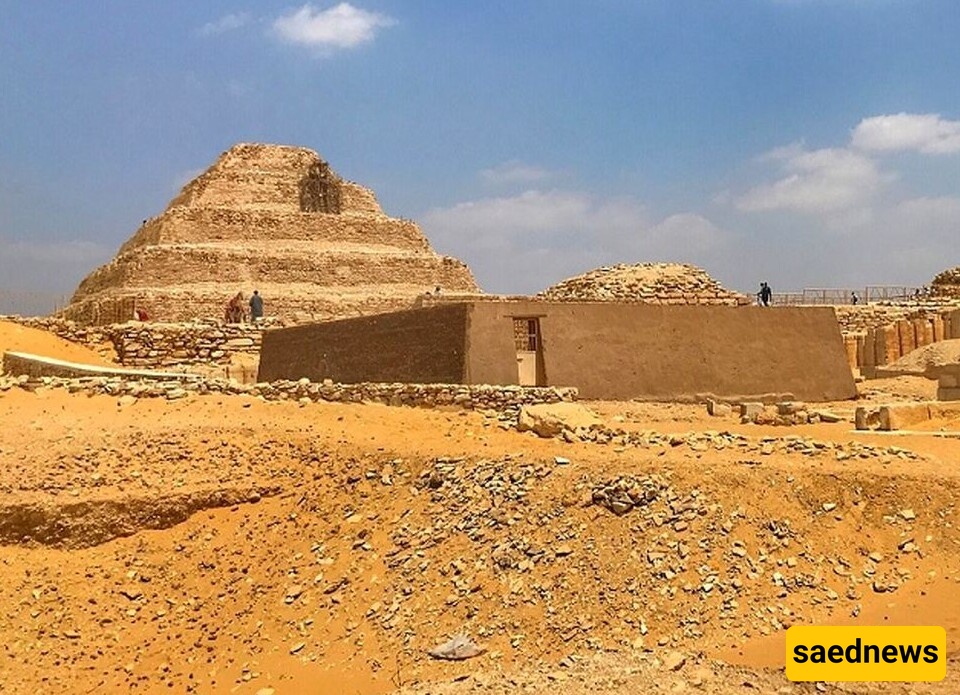
According to a report from Saed News (citing Faradid), one of the most confusing and enigmatic sections of the Pyramid Texts is the so-called “Cannibal Hymn” of ancient Egypt. According to this text, the pharaoh in the afterlife is portrayed as a bloodthirsty, predatory being who devours the gods.
Let us take a closer look at one of the strangest, most violent, and most surprising pieces of early Egyptian literature.
It is still difficult to determine exactly when the “first” things in history occurred. We do not know precisely when Egyptian religion began, and the same uncertainty applies to early written texts. In the case of Egypt, countless treasures still lie buried beneath the sands. Therefore, when we refer to the “Pyramid Texts,” we cannot claim they are the very first religious texts in Egyptian history, but we can say with certainty that they are the oldest known Egyptian religious writings.
Unlike later Egyptian religious books written on papyrus, the Pyramid Texts were carved onto the inner walls of pyramids during the Old Kingdom. To date, eleven pyramids have been found containing all or parts of these texts. They were commissioned by six pharaohs and five of their queens.
Egyptologists traditionally divide the Pyramid Texts into “utterances,” believing that priests performing funerary rituals would recite them. The texts cover various religious themes concerning the afterlife of kings and queens. It was believed that the pharaoh or queen could become an “akh” (a transformed spirit in Egyptian belief) only through specific rituals, allowing them to enter eternal life filled with joy.
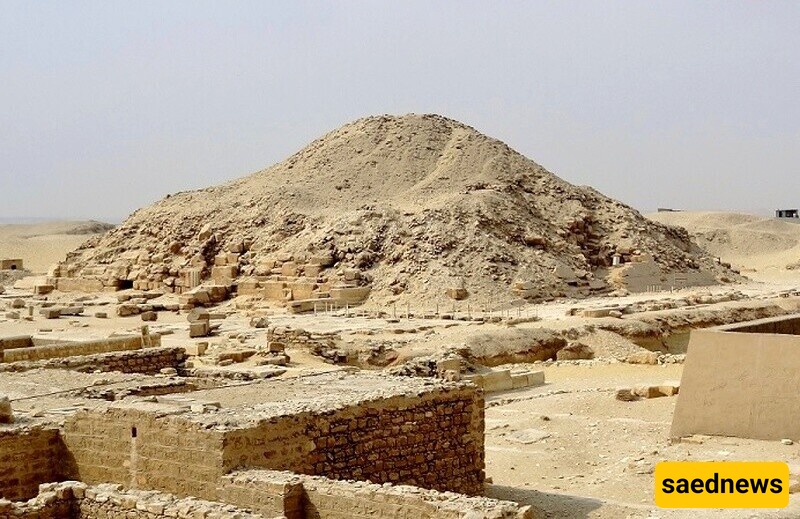
Among these utterances, those known as the “Cannibal Hymn” remain the most puzzling. These passages are found in only two pyramids: those of Unas and Teti. However, the version in the Pyramid of Unas is the longest and most complete. It is also one of the most mistranslated pieces of ancient Egyptian writing.
Most of the well-known pyramids of ancient Egypt belong to the Old Kingdom. The pyramid of Unas was built around 2300 BCE in Saqqara, near modern Cairo. Although it now appears as a ruin, it was once one of the most finely constructed pyramids with a smooth limestone casing.
Historical accounts of Unas describe his military campaigns in southern Canaan and his trade relations with Nubia and the Levant. He is also portrayed as the son of Ra and the earthly counterpart of Osiris. This religious aspect of his kingship is strongly reflected in his Pyramid Texts.
The Pyramid Texts describe the death and resurrection of the king and his ascent to the heavens with the help of Atum-Ra, where he becomes Osiris. One early stage involves claiming dominion over the “four pillars of the earth,” meaning the four cardinal directions. Gods witnessing Unas’s rule travel across Egypt to proclaim his authority.
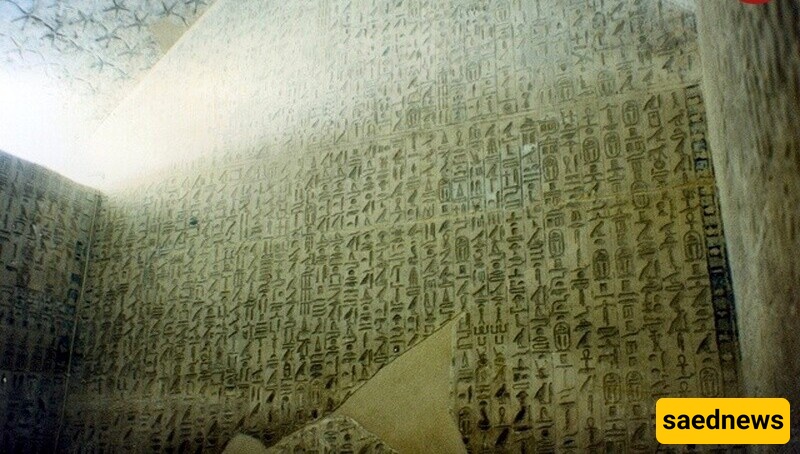
A passage (Utterance 217) states:
“Unas comes, an indestructible spirit; if he wishes you to die, you die; if he wishes you to live, you live!”
After confirming his kingship, Unas begins his ascent to the sky, where his father Atum-Ra resides:
“Ra-Atum, your son comes to you; Unas comes to you; lift him up, embrace him; he is your son, of your body, forever!”
He is raised by Shu, the god of air, and the sky goddess Nut welcomes him. He undergoes purification in a mythical place known as the “Field of Reeds,” believed to be located in the eastern sky. In Egyptian mythology, the sky is imagined as a mirror of the Nile, crossed by floating reeds and guided by a ferryman.
Then the text becomes increasingly strange:
“The sky rains, the stars darken, the bones of the earth tremble… Unas has risen as a power, a god who lives on his fathers, who feeds on his mothers.” (Utterance 273)
This passage suggests that Unas is stronger than the gods who came before him. He is accompanied by divine forces that are beneath him in power. The texts continue describing how he commands gods and even possesses destructive, supernatural abilities.
Another passage states:
“Unas is the bull of heaven, who lives on the existence of every god, who eats their entrails.”
Unlike other Egyptian religious texts that avoid explicit depictions of divine death, Utterances 273 and 274 directly describe the consumption of gods. It is said that he eats their magic and swallows their spirits. Gods slaughter other gods at his command, and their organs are served to the king.
One of the most controversial passages reads:
“He has crushed bones and marrow; he has taken the hearts of the gods; he has eaten the red, swallowed the green; Unas feeds on the lungs of the wise and lives on their hearts and magic.”
Even today, the meaning of this passage is unclear.
In the early 20th century, Egyptologist Ernest Alfred Wallis proposed a controversial theory: that Egyptians once practiced cannibalism and later created the myth of Osiris to discourage it. He based this idea largely on the Cannibal Hymn.
According to his interpretation, priests of the Old Kingdom used the story of Osiris’s death and dismemberment as a moral replacement for real cannibalistic practices. Eventually, burial customs shifted toward mummification rather than consumption of the dead.
Later scholarship rejected this theory. Researchers found no sufficient evidence of actual cannibalism in ancient Egypt. Instead, modern interpretations view the Cannibal Hymn as symbolic rather than literal.
In this reading, “eating the gods” represents the king absorbing divine power. It is a metaphor for the pharaoh’s transformation into a supreme celestial being and his identification with Osiris.
When the text says Unas “eats the red,” it refers to the Red Crown of Lower Egypt, while “the green” refers to the goddess Wadjet of Upper Egypt. Thus, the Cannibal Hymn symbolizes the unification of Upper and Lower Egypt under the divine authority of the king.
Rather than evidence of literal cannibalism, the text is now understood as a powerful religious metaphor for absolute royal power and cosmic unity.