Saed News: A remarkable underwater archaeological discovery in the Gulf of Cádiz has revealed the remains of a 17th-century ship carrying artillery and silver bars. This discovery sheds new light on smuggling networks and maritime trade in the Atlantic Ocean.
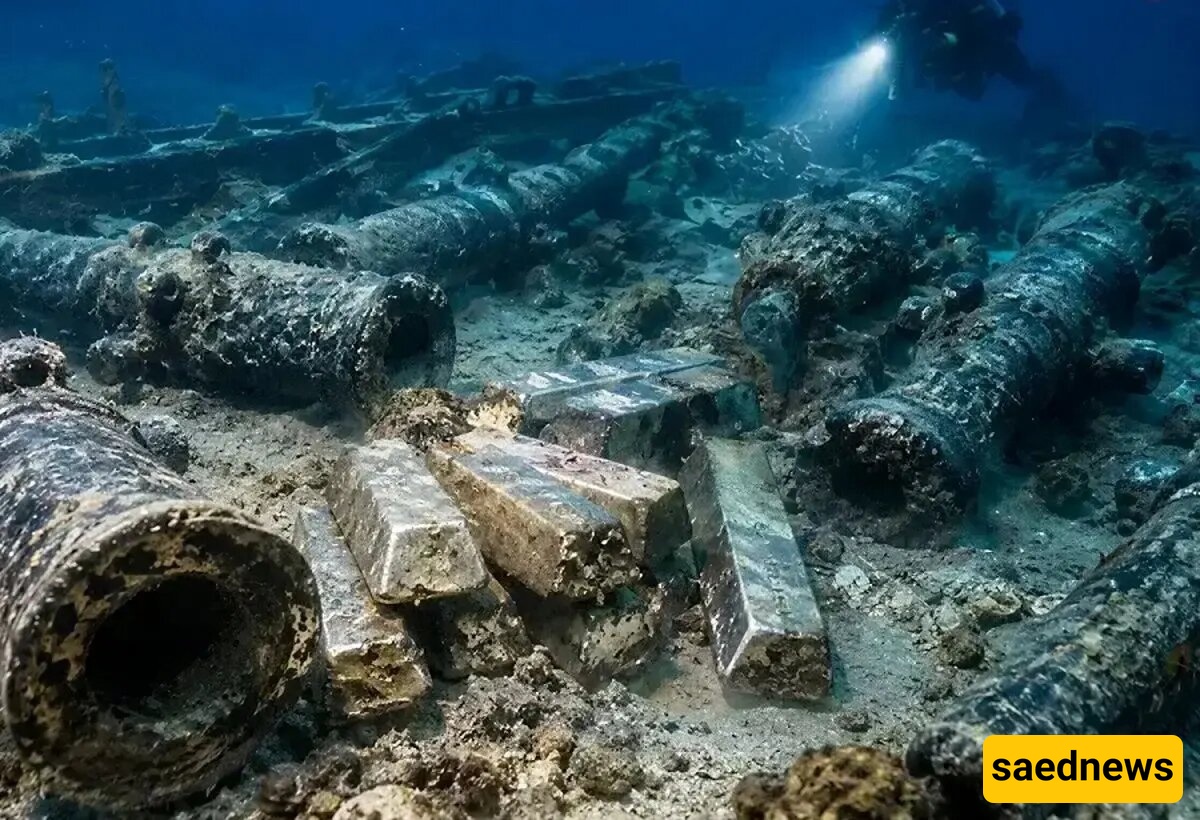
According to SAEDNEWS, citing Faradid, marine archaeologists have recovered 27 cannons and 18 silver bars from a shipwreck discovered during dredging operations related to the expansion of the Cádiz container port. This site is considered one of the most important underwater finds in recent years in the waters of Andalusia.
The wreck is currently referred to as “Delta One” until researchers continue their efforts to precisely identify it.
The artillery cargo appears to have originated in Sweden and was likely purchased through Dutch intermediaries, indicating the interconnected nature of arms trade networks in Europe during that period.
Marine archaeologists have identified five different cannon calibers dating back to the third quarter of the 1600s. Several pieces are heavily damaged, and some critical components such as barrel muzzles or side fittings (trunnions), used for mounting cannons on carriages, are missing.
Since no wooden gun carriages have been preserved, researchers believe some of the cannons may have been decommissioned and used as ballast. Another possibility is that the damage occurred during battle or shortly before the shipwreck.
The site has also been disturbed by modern dredging operations, and many artifacts have been displaced from their original positions. Archaeologists describe the ship as “decentralized and detached from its historical context,” making reconstruction of its original layout on the seabed difficult.
In addition to the artillery, divers also recovered 18 silver bars weighing approximately half a ton. One of the bars bears the date 1667, providing an important clue for dating the cargo and the shipwreck. Researchers believe the silver may have been part of an illegal smuggling operation.
In the 17th century, the Spanish monarchy strictly controlled the movement of precious metals from the Americas. Although Seville was officially the center of Atlantic trade, Cádiz became an important commercial hub due to its natural harbor and growing maritime activity.
These conditions enabled the expansion of extensive smuggling and informal trade routes that bypassed royal taxation and oversight. According to researchers, this discovery shows that foreign ships were widely involved in hidden trade networks beyond Spanish control.
The combination of silver and weapons aboard a single ship also reflects the unstable nature of Atlantic trade during a period marked by naval conflicts, political rivalries, and competing economic interests in Europe.