SAEDNEWS: Woodcarving is one of the beautiful traditional arts of Iran. To learn this craft, it is important to become familiar with the appropriate tools and types of wood used in this art.
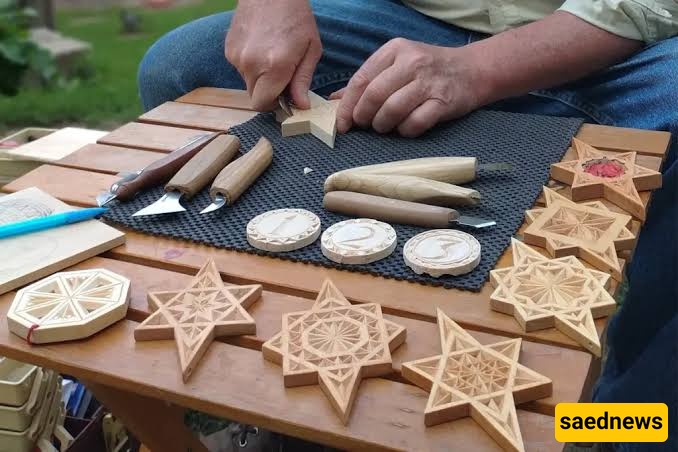
According to Saednews, Woodcarving, known as Monabbat-kari, is one of Iran’s traditional and highly refined crafts. Unfortunately, fewer people are practicing this art today. This guide introduces the essential tools used in woodcarving, explains how carving chisels are sharpened and maintained, and outlines the characteristics of suitable wood for this craft.
Knives and carving chisels, known as maghar, with blades of different sizes and shapes, are the primary tools used for woodcarving and wood engraving. Although their basic design has changed very little over time, woodcarvers commonly use several types, including:
Flat and skew chisels
Gouges, including curved, flat, and angled varieties
V-shaped and U-shaped carving tools
Chisels with different blade sizes and profiles
Carving knives
Saws
Wood-shaping tools
Smoothing and finishing tools such as files and planes
Knives are among the most versatile woodcarving tools and can be used for almost every part of the carving process, except for very deep excavation.
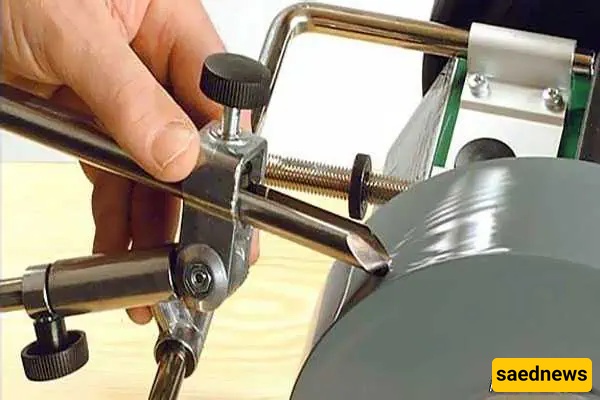
A carving chisel is generally sharpened in two stages. First, it is ground on a powered grinding wheel, and then its edge is refined and sharpened with an oilstone.
Flat chisels are normally ground at an angle of approximately 25 to 28 degrees. The guide on the grinding wheel is adjusted to the required angle, and the chisel is moved gently from left to right across the stone.
Because friction can generate enough heat to damage or burn the blade, the chisel should be cooled during grinding. Kerosene, diesel fuel, or oil may be used as coolants; if these are unavailable, water can be used instead.
Gouges and U-shaped chisels are ground from the sides, while V-shaped chisels are ground from both sides.
After grinding, the chisel should be worked on an oilstone to remove burrs and produce a sharp cutting edge.
For flat chisels, an ordinary flat oilstone can be used. For curved, U-shaped, and V-shaped chisels, cylindrical or triangular sharpening stones are more suitable. These shaped stones should generally be used on the inside of the chisel blade; the back of the blade can be sharpened with the same flat oilstone used for flat chisels.
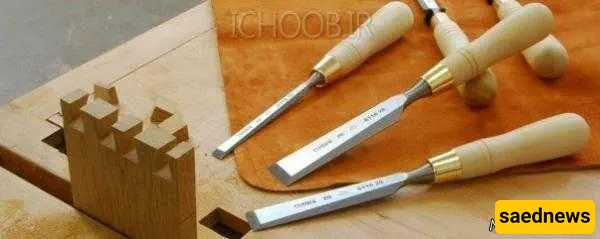
Sharpening with an oilstone should be done gently, using either a circular motion or a slow back-and-forth movement.
The process should continue until the chisel has developed a clean, sharp edge.
It is important to note that a chisel does not need to be reground on a powered grinding wheel every time it begins to feel dull. Routine sharpening should normally be done with an oilstone.
If the sharp edge of a chisel strikes a hard object and becomes chipped, the damaged tip should first be squared off on a powered grinding wheel before the chisel is sharpened again.
After sharpening, draw the cutting edge lightly across a piece of paper. If the chisel cuts the paper easily, it is sufficiently sharp. If it does not, further sharpening with an oilstone is required.
Waterproof abrasive paper and abrasive cloth can also be used as alternatives to an oilstone for refining the edge.
To protect carving chisels, their blades should be kept from striking or rubbing against one another. They should also be protected from damage caused by falling or coming into contact with hard surfaces.
Some imported flat chisels come with their own rubber blade protectors.
Another option is to make a leather case for the chisels and store them inside it. Individual leather sheaths can also be made for each chisel. Alternatively, a wooden or cardboard sheath can be made to cover each blade.
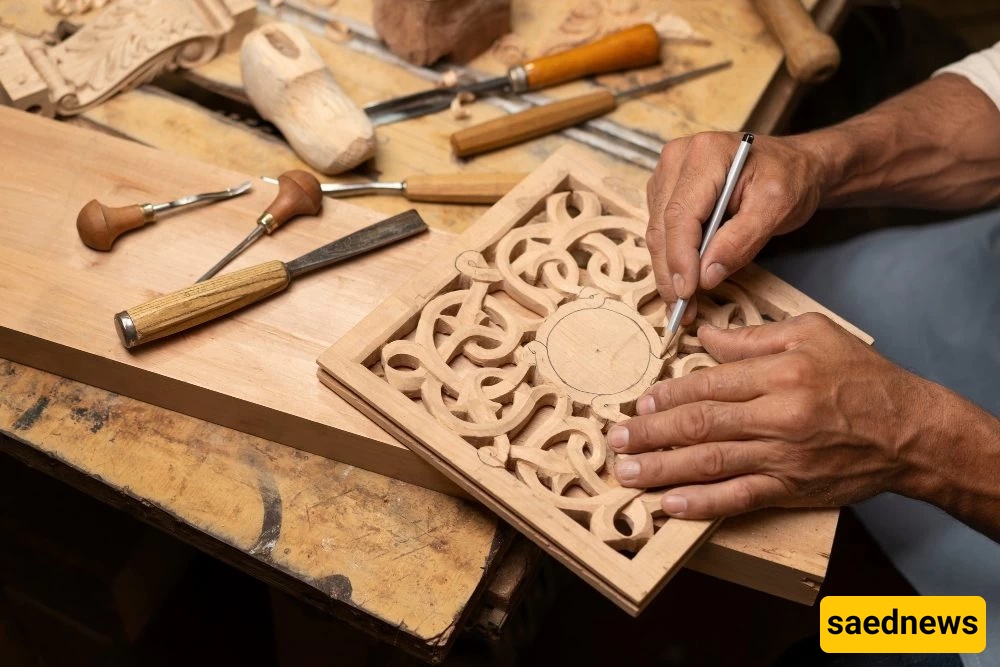
The ideal wood for carving should have the following characteristics:
An attractive and suitable color
A firm, stable texture despite being relatively easy to carve
As few knots as possible
Good resistance to wear and carving
Wood is the principal raw material used in woodcarving, and walnut is considered one of the most suitable woods for this craft.
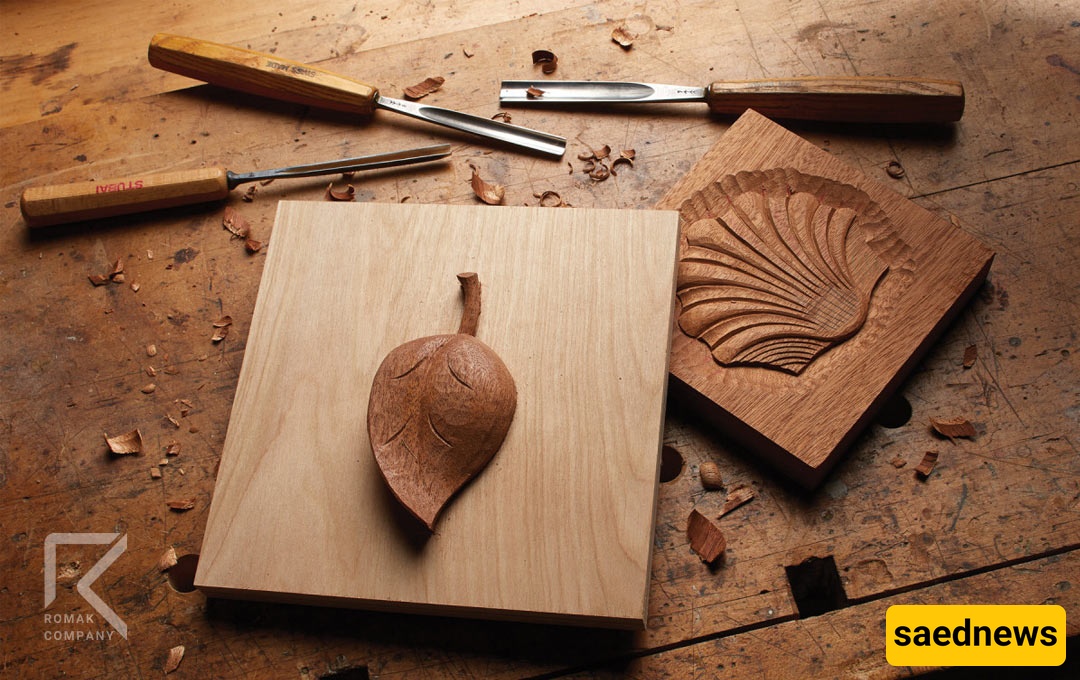
Walnut has several qualities that make it particularly valuable to woodcarvers:
It comes in a variety of natural colors.
It is durable while remaining easy to carve.
It has a fine and relatively firm grain.
Its grain can be both regular and irregular, creating attractive natural patterns.
It has moderate dimensional movement as its moisture content changes.
It belongs to the hardwood group of broad-leaved trees.
It accepts paint, stain, and lacquer well.
It has an attractive appearance and desirable working qualities.
For these reasons, walnut remains a favored material for detailed and decorative Iranian woodcarving.