Saed News: The Earth was once a mass of molten rock when it formed about 4.5 billion years ago. Over time, heavier elements such as iron and nickel sank toward the center of the planet, forming Earth’s initial core.
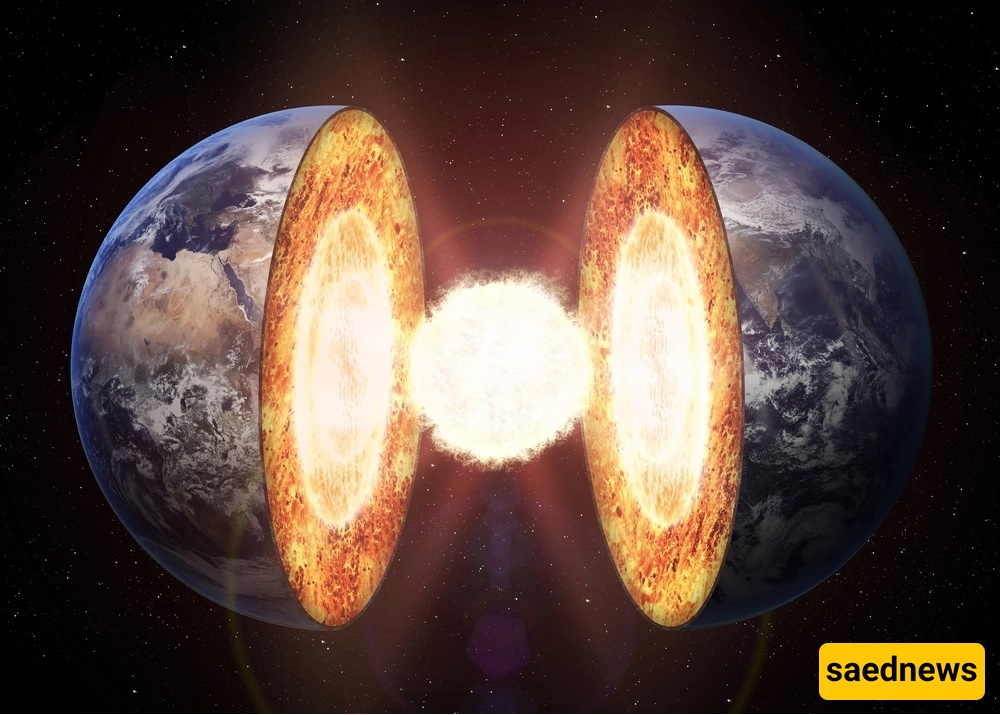
According to SAEDNEWS, today Earth’s core is still an extremely hot and dense sphere deep inside our planet. It consists of a liquid outer core that begins at a depth of about 2,900 kilometers below the surface and extends for about 2,200 kilometers. It also includes a solid inner core that starts at a depth of approximately 5,150 kilometers and has a radius of about 1,220 kilometers.
But how hot is the Earth’s core exactly, and how do scientists measure it when humans have never been able to drill that deep?
Scientists, using a combination of methods, estimate that the temperature of the Earth’s core is roughly similar to the surface of the Sun—about 5,000 to over 5,500 degrees Celsius. This temperature refers to the boundary between the inner and outer core, which is believed to be the hottest region.
However, this temperature has not been measured directly. Instead, it has been estimated through experiments and theoretical models of the core’s composition.
The Earth’s center is mainly composed of iron, making up about 85% along with nickel and other lighter elements. In the outer core, this material is liquid, while in the inner core it is solid. Researchers have determined this through experiments on iron alloys under extreme pressure, studies of meteorite composition, and the behavior of seismic waves passing through the Earth.
Since the outer core is mostly liquid iron, its temperature must be above iron’s melting point. The melting point of pure iron at Earth’s surface is about 1,538 degrees Celsius, but this does not account for the extreme pressure deep inside the planet. Such pressure raises the melting point of iron and many other materials, which is why the inner core remains solid despite its extremely high temperature.
To determine iron’s melting point under such extreme conditions, scientists have conducted high-pressure experiments. In some cases, iron samples are squeezed between diamond anvils and heated with lasers to extreme temperatures. In other experiments, shock waves or high-speed projectiles simulate core-like pressures. The results are then extrapolated to the conditions at the boundary between the inner and outer core, leading to estimates of about 5,000 to more than 5,500 degrees Celsius.
Shichun Huang, a geology professor at Sun Yat-sen University, says: “To some extent, everything we know about the Earth’s core is a well-informed scientific estimate.” Many processes, such as how the solid inner core crystallizes, are still not fully understood.
The liquid outer core also generates Earth’s magnetic field, which protects the planet and life on it from dangerous solar winds.
Much of the core’s heat comes from Earth’s formation history. When the planet formed, materials including iron were pulled together, and gravitational energy was converted into heat.
Scientists also believe that in the early formation of Earth, a Mars-sized object collided with the young planet, releasing enormous heat inside it. Some researchers also think radioactive elements such as potassium, uranium, and thorium may contribute to internal heat, although their exact role remains debated.
The hot core is one of the main reasons Earth can support life. Unlike many other planets, Earth has retained much of its original internal heat.
Quentin Williams, a mineral physicist, says Earth has not cooled efficiently and has preserved much of its primordial heat. This is why Earth has features like plate tectonics, which move surface plates, bring nutrients from deep inside, and create diverse environments for life to evolve. The semi-liquid iron core also generates the planet’s protective magnetic field.
Huang says: “If you care about life, you must also care about the Earth’s interior.” It is this extremely hot core at the center of the planet that makes life on Earth possible.