Saed News: The rare phenomenon known as “Earthshine” (in which the entire disk of the Moon appears faint and ghost-like) will be observable in the sky this week (April 19–22, 2026). This event, also known as “Da Vinci Glow”.
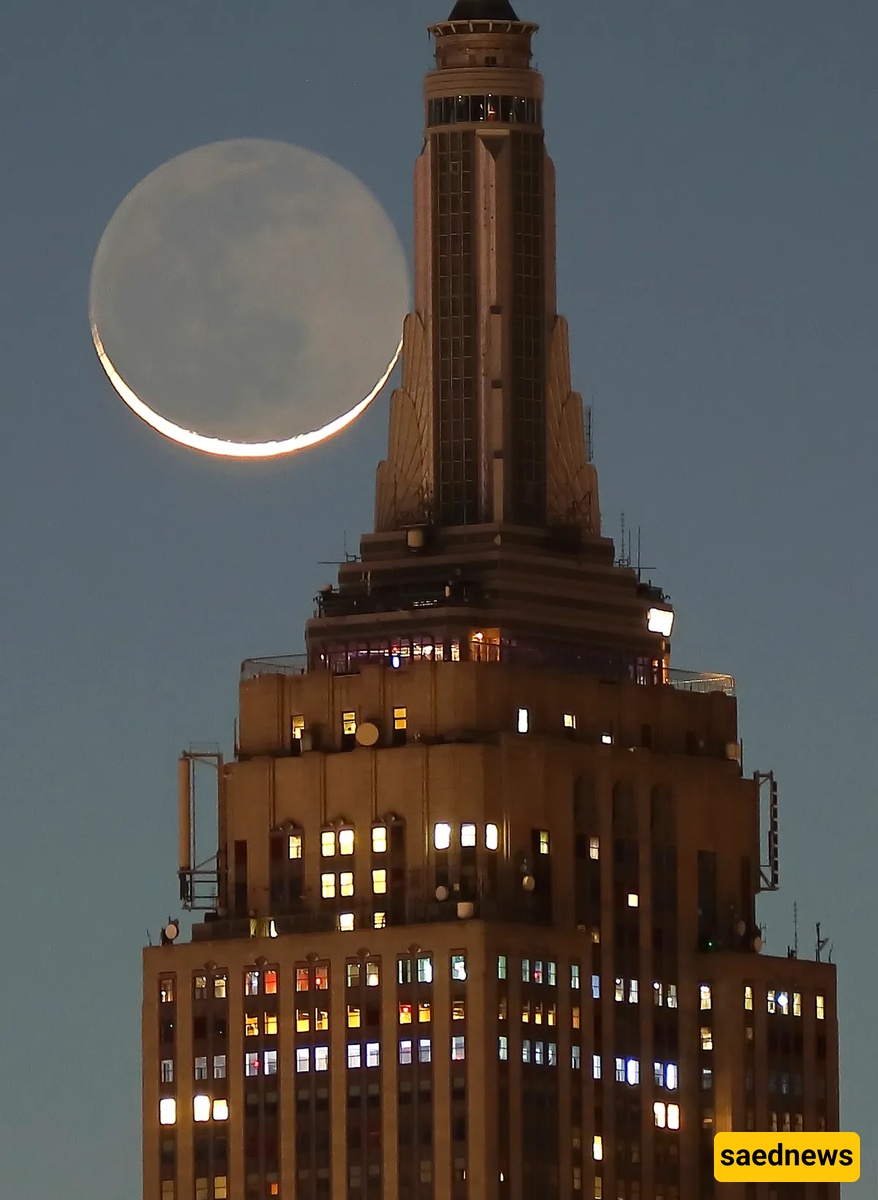
According to SAEDNEWS, the Moon is once again in the spotlight this April. After the successful flight of the Artemis 2 spacecraft near the Moon, attention has now turned to the beautiful and rare phenomenon called Earthshine. Although the full Moon is usually considered the main astronomical event each month (except during eclipses), the new Moon phase can also become equally fascinating a few times per year.
Earthshine is a real phenomenon that many may recognize from the song by the band Rush in their 2002 album “Vapor Trails.” It can be observed in April, May, and June. When you look at the sky and see the entire lunar disk faintly illuminated—not as bright as a full Moon—you are witnessing Earthshine.
During a full Moon, sunlight reflects directly from the Moon’s surface back to Earth, making it bright and visible. However, in Earthshine, the light path is different: sunlight first hits Earth, reflects off its surface (especially oceans, clouds, snow, and ice), then reaches the Moon, and finally reflects back to Earth. This double reflection causes the Moon to appear dim and ghost-like.
According to NASA, this phenomenon occurs only a few days per year, typically a few days before and after the new Moon in spring. The reason is a special alignment of Earth and the Moon that allows sunlight to reflect between them.
Astrophysicist Michael Zwirin from the Adler Planetarium explains that the main reason Earthshine is more visible in spring is the increased “albedo” of Earth. Albedo measures how much light a surface reflects. Snow and ice have high albedo, while asphalt or vegetation have low reflectivity.
He explains that during spring in the Northern Hemisphere (April to June), Earth’s albedo is higher because snow and ice still remain, reflecting more sunlight toward the Moon. In addition, the Northern Hemisphere is tilted more toward the Sun during spring, increasing reflection levels.
The exact timing changes each year because lunar phases are not identical annually. Earthshine occurs twice in each lunar cycle: during the waning crescent (before the new Moon) and waxing crescent (after the new Moon). This year’s new Moon was on April 17, making April 19–22, 2026 the best viewing window.
No special equipment is required to observe Earthshine, but timing is crucial. It is visible only about 45 minutes before sunrise and 45 minutes after sunset—creating two ~90-minute viewing windows each day. The best time is early morning, just before sunrise.
The effect will be strongest on April 14 and April 22, making these ideal dates for astrophotographers.
If you miss it in April, there will be four more opportunities in the coming months:
May 12–14
May 18–20
June 11–13
June 17–19
So keep your eyes on the sky and wait for this springtime wonder—a Moon that glows like a ghostly full disk.