SAEDNEWS: Learn scientific methods for distinguishing natural turquoise from synthetic and imitation stones, and discover the principles of caring for this valuable gemstone.
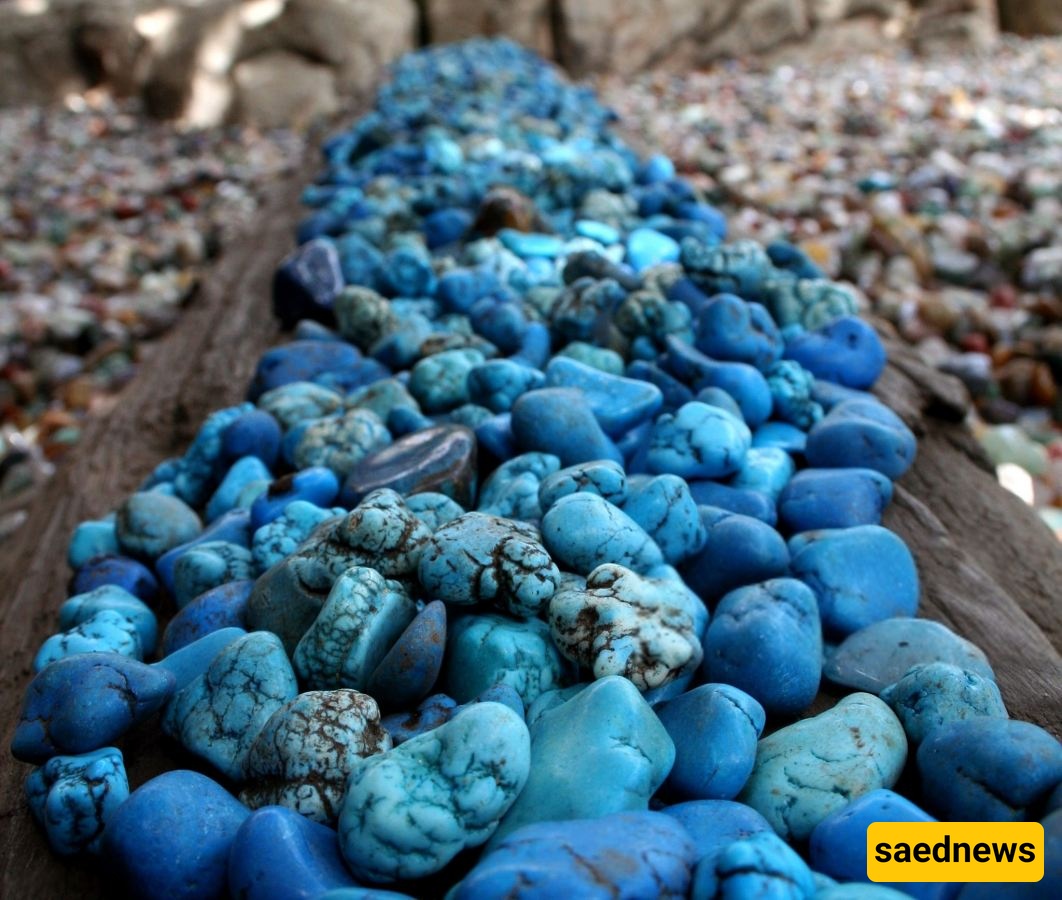
According to Saednews, For thousands of years, turquoise has been recognized as one of the most valuable and beloved ornamental gemstones in human civilizations. From the tombs of ancient Egyptian pharaohs to the royal thrones of Persia, this blue-green mineral has long symbolized power, protection, and good fortune.
However, in today’s world, with advances in technology and the mass production of synthetic and imitation stones, identifying genuine turquoise from fake alternatives has become a major challenge for buyers.
This comprehensive guide goes beyond a simple introduction and explores the physical, chemical, and geological characteristics of turquoise. You will learn about the history, traditional beliefs, and metaphysical properties associated with this gemstone, as well as scientific and practical methods for verifying its authenticity.
You will also discover modern preservation techniques and care instructions to help maintain the beauty of turquoise for generations.

Scientifically, turquoise is a hydrated phosphate mineral composed mainly of copper and aluminum. Its chemical formula is:
CuAl₆(PO₄)₄(OH)₈·4H₂O
This composition shows that copper (Cu) plays the primary role in creating the stone’s distinctive blue color.
The presence of iron (Fe) replacing aluminum, or impurities such as chromium and vanadium, can shift the color toward green shades.
Turquoise crystallizes in the triclinic crystal system. Its crystals are usually extremely small (microscopic) and occur as cryptocrystalline or fine-grained masses.
Because of this structure, turquoise is rarely found as large transparent crystals. Instead, it commonly appears as compact masses, veins, or stalactitic formations.
The porous nature of turquoise allows it to absorb dyes, oils, and other substances. This characteristic can be both a weakness and a useful factor in gemstone identification.
Turquoise has a hardness of approximately 5 to 6 on the Mohs scale. This means it is relatively soft and fragile compared with quartz (hardness 7) or ruby (hardness 9).
Its density typically ranges between:
2.60–2.80 g/cm³
These properties are useful when distinguishing genuine turquoise from plastic imitations (lower density) or glass imitations (higher density).
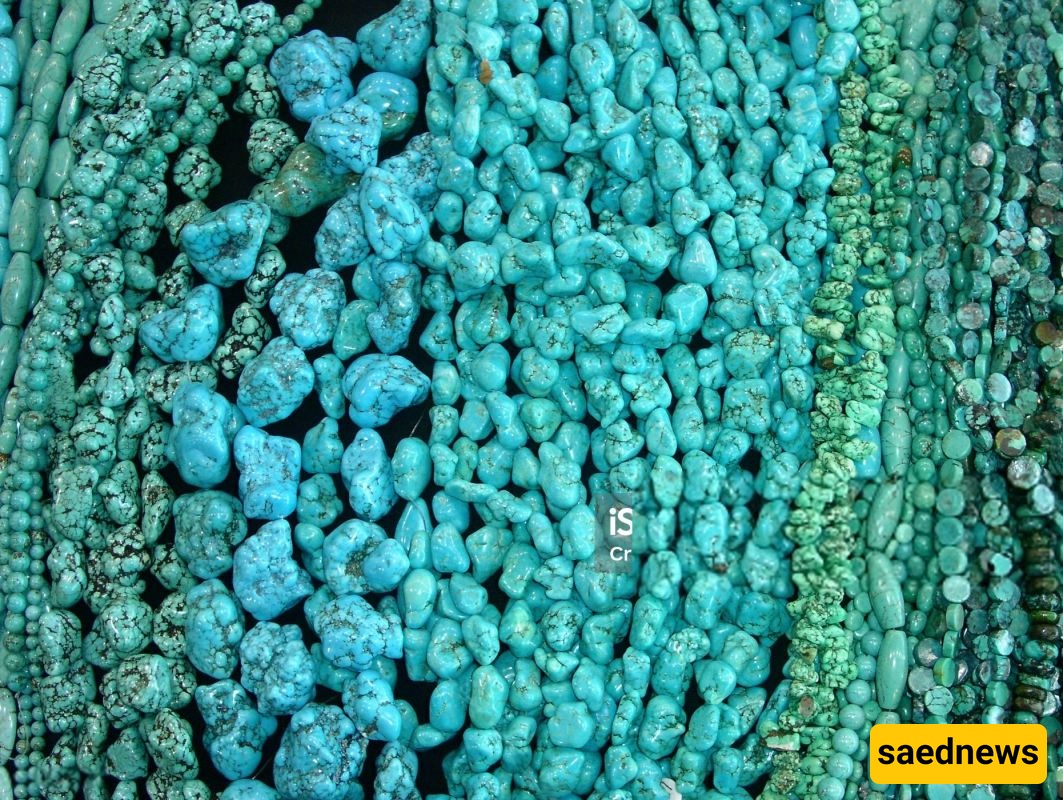
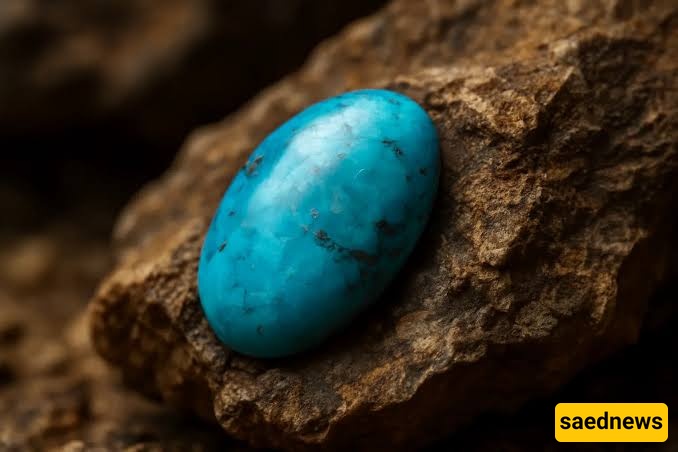
Color is the most important factor in determining turquoise quality and value.
The most valuable variety is a rich, even blue color known as:
“Sky Blue” or “Robin’s Egg Blue”
This famous color is especially associated with high-quality turquoise from the Nishapur mines of Iran.
Copper is the main element responsible for turquoise’s blue coloration. Higher copper concentration and fewer impurities generally produce a purer and deeper blue color.
When iron replaces aluminum within the mineral structure, the stone develops greener tones. Green turquoise usually has lower value unless it is prized for its unique texture, rarity, or historical importance.
In some deposits, such as the Sleeping Beauty mine in Arizona, zinc can create lighter and brighter blue shades.
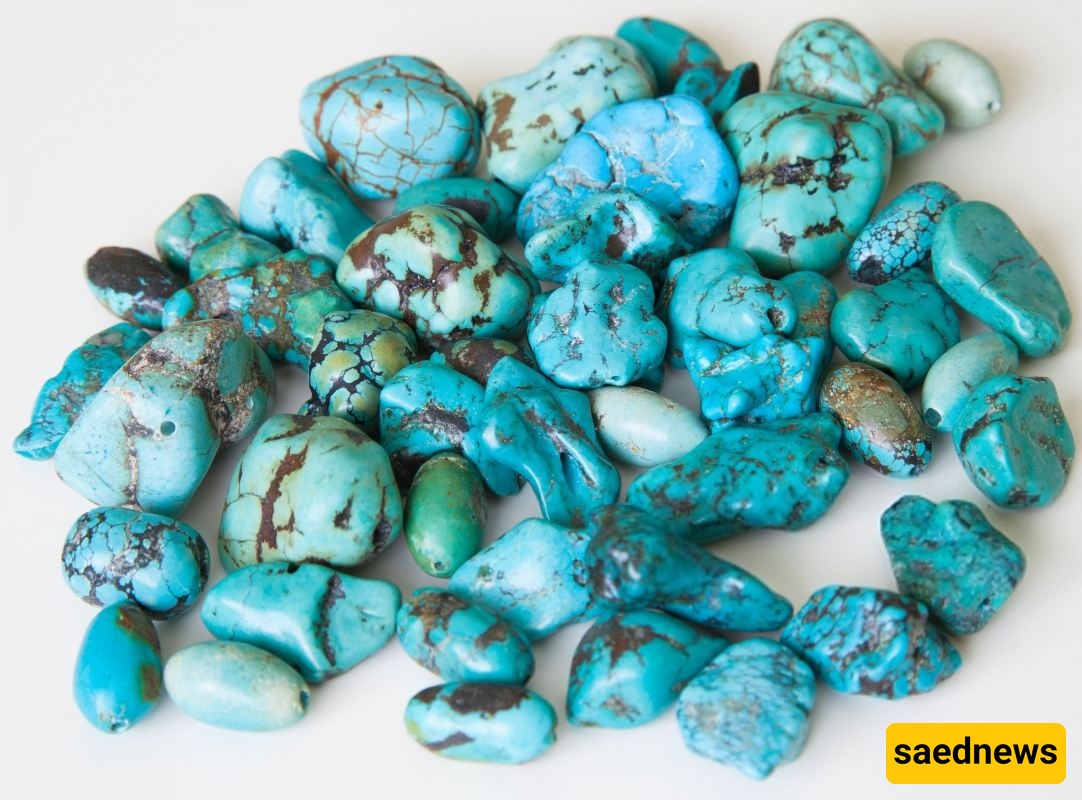
One of the recognizable characteristics of turquoise is the presence of dark veins or patterns called matrix.
These patterns represent the host rock in which turquoise formed.
Common matrix materials include:
Limonite: A brown iron oxide mineral.
Pyrite: A golden or bronze-colored iron sulfide.
Quartz or Calcite: White vein patterns.
Some cultures consider matrix patterns evidence of natural origin, while others prefer pure, matrix-free turquoise.
Chinese turquoise with spiderweb matrix patterns is particularly popular among collectors.
In the jewelry market, turquoise is divided into several categories. Understanding these differences is essential when purchasing.
Natural turquoise is only cut and polished after being mined.
No chemicals, dyes, or stabilizing materials are added.
Because many natural deposits are either highly porous or have less desirable colors, high-quality natural turquoise is rare and expensive.

More than 90% of turquoise available in the market belongs to this category.
In this process, porous natural turquoise is placed in a vacuum chamber, and a colorless epoxy resin or polymer is injected into its pores.
This treatment provides several benefits:
Increased hardness (approximately up to 7 Mohs)
Improved color stability
Better resistance to sweat and chemicals
Easier cutting and polishing
Important: Stabilized turquoise is still natural turquoise that has been treated. It should not be confused with synthetic turquoise. Honest sellers usually disclose this treatment.
In this process, chemical dyes are used to improve the color of pale or low-quality turquoise.
Sometimes other minerals, such as howlite or marble, are dyed to imitate turquoise.
Dyed turquoise can be difficult to identify, but an acetone test may reveal artificial coloring.
This type is made from crushed turquoise fragments and powder mixed with resin and compressed into a solid form.
Although it contains real turquoise material, its value is significantly lower than natural or stabilized turquoise.
Synthetic turquoise is produced entirely in laboratories through chemical processes.
One of the most famous examples is:
Gilson Turquoise
It has a chemical composition and crystal structure similar to natural turquoise.
Synthetic turquoise is usually:
Extremely uniform
Free of natural matrix patterns
Flat and consistent in color
A combination of the following methods can help distinguish real turquoise from imitations.
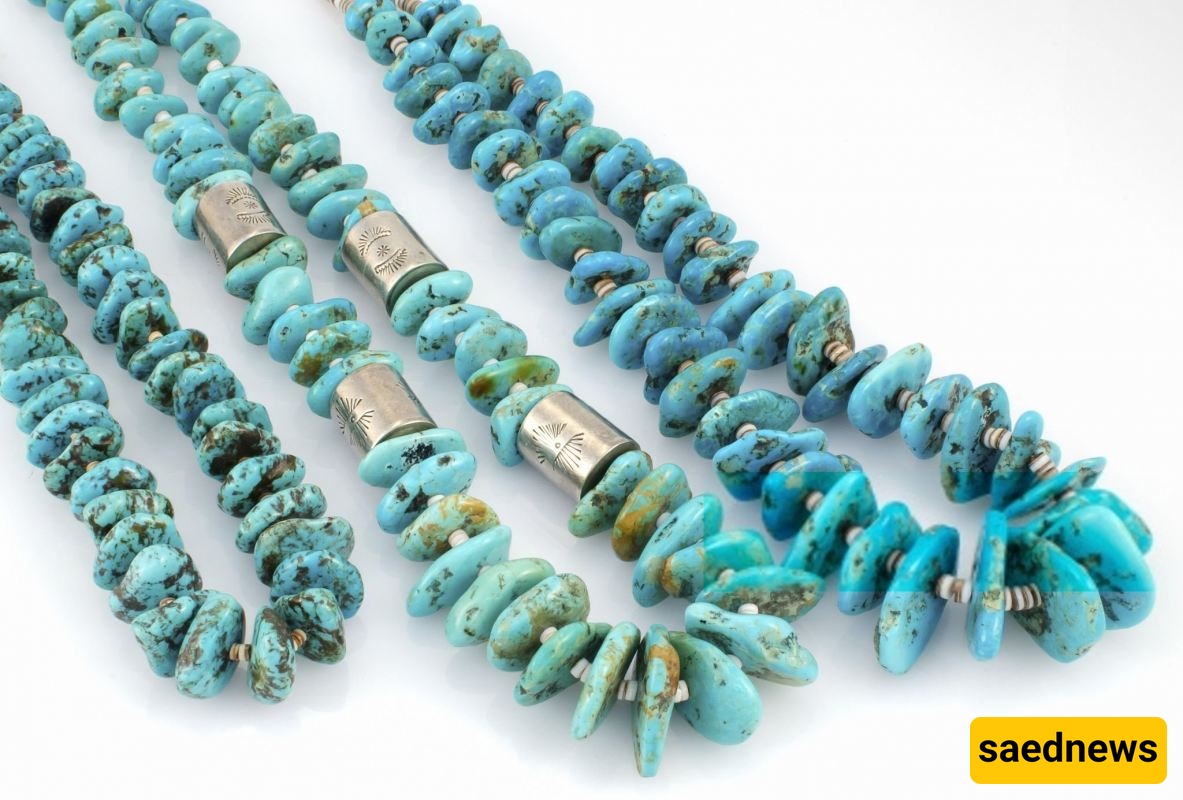
Natural turquoise usually has a slightly uneven and matte surface.
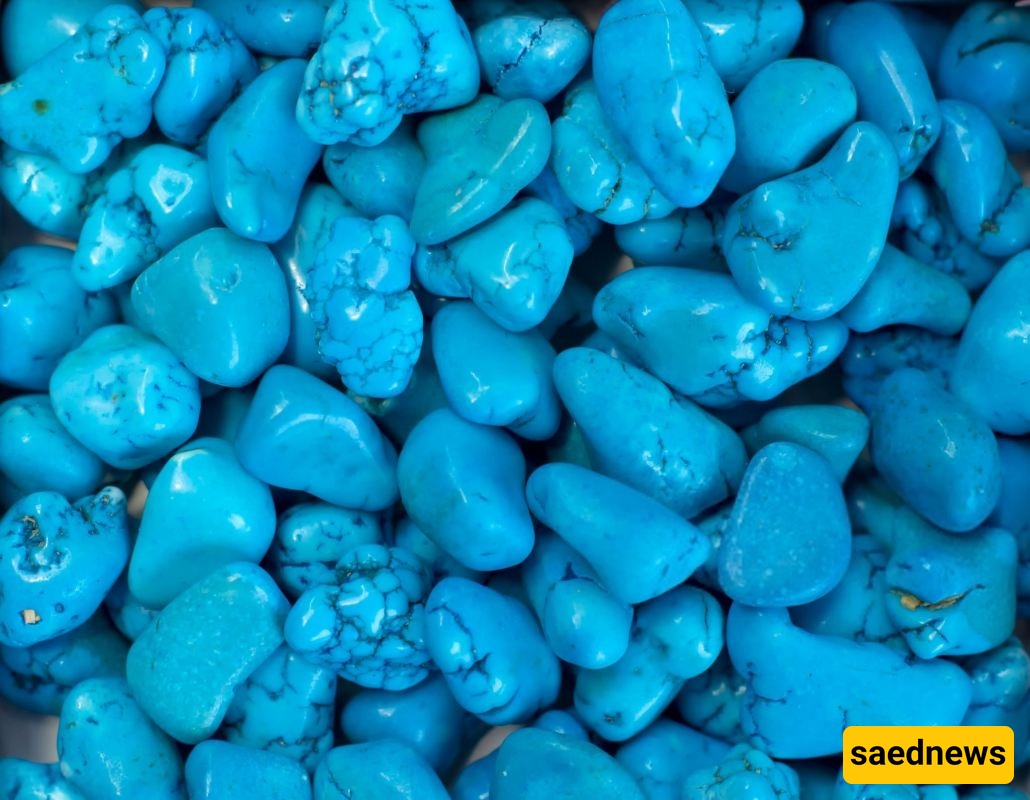
Synthetic turquoise, especially Gilson turquoise, often has a very smooth, glass-like appearance.
Natural turquoise matrix patterns are irregular with gradual transitions.
Plastic or ceramic imitations often show artificial, straight, and uniform patterns.
Tiny air bubbles trapped inside the stone can indicate glass or plastic imitation materials.
Authentic turquoise usually has a density between:
2.6 and 2.8
Using a precise scale and the Archimedes water displacement method, density can be calculated.
Plastic imitations (below 2 density) and glass imitations (above 3 density) can often be identified this way.
Natural turquoise can be scratched with a steel knife because steel has a hardness close to turquoise.
If it scratches very easily, it may be a softer material such as howlite.
If it cannot be scratched at all, it may be quartz or another harder gemstone.
This test should be performed carefully.
A heated needle can be gently applied to an inconspicuous area of the stone.
A smell of burning plastic or resin indicates stabilized or reconstructed turquoise.
Natural turquoise may produce an earthy or burnt-hair-like smell due to its water content.
Soak a cotton swab with acetone (nail polish remover) and gently rub the surface.
Blue color appearing on the cotton indicates dyed material.
Natural and stabilized turquoise should not release color.
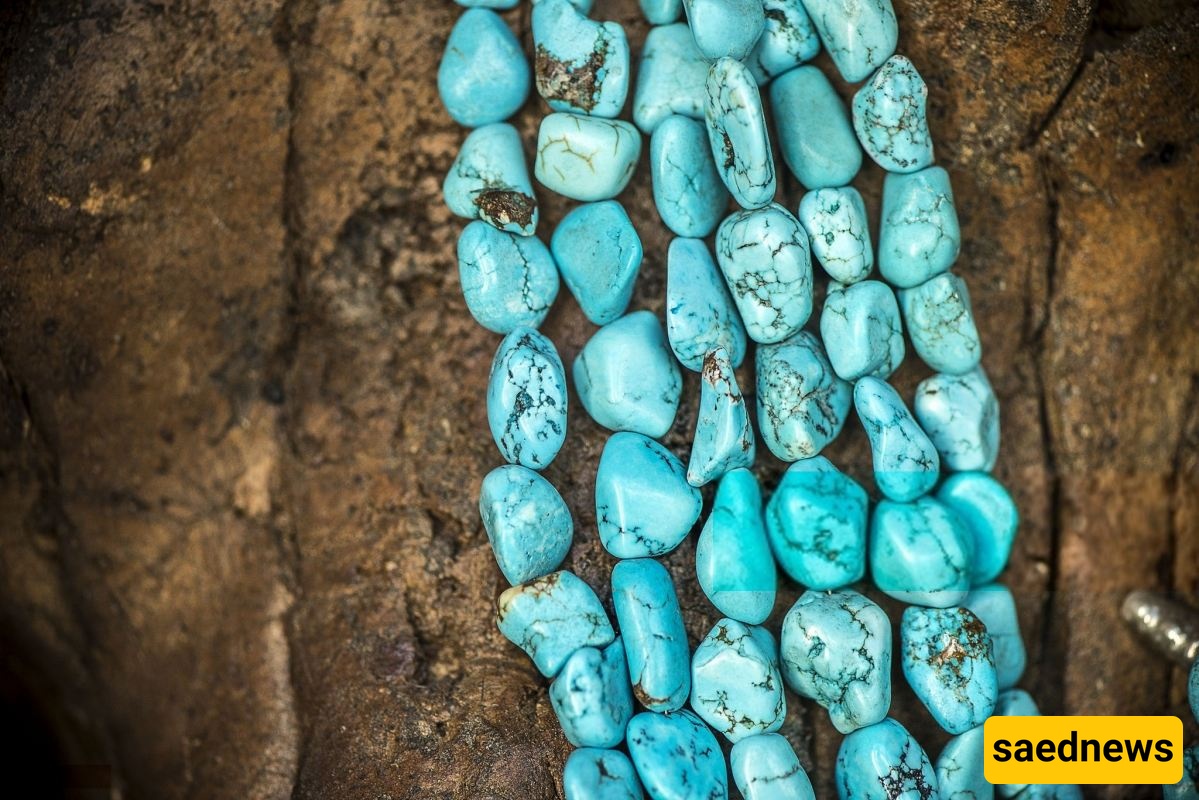
The quality and color of turquoise are strongly connected to its geological origin.
One of the oldest and most famous turquoise sources in the world.
Nishapur turquoise is known for:
Sky-blue Iranian color
Light brown limonite matrix
Exceptional quality
The mine has been active for approximately 7,000 years, and its turquoise is considered among the finest varieties worldwide.
This now-closed mine was famous for producing pure blue turquoise with little or no matrix.
Sleeping Beauty turquoise remains highly desirable among collectors.
One of America’s oldest turquoise mines.
Kingman turquoise is known for:
Strong blue colors
Dark matrix patterns
High-quality jewelry stones
Bisbee turquoise is valued for its:
Deep blue to violet-blue shades
Dark brown or black matrix patterns
Because the mine is closed, Bisbee turquoise is considered collectible.
Major Chinese turquoise sources include:
Hubei
Anhui
Shaanxi
China is one of the world’s largest producers of turquoise.
Chinese turquoise often has:
More green tones compared with Iranian and American varieties
Popular spiderweb matrix patterns
However, quality varies greatly.
Purchase from reputable sellers who provide authenticity guarantees and proper invoices.
For expensive stones, request laboratory analysis certificates from recognized gemological institutions such as GIA or IGI.
Always ask whether the stone is natural or stabilized.
Compare price with quality. Extremely cheap turquoise is often synthetic or imitation.
Turquoise is a sensitive gemstone and requires careful handling.
Keep turquoise away from:
Perfume
Hair spray
Lotions
Cleaning products
Pool chlorine
High temperatures may cause cracking and color changes.
Long exposure to direct sunlight can fade its color.
Clean turquoise only with:
A soft cloth
Mildly damp fabric
Avoid:
Strong detergents
Steam cleaners
Ultrasonic cleaners
Store turquoise separately from harder gemstones such as:
Diamonds
Rubies
This prevents scratches.
Some gemstone enthusiasts believe turquoise can be energetically refreshed by placing it under moonlight or on clear quartz.
However, avoid placing turquoise in salt water, as it may damage the stone.
Turquoise is more than a beautiful gemstone; it is a mineral with thousands of years of cultural significance, unique geological properties, and fascinating variations.
Understanding its composition, colors, treatments, origins, and identification methods allows collectors and buyers to make informed decisions and preserve the timeless beauty of this remarkable gemstone.