SAEDNEWS: Mahonia’s holly-like, spiny leaves surround yellow flowers in winter and spring. In autumn, it produces clusters of attractive berries. Easy to grow, Mahonia lomariifolia adds striking beauty to any garden.
According to Saednews:
Scientific name: Mahonia spp.
Family: Berberidaceae
Native region: Asia and Central America
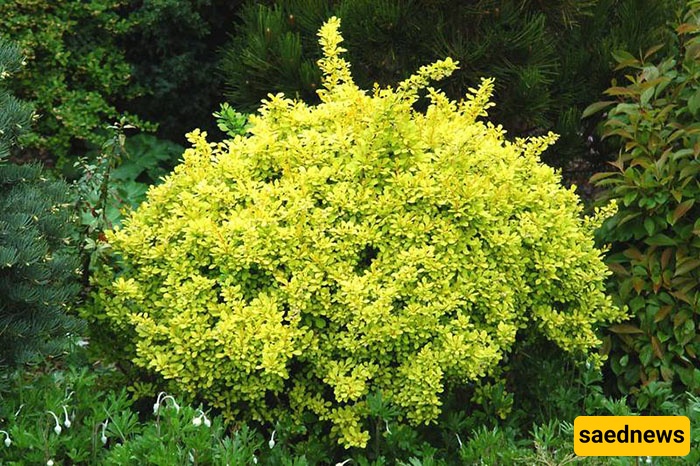
Mahonia is an evergreen shrub with glossy, spiny-edged leaves resembling holly or ornamental shrubs. Its stems are upright and reed-like.
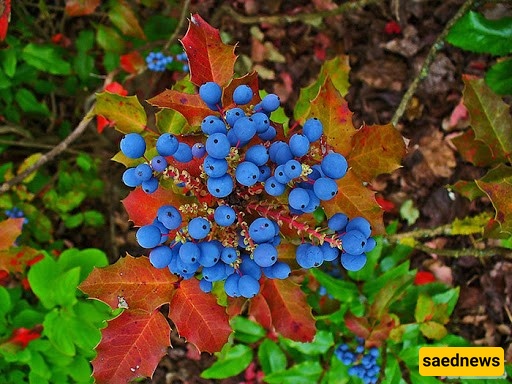
Most Mahonia species produce bright yellow flowers mainly in winter and spring. In autumn through early winter, they develop small grape-like clusters of red or blue berries, which add ornamental value to the plant. The blue-fruited varieties are especially well known due to their unusual color.
The shrubs typically grow between 1 to 3 meters in height and are suitable for hedges, borders, and landscape backgrounds. Mahonia plants are long-lived and reach maturity at around 5 years or older. Flowering and fruiting generally begin after 2 to 3 years.
This ornamental plant is commonly used in gardens and outdoor landscaping. For healthy growth, it should be planted in full sun to partial shade. It is drought-tolerant but prefers moderate watering.
The leaves are dark green, leathery, and spiny. Fragrant yellow flowers appear in clusters at the ends of branches in spring. After flowering, the plant produces small berry-like fruits that are purple in color.
In autumn, the foliage of some varieties turns golden, adding seasonal beauty. Another variety native to China also produces blue berries that are used to make jam and syrup.
Growth is relatively slow. The small, fragrant yellow flowers appear in mid-spring and give the plant a decorative appearance. The flowers are bisexual, and pollination is mainly carried out by wind.
The fruits ripen in mid-summer and are edible, with a sour taste. Their juice has a grape-like flavor and is used in lemonade, jelly, jam, and various beverages.
Mahonia grows best in cool and humid environments. It does not perform well in tropical or very hot climates.
It prefers partial shade and filtered sunlight. Morning sun is beneficial, but strong afternoon sunlight should be avoided.
Mahonia thrives in sandy, loamy, and moist soils with good drainage. Organic matter is essential for healthy growth. In summer, mulching is recommended to keep the roots cool.
Propagation is possible through mature seeds. Semi-hardwood or hardwood cuttings can also be used in autumn and early winter.
During warm months, deep and regular watering is required. If planted near large trees, care should be taken to ensure its roots do not dry out due to competition.
Seeds should be soaked in water for about 24 hours, changing the water twice during this period to prevent spoilage.
Suitable planting mixtures include:
60% coco peat + 40% peat moss
70% coco peat + 30% animal manure
30% garden soil + 30% sand + 20% leaf matter + 20% manure or vermicompost
After soaking, seeds are planted about 1 cm deep in suitable soil, watered well, and kept in a semi-shaded outdoor location. Mahonia is an outdoor plant and is not suitable for indoor cultivation.
For large-scale propagation, a prepared nursery bed should be used. The soil must be well-tilled. Seeds are sown evenly and lightly covered with sieved manure, then irrigated regularly to maintain moisture.
Germination usually occurs within 15 to 30 days, and in some cases up to 2 months. Once seedlings emerge, they grow gradually. In autumn, after leaf fall, seedlings can be transplanted into pots.
Spacing of 10 to 15 cm in nursery beds produces stronger seedlings. The nursery should be slightly elevated (about 20 cm) to prevent water accumulation during rainfall.
Mahonia can act as an alternate host for wheat rust disease. However, species such as M. aquifolium and M. bealei show partial resistance. Susceptible species should not be grown in regions where wheat cultivation is common.