SAEDNEWS: A country whose prime minister calls Trump a noble man, while joining a military pact seen as serving U.S. and Israeli interests against Iran and Muslim nations, can it truly be considered a suitable mediator between Iran and the United States?
According to SaedNews’ political service, Hossein Shariatmadari wrote in a commentary titled “The End of the Line!”:
Consider the following statement:
“My eyes tell me that if this man had not been there, something terrible could have happened. India and Pakistan are two nuclear powers. If you [referring to the same man] and your excellent team had not intervened, within four days the war could have reached a point where nobody would have been left alive to say what had happened. Mr. President, your valuable role should be written in golden letters in history. I will say nothing more except that may God bless you and grant you a long life so that you may always serve humanity.”
These were the words of Pakistan’s Prime Minister Shehbaz Sharif, spoken during a meeting with U.S. President Donald Trump, whom the author describes in strongly condemnatory terms.
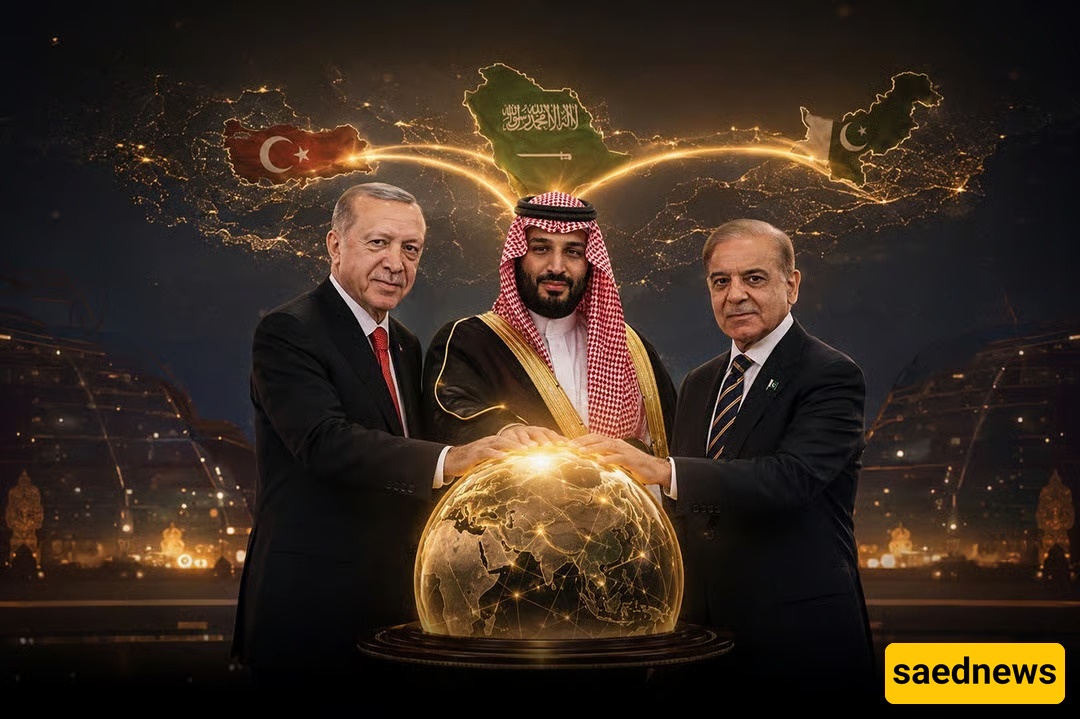
Yesterday, Pakistani Prime Minister Shehbaz Sharif and Turkish President Recep Tayyip Erdoğan traveled to Mecca, where they joined Saudi Crown Prince Mohammed bin Salman in signing a trilateral military agreement.
The author argues that the leaders of these three predominantly Muslim countries had remained silent in the face of the large-scale killing of civilians in Gaza. He further claims that there is evidence suggesting covert links between these countries and Israel during the conflict.
Under what has been described as the “Mecca Military Pact,” an armed attack against any one of the three countries will be treated as an attack against all three.
The article also points to a separate agreement signed the previous week in Riyadh by representatives of more than 40 countries. The stated purpose of that agreement is to “protect the security of the Red Sea and Bab el-Mandeb.” The author interprets this as an effort directed against Yemen’s Houthi movement, or Ansarullah, and ultimately against Iran and the broader resistance front.
Pakistan is reportedly among the signatories of that agreement.
The article further states that Ansarullah responded to the coalition by declaring that it would regard Saudi Arabia and the other participating countries alike and would target their vessels.
The article then turns to Pakistan’s role in negotiations following the U.S. and Israeli attacks on Iran, noting that Islamabad has acted as a mediator and may potentially take on that role again.
Shariatmadari questions the credibility of Pakistan as a neutral intermediary, arguing that its prime minister has publicly portrayed Trump as a worthy and honorable figure whose actions deserve to be recorded positively in history.
At the same time, the author points to Pakistan’s participation in the Mecca military agreement, which he portrays as being aligned with U.S. and Israeli interests and therefore, in his interpretation, opposed to Iran and other Muslim nations.
He also criticizes Pakistan for officially supporting efforts presented as protecting the security of the Red Sea and Bab el-Mandeb, arguing that such measures ultimately amount to opposition to Ansarullah and, indirectly, to Iran.
The central question he raises is whether a country with such policies and alignments can genuinely serve as a mediator.
His conclusion is that it cannot, while adding that Iranian officials are fortunately aware of this issue.
The author argues that the coalition of more than 40 countries assembled against Ansarullah, as well as the Mecca military pact, is unlikely to achieve its intended objectives.
He asks what these countries could realistically do that the United States and Israel have not already attempted.
At the same time, he points to reports suggesting that significant sections of the armed forces in Pakistan and Turkey, along with elements in several other Muslim countries, sympathize with Iran and the wider resistance front. According to the article, these sentiments have expanded considerably following the 12-day war and the Ramadan war.
The author concludes by invoking the views of the late Iranian revolutionary leader, saying that the existing global order has undergone major changes and that the divisions separating nations are gradually disappearing.
He argues that closer ties among peoples are becoming increasingly visible and that the idea of different ethnic groups evolving into nations, and nations ultimately coming together as a broader “Ummah,” is becoming increasingly apparent.