SAEDNEWS: The spokesperson for Iran's Ministry of Foreign Affairs announced that the Islamabad Memorandum was digitally signed by Trump and Pezeshkian. He added, "Our missiles do not like anyone talking about them at all. Our missiles are solely meant to be launched, not negotiated over."
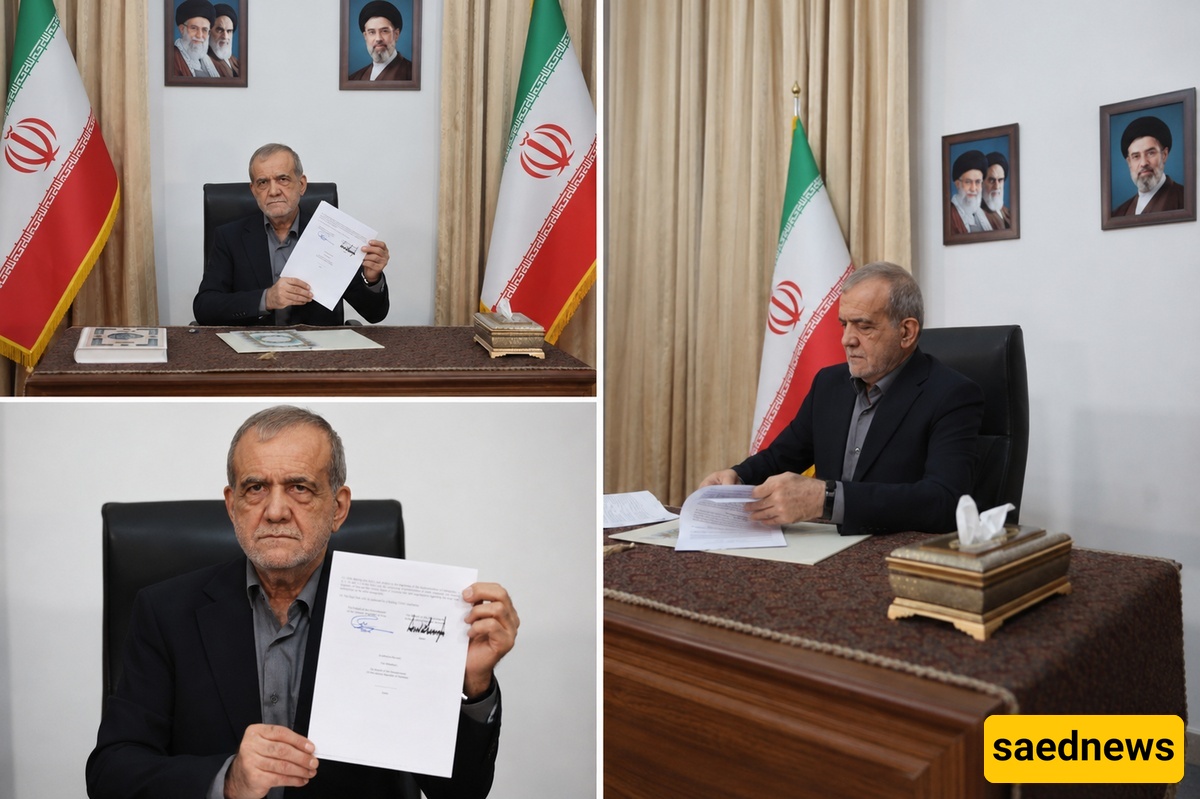
According to Saed News Political Desk, Iranian Foreign Ministry spokesperson Esmaeil Baghaei stated early Thursday morning (June 18) in a televised interview that the Islamabad Memorandum of Understanding had been signed by U.S. President Donald Trump and Iranian President Masoud Pezeshkian.
He said that, as they were speaking, the text had officially reached the stage of being signed by the presidents of both countries. The signing had been scheduled to take place in the early hours of June 18.
Baghaei explained that there had originally been a plan to hold a meeting in Switzerland where the document would be formally signed by both sides. However, after further review during the previous 24 hours, it was concluded that a better option would be for the presidents of the two countries to sign the text virtually.
The Foreign Ministry spokesperson added that there were several reasons for this decision, one of which was that when a document is signed by the highest authorities of both countries, violating it becomes more costly. Given past experiences, Iran preferred this approach. He also noted that a formal signing ceremony was not particularly necessary.
Regarding the meeting scheduled for Friday in Switzerland, Baghaei stated that it was intended to mark the next phase of negotiations and remained on the agenda. He said it would depend on what conclusions the parties reached through mediators in the coming hours.
Discussing the process that led to the Islamabad Memorandum, Baghaei said that Iran had come a long way and that the guidelines issued by the Supreme National Security Council immediately after the April 8 ceasefire had served as the basis for action. He emphasized that the number of clauses was not important; what mattered was that all issues vital to Iran’s interests and national security were included in the text. Some subjects required multiple clauses, making the distinction between ten or fourteen clauses insignificant.
He stressed that all matters deemed important by Iran and included in the negotiating delegation’s instructions had been incorporated into the fourteen-clause document.
Baghaei further stated that the text could now officially be considered finalized because both parties had signed it.
The senior Iranian diplomat noted that both sides had agreed not to publish the document before it was finalized. Nevertheless, he said Iran had repeatedly explained its general content and had not concealed any major issues from the public.
Addressing the provisions concerning Lebanon, Baghaei said that Iran had always stood by its friends and never abandoned them. He stressed that a ceasefire in Lebanon was as important to Iran as a ceasefire in Iran itself and that ending the war in Lebanon remained a priority.
He noted that Lebanon was mentioned three times in the first clause of the memorandum, emphasizing the end of the war in Lebanon as well as respect for Lebanon’s territorial integrity and sovereignty. He added that the final sentence of the clause indicated that the issue would again be highlighted in the final agreement to be drafted within sixty days.
When asked whether the memorandum guaranteed that no further military operations would occur, Baghaei replied, “No.”
He explained that signing a war-ending agreement did not mean forgetting the past or ignoring the lessons learned at a heavy cost. He said previous experiences must remain in view and that implementing international agreements is often much harder than drafting them, especially when dealing with parties that have demonstrated a lack of commitment to their obligations.
Baghaei stated that Iran’s diplomatic apparatus, supported by the people, defenders of the nation, and faith in God, had succeeded in achieving a text that served the country’s interests. He emphasized that from now on, all parties must ensure implementation in a way that compels the other side to honor its commitments.
He said the real work was only beginning. In addition to monitoring implementation of the memorandum, Iran would spend the next sixty days working on details related to implementation and discussing sanctions relief and nuclear issues, which were the only two subjects specifically designated for negotiations.
Baghaei stated that Iran had always relied on itself to protect its territorial integrity and national sovereignty. He said the reference in the text to U.S. respect for Iran’s sovereignty was a standard diplomatic expression common among nations.
On the nuclear issue, he explained that Iran had insisted from the outset that it would not discuss nuclear matters at this stage. He described this as a wise decision following previous negotiations that had twice collapsed and resulted in attacks against Iran. However, after signing the memorandum, discussions on nuclear matters and sanctions relief would take place for sixty days.
He stressed that lifting sanctions as soon as possible would benefit Iran and noted that the timeframe could be extended if necessary.
Regarding the lifting of what he described as a maritime blockade, Baghaei said that under the memorandum the United States had been expected to remove measures against Iran’s maritime trade within thirty days, while Iran would take corresponding steps regarding traffic through the Strait of Hormuz.
He explained that following developments related to an Israeli attack on Beirut’s southern suburbs and Iran’s plans for retaliation, urgent negotiations had taken place, leading the United States to immediately fulfill its commitment to remove maritime restrictions.
Baghaei said Iran would not rely solely on promises and had monitored developments closely. According to him, Iranian ships had entered and departed ports without problems in recent days. He said the U.S. commitment had already begun and that Iran’s corresponding obligations regarding the Strait of Hormuz would commence immediately after the signing of the memorandum.
Asked whether shipping traffic through the Strait of Hormuz would resume under Iranian arrangements beginning June 18, Baghaei answered affirmatively. He said the goal was to restore maritime traffic to levels that existed before March 1 within thirty days, allowing time for logistical and technical preparations.
Turning to the issue of foreign military forces in the region, Baghaei said that the withdrawal of such forces was a strategic objective for Iran. He argued that foreign military presence had brought insecurity, conflict, and division rather than stability.
He stated that regional countries had observed how U.S. military bases made them vulnerable to Iranian defensive actions. Expressing dissatisfaction with events that had unfolded since March 1, he said Iran had repeatedly warned neighboring countries not to allow the United States or Israel to use their territory and facilities against Iran. Nevertheless, when such actions occurred, Iran exercised what it regarded as its legitimate right of self-defense by targeting facilities used in attacks against it.
Baghaei added that despite these developments, Iran remained committed to good-neighborly relations and considered regional countries its friends. He expressed hope that regional governments would learn from recent events and work toward a collective security mechanism based on mutual trust.
According to Baghaei, the withdrawal of U.S. military forces from the surrounding region would be expected thirty days after a final agreement and would require separate negotiations.
Responding to comments attributed to President Trump about discussing Iran’s ballistic missiles, Baghaei stated that Iran’s missiles were not a subject for negotiation. He declared that Iran’s defensive capabilities would not be discussed with any party under any circumstances, particularly after recent events had demonstrated the importance of indigenous missile capabilities for protecting the country.
On the Strait of Hormuz, Baghaei said the memorandum reflected Iran’s responsible approach to international shipping and freedom of navigation. He noted that Iran and Oman are the two coastal states bordering the strait and that its waters form part of their territorial seas. He said both countries had safeguarded the strait for decades.
According to Baghaei, events that began in early March—including the use of regional territory against Iran and the exploitation of the Strait of Hormuz to threaten Iran’s national security—prompted Tehran to adopt measures permitted under international law.
He said Iran wished to prevent a recurrence of recent tensions and intended, together with Oman, to establish arrangements ensuring safe passage for ships through the strait. Consultations with other regional countries would also continue to guarantee maritime security.
Baghaei noted that providing such services would naturally involve costs and that users of those services would be expected to pay corresponding fees.
He explained that discussions with Oman on these mechanisms were already advanced, while talks with other countries would continue. He expressed confidence that safe navigation could be achieved while preserving Iran’s sovereignty as a coastal state.
Addressing questions about why the immediate lifting of maritime restrictions was not explicitly mentioned in the text, Baghaei said the action had simply occurred earlier than scheduled. He explained that after the text was finalized on June 15, the U.S. president announced that the measures would be lifted immediately, and Iran subsequently observed that implementation had begun.
Baghaei also emphasized the importance of reconstructing damage caused by the war. He described the conflict as an illegal war imposed on Iran by the United States and Israel and said numerous crimes had been committed during the forty-day conflict.
He argued that while some of the damage could never be quantified, Iran would continue to seek accountability. He added that not all of Iran’s demands could be addressed within the memorandum itself and that issues such as justice and accountability would continue to be pursued through international mechanisms.
Regarding reconstruction, Baghaei said the memorandum included provisions addressing material damages and that implementation mechanisms would be finalized within sixty days. Extensive discussions had already taken place regarding financing arrangements.
When asked whether reconstruction would be financed directly by the United States or through regional partners, Baghaei responded that the source was less important than ensuring the commitment was fulfilled. He noted that the United States had committed itself in the text to facilitating the process and removing obstacles.
He pointed out that U.S. sanctions had hindered investment in Iran and said the memorandum required Washington to issue all necessary approvals and licenses to facilitate reconstruction and economic development.
On sanctions relief, Baghaei said the document specified that all unilateral U.S. sanctions—both primary and secondary—as well as all United Nations Security Council sanctions and relevant resolutions, should be removed.
He explained that details concerning how the United States would fulfill these obligations were to be negotiated within the sixty-day period and that all sanctions imposed on Iran, regardless of their stated justification, should ultimately be addressed.
Asked what would happen if the United States implemented some provisions but not others, Baghaei replied that commitments were reciprocal and that Iran would not fulfill its obligations if the other side failed to do the same.
Regarding nuclear issues, Baghaei stated that specific matters such as uranium enrichment levels and Iran’s stockpile of enriched material had not been discussed in detail.
He said that over the past eighteen months, Iran had repeatedly heard demands from the other side regarding the transfer of enriched uranium abroad, including to the United States. Iran had consistently rejected those proposals.
According to Baghaei, one option discussed involved diluting enriched material within Iran. He emphasized that this was not a new idea and had been raised since the beginning of nuclear negotiations. The proposal was intended to block options that Iran considered entirely unacceptable.
He reiterated that transferring enriched material outside Iran remained unacceptable and stressed that Iran must retain a nuclear program consistent with its needs.
Baghaei also noted that the memorandum had been signed in both Persian and English, describing this as evidence of transparency.
Regarding oil exports, he said that U.S. sanctions on Iranian oil sales had imposed significant costs on Iran. Under the memorandum, the United States had committed not only to removing restrictions on paper but also to ensuring that Iran could sell oil freely, insure tankers, conduct transportation without obstacles, and receive revenue from sales without difficulty.
He stated that implementation of these commitments began immediately and should continue throughout negotiations until a final agreement was reached, at which point all sanctions would be lifted.
Finally, discussing Iran’s frozen assets abroad, Baghaei said Iran must be able to access and use those funds whenever it chooses. He explained that detailed mechanisms had already been discussed over the previous weeks and that the United States had committed itself to removing all barriers.
Recalling previous experiences in which the United States failed to honor commitments regarding Iranian assets, Baghaei said those lessons had been carefully considered during negotiations to ensure stronger guarantees this time.