SAEDNEWS: Missile and Drone Strikes Target U.S. Bases in Kuwait and Bahrain Following American Attack on Sirik and Qeshm; Airspace on High Alert Amid Explosions and Sirens
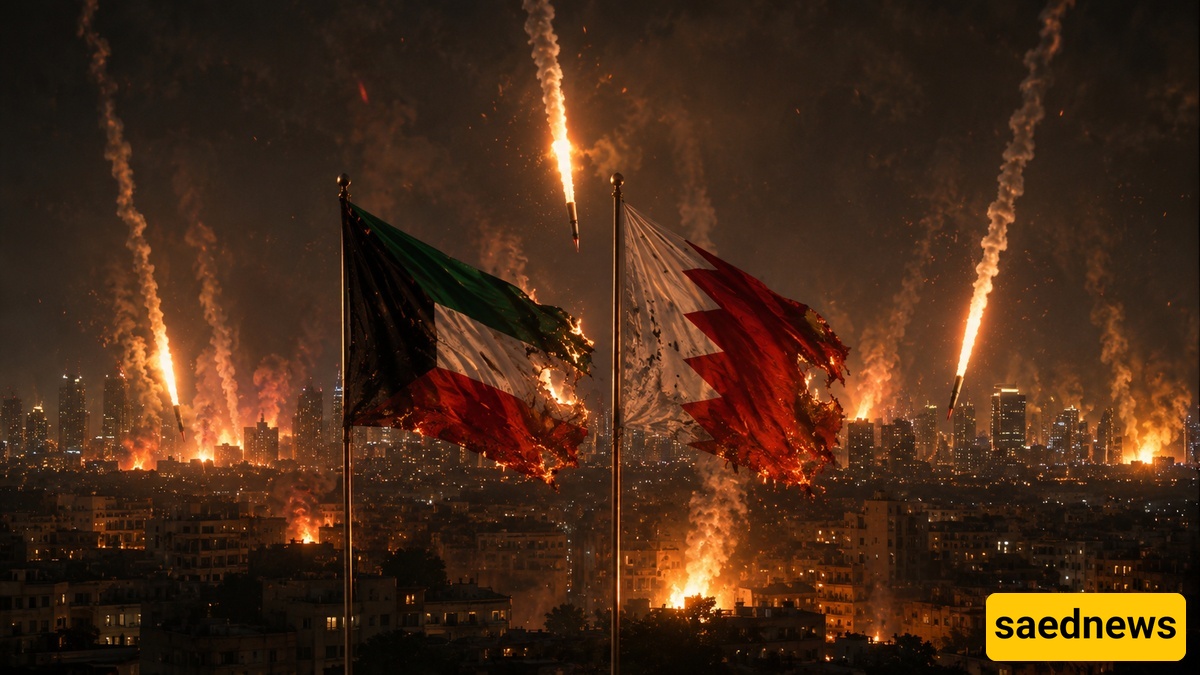
According to the political news service of the Saed News website, the incident began with the sound of sirens in Kuwait and Bahrain. Al Jazeera network and Fars News Agency quickly reported the activation of air defense systems, and at the same time, news sources announced that aircraft intended to land in Kuwait changed their routes toward other areas. The Naya news website also reported that two powerful explosions were heard in Kuwait as a result of rockets and drones striking. However, the Kuwaiti army stated that these sounds were caused by the operation of the country’s air defense systems to intercept projectiles in the sky.
Moments later, a second wave of attacks began, and air raid sirens were again sounded in Kuwait. Following these events, the Public Relations Office of the Islamic Revolutionary Guard Corps (IRGC) issued a statement, published by the Islamic Republic of Iran Broadcasting (IRIB) News Agency, explaining the reason for the attacks. According to the statement, these strikes were carried out in response to attacks by the U.S. military on the Sirik area and Qeshm Island, and during the operation, missiles from the Aerospace Force targeted U.S. military bases in Gulf countries.
Based on an exclusive analysis by the Saed News website, last night’s events indicate that the dynamics of the regional conflict have taken on a new form. When the United States decided to attack points inside Iranian territory such as Qeshm and Sirik, responding to this action became an absolute necessity for Iran. However, the important point is the selection of targets for this response; striking U.S. bases in Kuwait and Bahrain sends a clear message: any location hosting U.S. forces and from which a threat to Iran may originate will not be out of reach. This means that countries hosting U.S. bases are now more aware than ever of the costs of such hosting.
The diversion of commercial flights and the repeated activation of air raid sirens in neighboring capitals also reveal another reality: the economic security of these countries is strongly tied to stability in the Persian Gulf. These events clearly show that the expansion of conflict is not limited to military bases alone, but also disrupts daily life, flights, and regional trade. The United States now faces a major challenge, as its Arab allies in the region do not want the conflict to spread into their cities, and this issue may become a lever of pressure on the U.S. to accept Iran’s demands in nuclear negotiations.