SAEDNEWS: 30 vs 34 Cubic-Foot Refrigerators: Real Differences in Capacity, Dimensions, Energy Consumption, and Price for an Informed Decision

According to Saednews, If you have a family of 3 to 4 people, a 30-cubic-foot refrigerator is an economical and sufficient choice; however, for larger families or those who buy in bulk, a 34-cubic-foot model is a better option. Choosing the right capacity is one of the first challenges for refrigerator buyers.
When discussing the difference between 30 and 34 cubic feet refrigerators, the first and most important factor is the storage capacity of the fridge and freezer. However, the difference is not limited only to numbers and also affects aspects such as dimensions, energy consumption, and price. We will examine each of these separately to give you a clear picture of the differences.
For most people, the unit “cubic feet” may seem a bit confusing. To better understand this concept and the difference between 30 and 34 cubic feet refrigerators, imagine a standard shopping bag found in all stores; its volume is approximately equal to one cubic foot. Therefore, 4 cubic feet means space for four extra bags of groceries inside the refrigerator.
This extra space is practically reflected in the following ways:
More space for bulky items: In a 34-cubic-foot refrigerator, you can easily place large pots, bulky salad containers, or several bottles upright without needing to rearrange other food items. This is especially useful for families who regularly cook in large quantities.
Better organization: More space allows you to arrange food items with better spacing and order. This not only makes it easier to find items, but also improves cold air circulation, helping food stay fresher and preventing overcrowding.
Flexibility for occasions: If you host parties or do seasonal bulk shopping (such as storing summer fruits and vegetables), those extra 4 cubic feet become a decisive advantage and help you avoid constant lack-of-space issues.
The comparison between 30 and 34 cubic feet refrigerators shows that while 30 cubic feet is sufficient for most families, the 34 cubic feet refrigerator provides more convenience and flexibility.
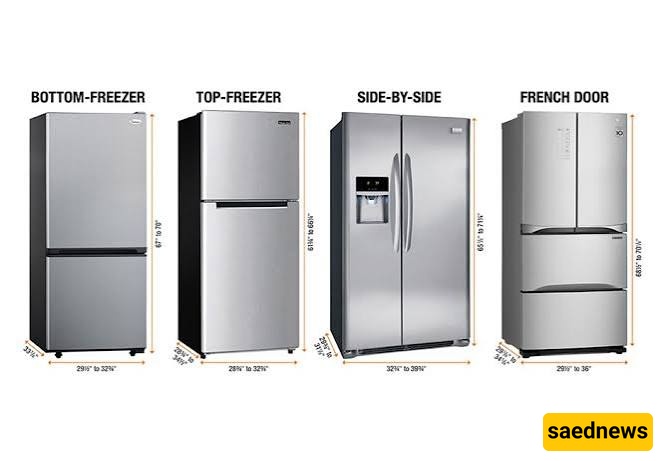
Increasing internal capacity directly affects the physical dimensions of the refrigerator. This is a critical point to consider before purchasing any type of refrigerator, such as a side-by-side model. A larger refrigerator, even if only slightly wider or deeper, may not fit in your kitchen space.
Feeling confused and stressed while looking at a cluttered refrigerator—will a 34-cubic-foot fridge even fit in your kitchen?
When measuring the installation space:
Measure width, depth, and height of the available space precisely.
Leave 2 to 5 cm of clearance on each side for ventilation.
Check the delivery path to ensure the refrigerator can pass through doors and hallways.
Feature | 30 cu ft (approx.) | 34 cu ft (approx.) | Difference |
|---|---|---|---|
Width | 80–90 cm | 90–95 cm | Up to 5 cm wider |
Depth | 85–90 cm | 90–95 cm | Up to 5 cm deeper |
Height | 175–180 cm | 180–185 cm | Up to 5 cm taller |
The above values are general estimates and may vary depending on brand and model.
A common belief is that larger refrigerators always consume more electricity. However, this is not necessarily true. While a 34-cubic-foot model may consume slightly more energy than a 30-cubic-foot model under identical conditions (brand, technology, and production year), other factors are more important:
Energy rating: The most important factor is the energy label. A modern 34-cubic-foot refrigerator with an A++ rating may consume less electricity than an older 30-cubic-foot model with a B rating.
Motor technology: Inverter linear compressors significantly reduce energy consumption.
Insulation quality: Good body insulation reduces cold air loss and decreases compressor workload.
Generally, as expected, 34-cubic-foot refrigerators are more expensive due to their larger capacity and size. The price difference varies depending on brand, features, and technology.
Model level | Approx. price difference (34 vs 30 cu ft) |
|---|---|
Basic models | 10–20% more expensive |
Mid-range models (water dispenser & ice maker) | 15–25% more expensive |
Smart & full-feature models | 20–30% (or more) higher |
Sometimes the price difference between two sizes of the same model is less than the difference between two brands. Therefore, set your budget first and then choose the best option within that range in terms of capacity and features. Bigger is not always better; a smart choice is one that fits your needs and budget.
After comparing and fully understanding the differences, the question remains: which is better for you, a 30 or 34 cubic feet refrigerator? There is no single answer, as the best choice depends entirely on your lifestyle, family size, and kitchen space. The best refrigerator is not necessarily the largest or most expensive, but the one that matches your needs.