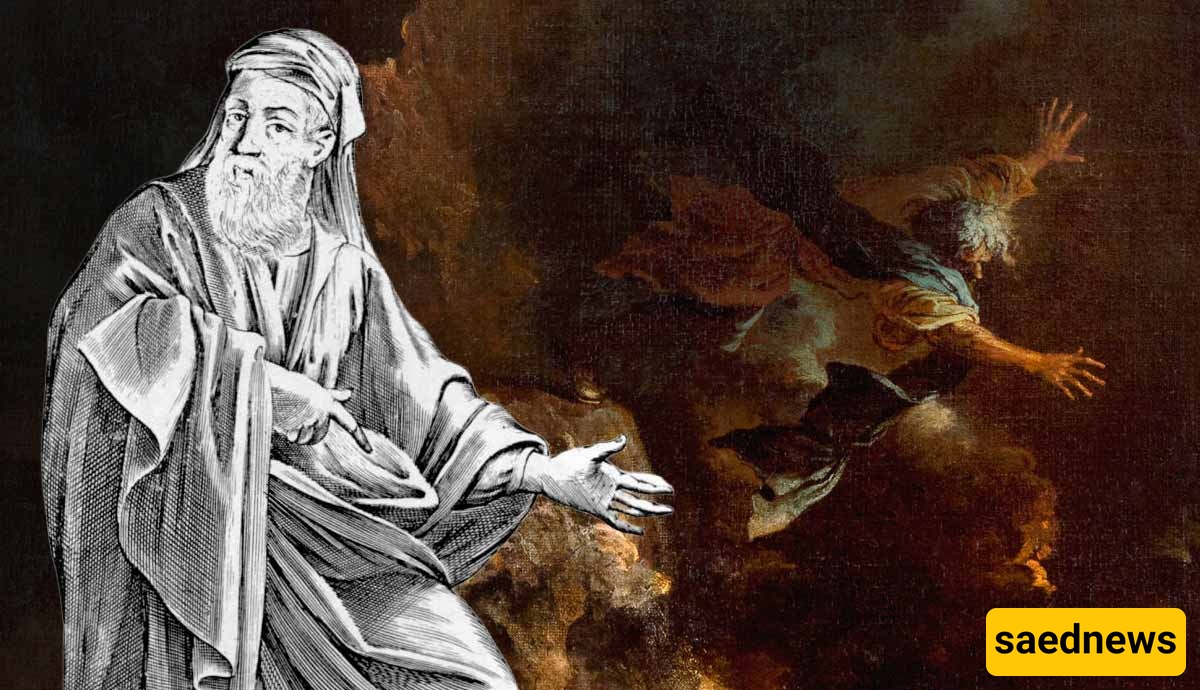
Saed News: Empedocles, who stands at the intersection of ancient Greek cosmology and early biology, is best known for proposing the idea that the entire universe is composed of four “roots.” It is said that Empedocles deliberately threw himself into Mount Etna to prove his divinity, leaving behind only a bronze sandal.
According to SAEDNEWS, if we return to the origins of Western philosophy, it is easy to see that the pre-Socratic philosophers were fascinated by the world as a whole. Some writers even argue that philosophy itself emerged from this fascination, as they were all trying to understand the meaning of the universe and its fundamental cause.
Philosophers such as Thales of Miletus, his followers Anaximenes and Anaximander, Heraclitus, Pythagoras, Leucippus, and Democritus all proposed different theories about the nature and origin of the universe. However, Empedocles, a polymath from Sicily, combined the roles of scientist, prophet, physician, and philosopher. This made him unique among the pre-Socratics.
Empedocles (c. 495–435 BCE) was from Akragas (modern-day Agrigento in Sicily). Unlike other philosophers, he had a very outgoing personality. He was a man constantly traveling and engaging in conversations with those interested in philosophy. He was an exceptionally skilled orator, to the extent that legends say his audiences were completely mesmerized during his speeches, especially when he was teaching. For this reason, he can even be considered a founder of rhetoric, although Aristotle later systematized it.
He was born into a wealthy, aristocratic, and cultured family, and therefore lived an aristocratic lifestyle typical of his time. Because of this status, he also played a role in local politics, participated in public affairs, and was recognized as a leader by the people. Many myths and accounts exist about his life, but the most fascinating part is his legendary death.
At the end of his life, it is said that Empedocles threw himself into the active volcano of Mount Etna to prove his divinity. According to the story, the volcano swallowed him completely, but only a bronze sandal remained, later thrown out by lava, revealing his mortality. Although this story is more mythical than historical, it reflects the aura of the supernatural that surrounded him.
According to Empedocles, everything in the material world is composed of four roots: earth, air, fire, and water. Unlike philosophers before and after him, he does not call these “elements,” but rather fundamental substances with an inherent capacity to generate all things in the cosmos. These four roots are eternal and unchanging, while the objects formed from them are transient and mutable.
It can be seen that this view directly contrasts with some earlier philosophical traditions. Historians of philosophy such as Jonathan Barnes note that Empedocles’ philosophy stands in opposition to Heraclitus and Parmenides. Barnes explains that this view contrasts with Heraclitus’ idea of “panta rhei” (everything flows), according to which the only constant in the world is change itself. In contrast, Parmenides believed that plurality and change are illusions and that only “unity” is real. Empedocles positions himself between these two views and presents a different system.
Now that we are familiar with his metaphysical concepts, we must see how they operate within his cosmic system. Empedocles calls earth, air, fire, and water “roots.” Alongside these four roots, there are two powerful forces: Love (Philia) and Strife (Neikos). These two forces are the engines of cosmic transformation, guiding the combination and separation of the roots and producing the transient phenomena of the world.
Love causes things to attract each other, unite, and eventually become one. Strife, on the other hand, causes things to separate, repel each other, and ultimately disintegrate or even be destroyed. However, Empedocles does not consider either force superior to the other. Love does not represent good, nor Strife evil; both are necessary for the creation of the universe.
When one of these forces reaches its extreme, life becomes unbearable and ceases to exist. Love tends to bring everything together, but in its extreme form it creates such unity that no distinctions remain, making interaction impossible. Conversely, when Love is weakened under the dominance of Strife, this compressed state expands, things separate, and matter takes form while distinct beings emerge.
But when Strife reaches its peak and completely suppresses Love, everything becomes fully separated, collapses, and dies. Everything remains dead until Love reactivates, restoring forces of attraction and recreating the conditions for life. Love acts like a magnet, drawing all elements together, reducing distance, and enabling the rebirth of life.
After examining his metaphysics and cosmology, we turn to his theory of knowledge. At the core of Empedocles’ epistemology is an attempt to explain the physiological mechanism of perception and cognition. These processes are based on the principle that we understand the roots of the cosmos through corresponding roots within ourselves.
According to his view, perception arises through effluences from external objects that enter the pores of the human sensory system. These pores vary in size and shape and only accept flows that are compatible with them.
For example, we perceive bright colors through pores compatible with fiery streams, and dark colors through pores compatible with watery streams. Similarly, smell operates through pores related to respiration in the nose, and hearing through pores in the ears.
Ultimately, his theory is based on the fundamental law of “like by like,” meaning perception is only possible through interaction between similar things. Empedocles applies this principle to knowledge and even ethics. We perceive love, the roots, and divinity through their corresponding similarities within us. This harmony allows sensory input to shape thought and feeling, ultimately enabling the divine within humans to perceive the divine outside.
The divine element within the human soul acts as a bridge between humans and the “Sphairos,” a god-like state in which everything exists in perfect unity under the dominance of Love.
Some thinkers, especially Aristotle and his student Theophrastus, disagreed with Empedocles, particularly in epistemology. The main conflict between him and the Peripatetic school lies in the conflation of mental faculties. In On the Soul, Aristotle argues that Empedocles’ system is overly simplistic because it fails to distinguish between “noesis” (rational thought) and “aisthesis” (sensory perception).
For Aristotle, thinking is an independent faculty of the soul that grasps universals, while perception relates to particulars. Empedocles, however, reduces both to a physical interaction of “like with like,” thereby eliminating the special status of reason. Theophrastus, in On the Senses, also examines this view and highlights logical inconsistencies in the concept of pores and effluences. He questions how a physical pore could account for the complexity of mental thought—a question later linked to some issues in modern philosophy of mind.