Saed News: Katherine Johnson, a prominent American scientist and mathematician, overcame severe racial and gender limitations in the 1950s and succeeded in becoming one of the key figures of NASA in orbital calculations for space missions, paving the way for future generations of women in the field of basic sciences.
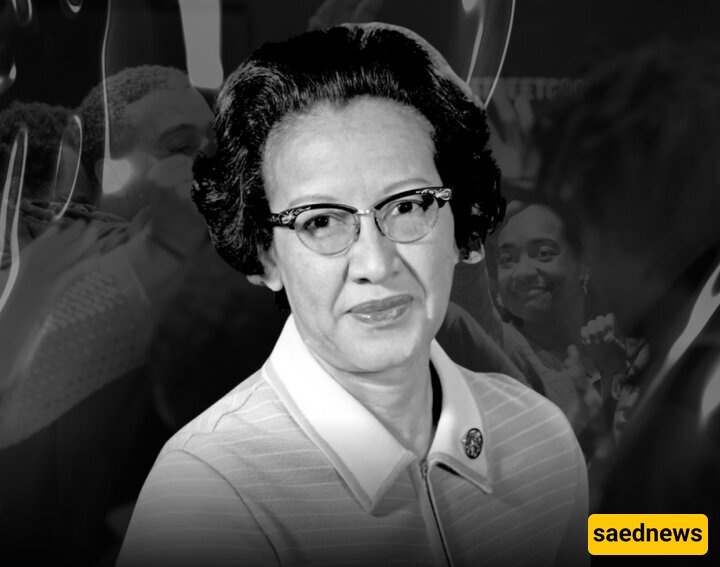
According to SAEDNEWS, a review of the history of scientific geniuses shows that some of humanity’s greatest achievements were born within the harshest social limitations. Katherine Johnson is one of these exceptional figures. She, who showed remarkable talent in mathematics from childhood, grew up during a time when racial segregation laws in the United States severely limited educational and career opportunities for African-American citizens. Nevertheless, she managed to become one of the first Black students to enter graduate studies and opened her professional path toward the world’s largest space organization.
In 1953, Katherine Johnson joined the Langley Aeronautical Laboratory (NACA, which later became NASA). At that time, modern electronic computers did not yet exist, and a group of women mathematicians processed raw flight data and converted it into engineering parameters using mechanical calculators; these women were called “computers” at that time.
Due to the racist laws of that era, Johnson began her work in the West Computing Section, which was designated for Black employees and segregated from other departments. However, her exceptional accuracy in calculations and strong scientific ability went beyond the walls of discrimination. She gradually moved from performing simple mathematical tasks on the ground to designing advanced spacecraft trajectories and performing flight control calculations for NASA’s crewed missions.
Katherine Johnson built an outstanding career and became a symbol of women’s success in STEM (science, technology, engineering, and mathematics). Her contributions were widely recognized and honored in her later years and beyond.
Barack Obama, then President of the United States, awarded her the Presidential Medal of Freedom, the nation’s highest civilian honor. In 2016, NASA named its new computational research center at Langley the “Katherine G. Johnson Computational Research Facility” in recognition of her contributions. Her name was included in the BBC list of the 100 most influential women in the world, and she was awarded several honorary doctorates from prestigious universities. Her life story and that of her fellow women of her era serve today as an inspiring model for young people, especially girls around the world who wish to pursue science and technology.
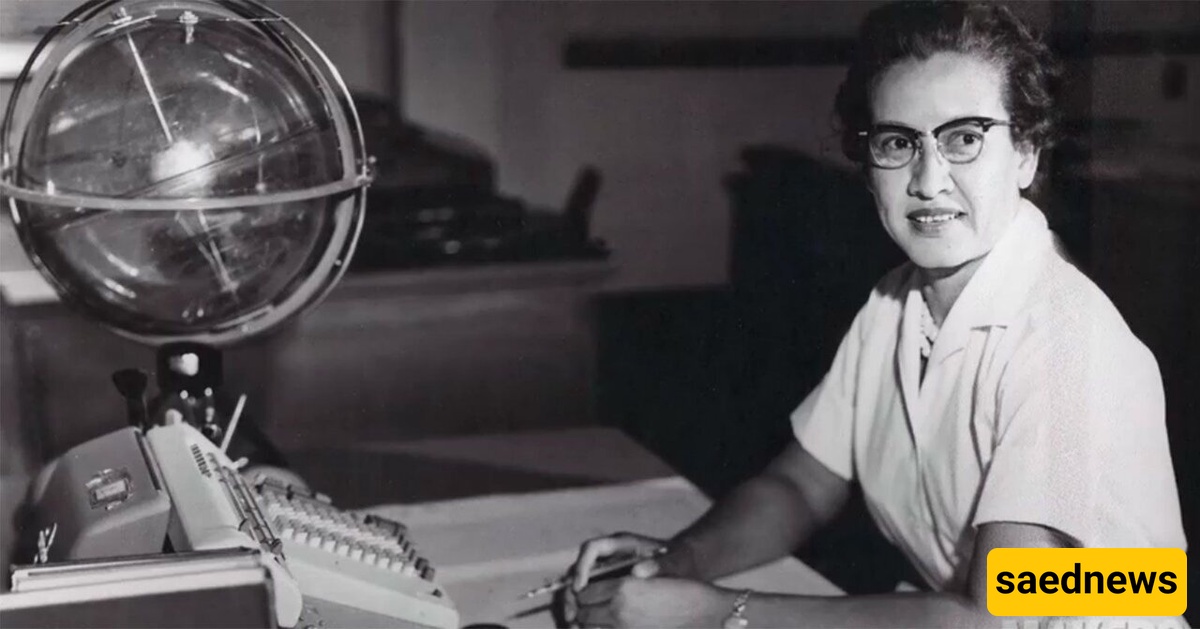
If we summarize her achievements clearly and simply, we reach the following list:
In 1961, when Alan Shepard was to be launched as the first American astronaut into space, Katherine Johnson manually performed all calculations related to the launch trajectory, ascent angle, and the exact landing location of his capsule in the ocean. Even the smallest error in these calculations could have led to the astronaut being lost in space or drowning in the ocean.
When NASA first decided to use new IBM digital computers to calculate the spacecraft’s orbit around Earth, the mission astronaut (John Glenn) did not trust the new machines. He officially stated that he would not fly until Katherine Johnson manually calculated and verified the computer’s output numbers. Johnson checked the numbers and said: “The numbers are correct.” The mission was successfully completed.
Katherine Johnson’s greatest achievement was the precise calculation of the flight path for the Apollo 11 mission in 1969, the mission that first landed humans (Neil Armstrong) on the Moon. She not only calculated the route to the Moon but also formulated the complex process of rendezvous and docking of the lunar module with the command spacecraft in lunar orbit, ensuring astronauts could safely return to Earth.
Her greatest non-scientific achievement was succeeding in a completely racist and male-dominated environment. At a time when Black Americans in the United States did not even have the right to use the same restrooms as white citizens and women were not taken seriously in engineering environments, she relied on her knowledge to enter NASA’s critical decision-making rooms. She was the first woman in her department whose name was recorded as the lead author in a NASA scientific report.