Saed News: In an experiment, volunteers who were given wings through virtual reality for several hours began to think of these wings in a way similar to real body parts.
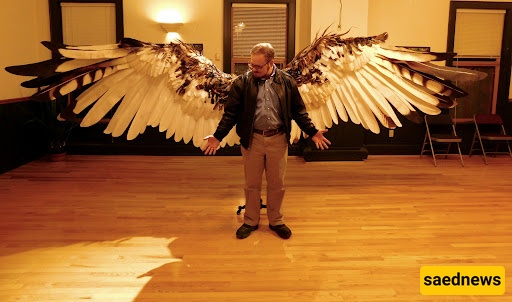
According to SAEDNEWS, scientists gave people wings using virtual reality and, to their surprise, observed that this caused strange changes in their brains.
As a new study shows, immersion in virtual reality (VR) can do unusual things to the human brain.
In one experiment, volunteers who were given wings through virtual reality for several hours began to think of these wings in a way similar to real body parts.
A brain region called the occipito-temporal cortex (OTC) is used for visual processing of body parts, and experts believe this region has been wired over hundreds of thousands of years of evolution to recognize human limbs such as arms and legs.
This new study by researchers from Beijing Normal University and Beijing University in China aimed to investigate how the occipito-temporal cortex responds to seeing large feathered wings as body parts in virtual reality, which are not traditionally attached to humans.
The fact that the brain has changed in its processing patterns is evidence that it has inherent plasticity and is capable of adapting to such changes. This plasticity could potentially be used to learn how to operate new limbs and adapt to new ways of movement.
Researchers say: technological advances increasingly allow humans to go beyond evolutionary limitations, such as moving at unprecedented speeds or even flying through the air. Virtual reality pushes these boundaries further by enabling the visualization of artificial non-human entities that do not exist biologically, such as wings.
Researchers recruited 25 volunteers who, over one week, participated in four 30-minute sessions to try out their virtual wings. They were given training tasks such as flying through rings in the sky.
In the virtual reality world, the wings completely replaced the participants’ arms. Therefore, they could no longer see their arms, only wings in their place. The wings were also designed to simulate realistic aerodynamics.
By analyzing functional MRI (fMRI) scans taken before and after the training period, researchers found that the OTC region had been rewired to show a stronger response to virtual wing images than before.
In addition, the neural pattern of wings became more similar to that used for viewing human arms, especially in the right hemisphere of the brain, which is generally responsible for processing images of body parts other than hands.
The OTC region also formed stronger connections with other brain areas involved in movement planning and coordination, known as fronto-parietal regions.
It is not entirely correct to say that VR wings replaced human arms in the brain; rather, the brain activity patterns when viewing wings became more similar to those used when observing tools or animal tails, but there was clearly a shift in this direction.
Researchers say: it is important to note that we are not saying wings have become part of the body’s conventional representation. We are simply reporting that their neural response profiles have become significantly more similar to those of body parts.
Previous research shows that when we use tools or artificial limbs, the brain maintains a clear boundary between these objects and the rest of the body, and they are still seen as external objects that must be controlled.
However, in this VR wings study, things appear different. These immersive experiences seem to go beyond creating an illusion and extend into reshaping what the brain perceives as reality, even redefining what it means to be human.
Researchers believe these findings could in the future help develop physical therapies, for example for amputees, and improve our understanding of how VR can free us from standard ways of thinking.
Kunlin Wei, a psychologist at Beijing University, says: In the future, we may spend a lot of time in virtual reality. We are very interested in what this means for the human brain.
This study was published in the journal Cell Reports.