SAEDNEWS: Laboratories are beginning to close the loop between AI, robots and scientific experiments, allowing machines to choose, perform and analyze experiments with surprisingly little human intervention.
According to SaedNews, the laboratory of the future may look less like a room full of scientists moving between benches and more like a carefully engineered system that can think, act, measure and try again.
The idea is known as a self-driving laboratory or autonomous laboratory. These systems combine artificial intelligence, robotics, automated instruments and data analysis into a closed experimental loop. Instead of a researcher deciding what to test, waiting for the result and then designing the next experiment, the machine can use the previous result to determine what it should try next.
That does not mean laboratories are suddenly becoming completely independent of people. In most real-world systems, humans still define the scientific objective, establish constraints, provide oversight and ultimately decide whether a finding is trustworthy. The more accurate description is that parts of the scientific process are becoming autonomous.
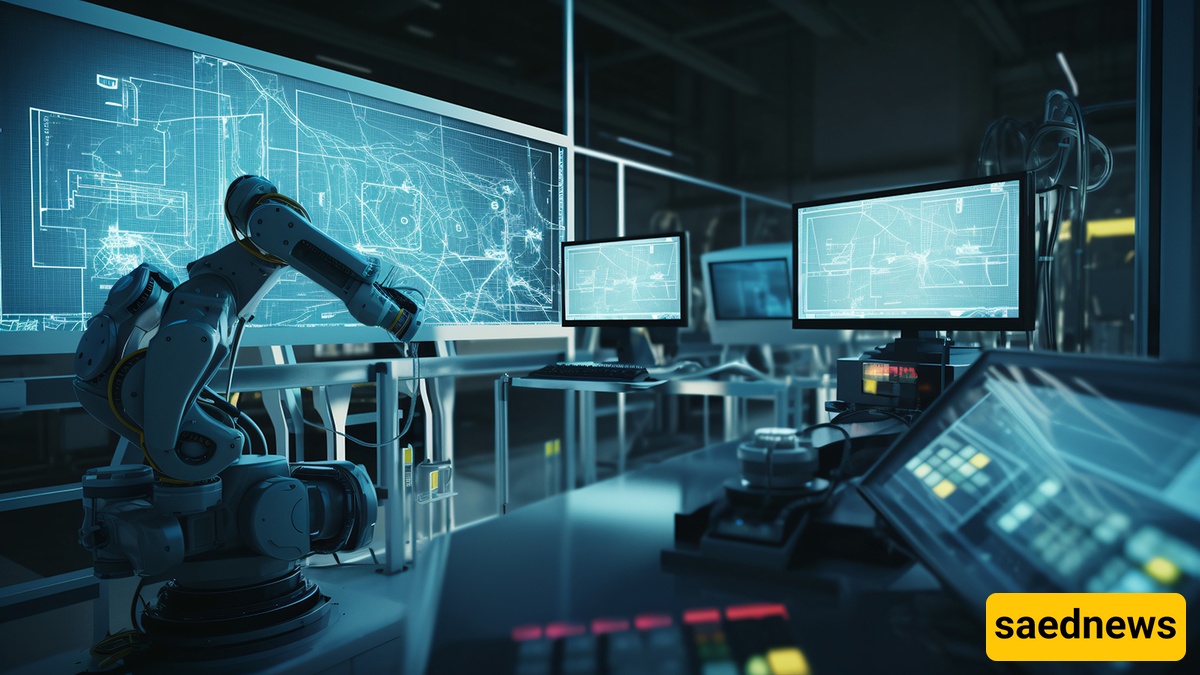
A conventional experiment often follows a familiar pattern: a scientist proposes an idea, prepares an experiment, runs it, studies the result and decides what to do next.
A self-driving laboratory attempts to turn that sequence into a continuous loop.
The AI can select an experiment, robotic equipment can prepare materials and execute the procedure, instruments can measure the outcome, and software can interpret the new data. The result is then fed back into the system, which selects another experiment.
Researchers commonly describe this workflow as Design, Make, Test and Analyze. The important difference is that the final analysis can influence the next experimental design automatically rather than waiting for a person to make every decision.
This matters because scientific discovery often involves enormous numbers of possible combinations.
A chemist might want to find a better catalyst, a more efficient reaction condition or a new material. Testing every possibility manually could consume months or years. An autonomous system can instead concentrate on the experiments that its models predict will provide the most useful information.
The most interesting part of these systems is not the robotic arm.
Robots have been performing repetitive laboratory tasks for years. What makes a laboratory genuinely "self-driving" is the connection between physical automation and computational decision-making.
An AI system can use previous results to determine which experiment is worth running next. Techniques such as Bayesian optimization and active learning allow algorithms to balance two competing goals: exploring unfamiliar parts of an experimental space and exploiting conditions that already appear promising.
That creates something closer to a scientific feedback mechanism than a traditional automated production line.
Instead of:
Human → robot → result
the process becomes:
AI decision → robot experiment → measurement → AI analysis → next experiment
And the cycle can continue.
One of the clearest demonstrations came from the autonomous A-Lab, developed for inorganic materials synthesis.
Researchers described a system that combined computational predictions, historical scientific data, machine learning and robotics to plan and interpret experiments. During a 17-day period of continuous operation, the A-Lab reported realizing 36 compounds from 57 targets.
The significance is not simply the number of compounds.
The system was designed to connect prediction with physical experimentation. Instead of treating computation and laboratory work as separate stages, it used experimental results to inform subsequent decisions.
That is the basic idea behind self-driving science: the machine does not merely execute a recipe; it learns from what happened and changes the next recipe.
There is another important development happening alongside robotic laboratories.
In computational science, AI systems are increasingly capable of automating parts of the research process itself.
A 2026 Nature paper described The AI Scientist, a system designed to automate an end-to-end research pipeline in machine learning. It can generate research ideas, write code, run computational experiments, analyze results, prepare figures and draft manuscripts, with an automated review stage included in the workflow.
This is different from an AI physically mixing chemicals in a laboratory, but the two developments point in the same direction.
One system automates the digital side of research.
The other automates the physical side.
The long-term vision is to connect them.
The newest generation of autonomous laboratory research is also trying to address one of the biggest weaknesses of AI: mistakes.
A 2026 study introducing AutoLabs described a multi-agent architecture designed to translate natural-language instructions into executable protocols for a high-throughput liquid handler, with self-correction built into the system.
That distinction is crucial.
A laboratory cannot simply accept an AI's answer because the answer sounds convincing. The physical world is unforgiving. A misplaced liquid, incorrect temperature, contaminated sample or unsuitable reaction condition can invalidate an experiment.
Self-correction therefore means more than asking a language model to reconsider its wording. The system has to detect failures, interpret experimental feedback and alter what happens next.
The phrase "laboratory without humans" makes for a powerful headline, but it describes the technology more dramatically than current reality.
A recent review in Nature Reviews Chemistry emphasized that self-driving laboratories are evolving toward multipurpose discovery platforms, but that major challenges remain around scalability, generalizability and complete experimental provenance. The authors also stress the need for trustworthy AI, interoperable hardware and comprehensive experimental data.
A separate 2026 perspective from researchers at Argonne National Laboratory highlighted another problem: autonomous experimentation does not automatically work simply because AI and robotics are connected. Data quality, reagent availability, equipment limitations and poorly matched models can all prevent an AI recommendation from producing a useful result.
In other words, the difficult part is not just teaching a robot to move a container.
It is building a system that understands what the experiment means.
This may be where autonomous laboratories become especially interesting.
Scientists are trained to recognize anomalies, but humans can also overlook unusual results because of expectations, limited time or a preference for familiar explanations.
A machine can potentially treat an unexpected result as a reason to investigate rather than as an inconvenience.
The A-Lab work, for example, showed how failed syntheses could generate information useful for improving subsequent experimental approaches.
That suggests an important change in the culture of experimentation.
A failed experiment is no longer necessarily the end of a branch of research. In a sufficiently automated system, it can become another data point that changes the next decision.
Potentially, yes—but not simply because robots work faster.
The bigger advantage is parallel exploration.
A human researcher has limited working hours and attention. An automated system can run repeated experiments with far less direct intervention, allowing a research team to explore a much larger experimental space.
A 2026 Nature Synthesis study introduced a more affordable self-driving chemistry platform called RoboChem-Flex, designed to reduce the cost and complexity that have traditionally limited autonomous laboratories. The researchers demonstrated the system across six case studies involving several types of catalytic chemistry and reported autonomous optimization of reaction conditions.
The fact that researchers are working to make these systems cheaper is important. If autonomous laboratories remain extremely expensive and highly specialized, their impact will be limited to a small number of institutions.
Lower-cost, modular systems could make the technology much more widely accessible.
There is a temptation to imagine an AI scientist as an objective super-researcher that never gets tired and never makes human mistakes.
That is not how the technology works.
AI systems can make incorrect assumptions, misunderstand scientific literature, generate faulty plans or optimize for the wrong objective. Automation can also make errors happen at a much larger scale: a mistake repeated by a robot hundreds of times is still a mistake.
This is why recent research increasingly focuses on reproducibility, safety, auditability and the ability to reconstruct exactly how an autonomous experiment was designed and executed.
The question therefore changes from:
"Can AI run a laboratory?"
to:
"Can we prove that an AI-run laboratory knows when it is wrong?"
That is a much harder problem.
If autonomous laboratories mature, the role of a scientist could change significantly.
Instead of spending much of the day preparing samples, changing experimental conditions and recording measurements, researchers could spend more time defining important questions, designing objectives, evaluating unexpected discoveries and deciding which findings deserve deeper investigation.
The human would move upward in the workflow.
Rather than asking:
"What should I do next in the laboratory?"
the scientist might ask:
"What question is worth giving the laboratory to solve?"
That shift could be just as important as the robotics itself.
The short answer is: the laboratory does not become a machine that replaces science. It becomes a machine that can perform parts of science continuously.
The most advanced systems already demonstrate pieces of the vision: AI can propose experiments, robotics can execute them, instruments can collect measurements and algorithms can use those measurements to decide what to try next.
But fully autonomous scientific discovery remains a work in progress.
The future laboratory is therefore unlikely to be an empty room with a robot scientist left alone overnight. It is more likely to be a partnership in which humans establish goals and boundaries while machines handle enormous amounts of experimental search.
And that may be the more consequential development.
The real revolution is not that scientists disappear from laboratories.
It is that the laboratory itself begins to participate in deciding what should be tested next.