SAEDNEWS: In this article, we scientifically explore why cats are afraid of dogs, the signs of fear to look for, and effective, practical ways to reduce tension between cats and dogs.

According to Saednews, Fear of dogs is one of the most common beliefs about domestic cat behavior. Many cat owners have noticed that when their cats hear a dog barking or see one nearby, they hide, flatten their ears, crouch down, or quickly run away.
But are all cats afraid of dogs? The short answer is no. Not all cats and dogs behave the same way. However, a cat's fear of dogs is not entirely unfounded. It can be rooted in evolutionary instincts, differences in body language, past experiences, socialization, and environmental factors.
In this article, we explore the scientific and practical reasons why cats may fear dogs, the signs that reveal this fear, and effective ways to reduce tension between the two animals.
The goal is not only to answer the question "Why are cats afraid of dogs?" but also to help pet owners better understand feline behavior and create a safer, more comfortable environment for their cats.

Fear is a defense mechanism. In the wild, cats are both predators and potential prey. As a result, their brains have evolved to respond cautiously to unfamiliar, large, loud, and fast-moving stimuli.
Dogs, particularly large breeds, can represent such a stimulus. However, this fear is not always instinctive or permanent. With proper socialization, many cats can learn to live peacefully alongside dogs.
It is important to understand that a cat's fear of a dog does not necessarily mean hostility. A cat may perceive a dog as unpredictable, noisy, or potentially aggressive. Under these circumstances, fear is a reasonable and even adaptive response.
The problem begins when fear becomes severe, persistent, or widespread enough to negatively affect the cat's quality of life.
Domestic cats descended from predatory ancestors. However, their relatively small size compared with large dogs can make them feel vulnerable in certain situations.
Dogs, meanwhile, descended from pack-hunting ancestors, and some breeds have retained strong instincts to chase, sniff, and pursue moving animals.
The combination of these characteristics can create tension. A dog may chase a cat, while the cat interprets the pursuit as a serious threat.
Cats are also naturally territorial and sensitive to environmental changes. When a dog enters a cat's territory, it can disrupt the cat's sense of security. Even if the dog is not aggressive, its presence may be perceived as a warning sign.
Therefore, a cat's fear of dogs does not depend solely on the dog's behavior. It also depends on how the cat perceives its surroundings and how much control it feels it has over its territory.
Some of the fear cats experience around dogs comes from misunderstandings in communication. Cats and dogs use different forms of body language.
For example, an upright tail in a cat can indicate confidence or a friendly greeting, while tail wagging in dogs can have several different meanings.
Direct eye contact in dogs may indicate attention or a potentially threatening behavior. For cats, however, prolonged staring can often signal danger or social pressure.
Dogs also tend to approach quickly and sniff as part of their natural social exploration. Cats, on the other hand, need personal space and a comfortable distance.
A dog's sudden approach, even when intended as an invitation to play, can feel threatening to a cat.
Barking is another important factor. Loud and unexpected sounds can stimulate a cat's nervous system and trigger a fear response.
Consequently, some of the fear cats experience around dogs results from differences in how the two species communicate.
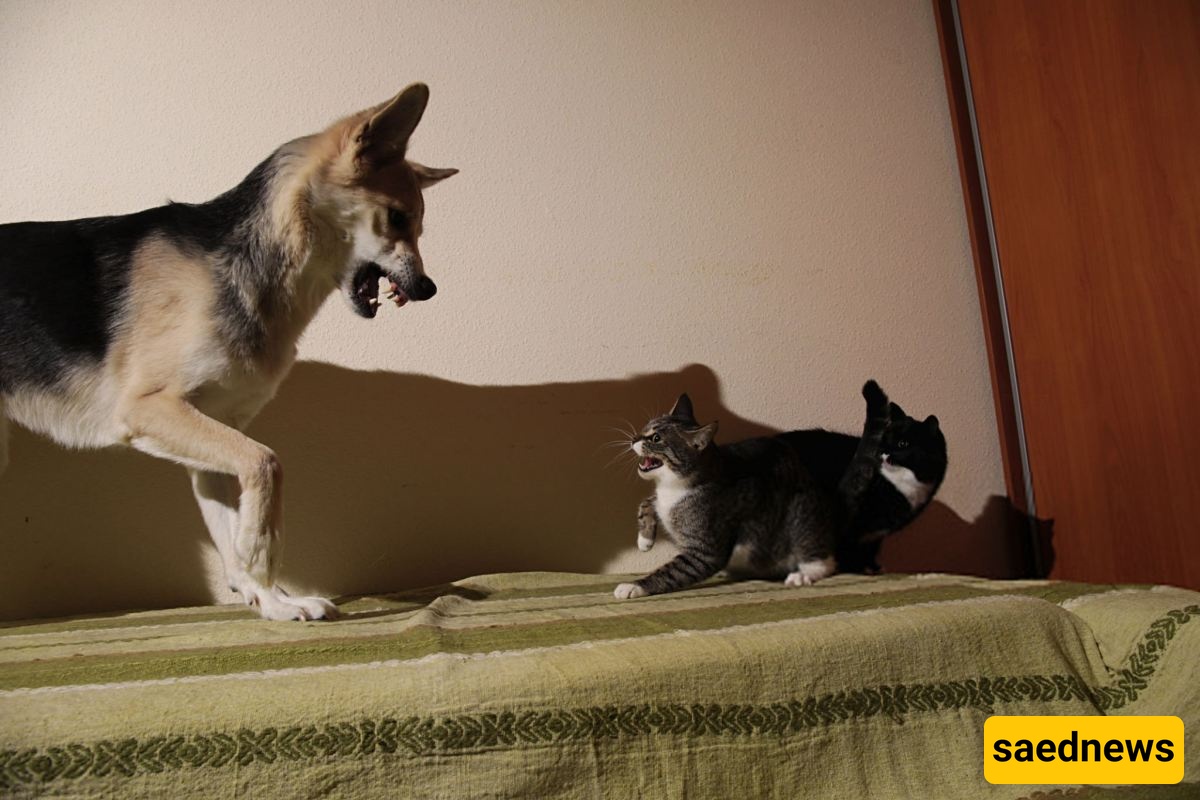
Cats are highly sensitive to environmental stimuli. A dog's large size, loud barking, sudden movements, and unfamiliar smell can all trigger fear.
Dogs that run excitedly, jump around, or chase cats are particularly intimidating. Even a calm but large dog may appear threatening from a cat's perspective.
A dog's scent can also play an important role. Cats have a highly developed sense of smell, and unfamiliar odors can make them cautious.
If a cat has previously had a negative experience with a dog, even a similar smell may trigger a fear response.
This demonstrates that fear of dogs is not always an immediate reaction. It can also be learned and reinforced through conditioning.
One of the most important factors influencing a cat's fear of dogs is its level of socialization during early development.
Cats that are introduced to calm and friendly dogs during their early weeks of life may be less likely to develop intense fear as adults.
The sensitive socialization period in kittens generally occurs between the second and seventh weeks after birth, although positive experiences later in life also matter.
In contrast, a cat that has never encountered a dog before adulthood may perceive any dog as unfamiliar and potentially dangerous.
Negative experiences, such as being chased, frightened, attacked, or startled by sudden barking, can also strengthen fear.
If a cat has previously been frightened by a dog, it may remain cautious around dogs even after a considerable amount of time has passed.
Not all cats have the same personality. Some are naturally more confident, curious, and sociable, while others are more sensitive, cautious, and fearful.
Genetics, the mother's temperament, and the environment in which a kitten grows up can all influence these characteristics.
Cats born to fearful mothers or raised in stressful environments may be more likely to develop fearful behaviors.
Age is another important consideration. Older cats may be less tolerant, more sensitive, or affected by physical conditions that make them react more strongly to dogs.
Sick cats or those experiencing pain may also have a lower tolerance for environmental stimulation.
Therefore, a cat's fear of dogs should be considered in the broader context of its health, age, and temperament.

A cat can learn to fear dogs through a process known as fear conditioning.
If a cat has an unpleasant experience in the presence of a dog, it may begin associating even neutral signals, such as the sound of a collar, a dog's smell, or the sound of a door opening, with danger.
This type of learning can cause fear to spread to other situations and make the cat cautious around all dogs.
For example, a cat that has been chased by a dog once may later run away whenever it sees another dog, even one that is calm and on a leash.
In these situations, the cat's fear is no longer simply a response to an immediate threat. It is also a response to the anticipation of danger.
This highlights the importance of gradual exposure and positive experiences when helping cats overcome their fear.
Cats are strongly attached to their territory. The sudden arrival of a dog in the home can disrupt their established environment.
If a cat has no hiding places, escape routes, or elevated safe spaces, its fear may become more intense.
Cats living in small spaces with energetic dogs may experience ongoing stress.
Providing environmental resources such as hiding spots, shelves, elevated beds, and separate feeding areas can help cats feel more in control.
When a cat knows it can move away from the dog and reach a safe area whenever necessary, its fear will often decrease.
Therefore, fear of dogs cannot always be resolved simply by expecting a cat to get used to them. The environment must also feel safe and predictable.

Human reactions can also influence a cat's fear of dogs.
If a cat owner becomes anxious, raises their voice, or suddenly picks up the cat whenever a dog appears, this may reinforce the cat's fear.
Cats are sensitive to human emotions and can respond to tension in their surroundings.
Remaining calm and managing interactions appropriately are therefore essential.
Punishing a cat for being frightened or forcing it into close contact with a dog is also harmful and ineffective.
Fear cannot be overcome through force. The correct approach involves gradual, controlled exposure combined with positive reinforcement.
If a cat's fear is severe, consulting a veterinarian or an animal behavior specialist is recommended.
No. Many cats can live peacefully with dogs when they are introduced gradually and have positive experiences.
Some cats even play with dogs or sleep beside them.
Therefore, the belief that cats are afraid of dogs is not an absolute rule. It is a common tendency influenced by several factors.
However, it is unrealistic to expect every cat to become friends with every dog.
Individual personality, previous experiences, age, health, and environmental conditions all play important roles.
The goal should not be to turn a cat into an animal that feels no fear. Instead, the priority should be to provide security, reduce stress, and responsibly manage the relationship between cats and dogs.
Cats do not always express fear openly. They may remain seemingly calm until they feel that a situation has become threatening.
Recognizing the early signs of fear is important because timely intervention can prevent stress from becoming more severe.
Common signs of fear or anxiety in cats around dogs include:
Crouching down and arching the back.
Flattening the ears and spreading the whiskers.
Dilated pupils.
Staring at the dog or completely avoiding eye contact.
Hiding under furniture, beds, or inside closets.
Running away quickly or freezing in place.
Hissing, growling, or making aggressive vocalizations.
Repeated lip licking, yawning, or nervous tail movements.
Changes in appetite, including eating less or excessively.
Avoiding the litter box during periods of stress.
Defensive aggression, such as attacking only when escape is impossible.
If a cat consistently hides, refuses to eat, or excessively grooms itself whenever a dog is nearby, it may be experiencing chronic stress.
In such cases, the environment and the way the cat is exposed to the dog should be reassessed.

Some human behaviors, even when well-intentioned, can make a cat's fear worse.
The most common mistakes include:
Forcing a cat to approach a dog: Fear does not disappear through force. Forced interaction can increase feelings of vulnerability.
Punishing a cat for running away or hissing: Punishment can intensify fear and damage the cat's trust.
Suddenly picking up a frightened cat: A scared cat may scratch or bite. It is generally better to allow it to have an open escape route.
Ignoring the need for safe spaces: Cats should have elevated or hidden areas that dogs cannot access.
Making animals share food in a confined space: Eating beside a dog can be stressful for a cat. Food and water resources should be separate and easily accessible.
Expecting them to become comfortable immediately: Introducing cats and dogs is a gradual process that may take weeks or even months.
If you are planning to bring a dog into a home with a cat, or introduce two animals that have never met, following these steps can help.
Initially, keep the cat and dog in separate areas.
The cat should have access to a safe room that the dog cannot enter.
This stage is essential for reducing the initial shock and allowing both animals to become familiar with each other's presence through scent.
Place items such as blankets or towels carrying the scent of one animal in the other animal's living area.
Becoming familiar with each other's scent can reduce fear caused by unfamiliarity.
Carry out this process calmly and without forcing either animal to interact with the item.
Slightly open a door or use a secure barrier so that the animals can see each other without having direct physical contact.
During this stage, reward calm behavior with treats or play.
If the cat shows signs of intense fear, increase the distance between them.

The first face-to-face meetings should be brief and carefully controlled.
Keep the dog on a leash or under appropriate restraint.
The dog should be trained to remain calm and avoid chasing the cat.
If the cat hides, do not pull it out. Allow it to decide when it feels comfortable enough to come out.
Slowly increase the amount of time the animals spend in the same space.
However, always maintain escape routes and safe hiding places for the cat.
Measure progress through calm, relaxed behavior rather than forced physical closeness.
Cats may fear dogs because of evolutionary instincts, differences in communication, unfamiliar sounds and movements, negative experiences, territorial behavior, and individual temperament.
However, this fear is not universal or necessarily permanent.
With appropriate socialization, patience, positive reinforcement, and a safe environment, many cats can learn to coexist peacefully with dogs.
Understanding your cat's behavior and respecting its boundaries are the most important steps toward building a positive relationship between these two animals.