SAEDNEWS: Iran’s ambassador to the United Nations has criticized a Canadian-sponsored draft resolution on human rights in Iran, describing it as a politically motivated effort to pressure Tehran and urging UN member states to vote against it.
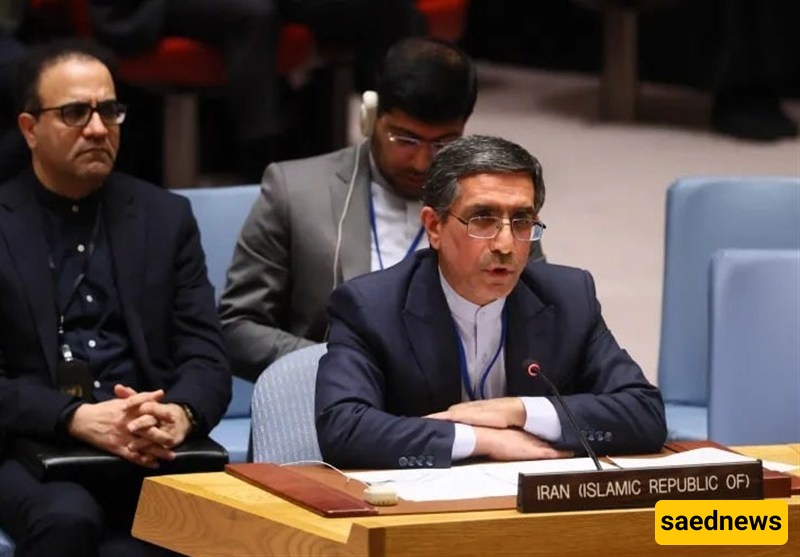
According to Saednews, Addressing the United Nations Human Rights Council ahead of the November 18 vote on a proposed resolution targeting Iran, Gholamhossein Darzi, Iran’s ambassador and chargé d’affaires to the UN, strongly criticized Canada and several Western countries for what he described as their selective approach to human rights.
Darzi accused the countries sponsoring the resolution of using human rights concerns as a political instrument to advance their geopolitical interests, rather than genuinely protecting fundamental freedoms and human dignity.
He also condemned their failure to speak out against civilian casualties and widespread destruction resulting from US-Israeli military attacks on Iran, particularly the deaths of 168 students and teachers in the strike on Shajareh Tayyebeh School in Minab.
The following is the full text of his address:
In the Name of God, the Most Compassionate, the Most Merciful
Mr. Chair,
Once again, Canada, together with a limited number of its Western allies, has introduced another draft resolution that is selective in nature and driven by political considerations. Rather than genuinely advancing human rights, this initiative seeks to turn a fundamental international principle into a tool for exerting pressure on a sovereign nation.
The Islamic Republic of Iran firmly and unequivocally rejects this draft resolution in its entirety.
Resolutions directed at individual countries in this manner run counter to the principles enshrined in the UN Charter, particularly sovereign equality, impartiality and non-interference in the internal affairs of States. Such initiatives are neither negotiated through inclusive consultations nor supported by broad international agreement. Instead, the same small group of countries repeatedly advances them as instruments of political coercion and geopolitical influence.
This approach undermines mutual confidence, damages constructive engagement and fails to bring any meaningful improvement to the daily lives of ordinary people.
The results of these annual resolutions speak for themselves. They have done nothing to improve the human rights conditions of even one Iranian citizen. Nor have they addressed the serious violations suffered by the Iranian population as a consequence of military aggression and unlawful sanctions.
Their only outcome has been greater international division, the reinforcement of double standards and further damage to the credibility of the United Nations human rights framework among a considerable number of its members.
Perpetuating this approach does not advance human rights. On the contrary, it undermines the entire system by showing how international mechanisms can be manipulated to serve narrow political interests.
Over the past year, the Islamic Republic of Iran has confronted a coordinated series of hostile actions, including military attacks, attempts to provoke and exploit domestic unrest, the introduction of unilateral coercive measures and escalating economic restrictions.
US officials have themselves acknowledged efforts aimed at creating instability in Iran and bringing about the collapse of its political system. Peaceful demonstrations over economic difficulties were exploited and transformed into violent unrest, with clear indications of foreign interference.
Throughout these developments, the most serious external dangers to the Iranian people's right to life and personal security have originated beyond the country's borders.
Nevertheless, the proposed resolution makes no reference to these threats. It overlooks the deaths of Iranian children and other innocent civilians, as well as the devastating consequences of unilateral sanctions. Instead, it repeats allegations that have not been independently verified and relies on mechanisms established without the approval of the country concerned.
Mr. Chair,
The international silence over the killing of Iranian civilians is particularly alarming.
During the military aggression against the Islamic Republic of Iran earlier this year, at least 168 children attending school and their teachers were killed when Shajareh Tayyebeh School in Minab was attacked.
The mothers of these children continue to endure the unbearable pain of losing their loved ones. Yet the countries behind today's resolution, despite portraying themselves as defenders of human rights and children's welfare, have deliberately remained silent.
One of the victims was Makan Nassiri, who was directly struck by a missile. His remains have never been found, leaving his mother without even the opportunity to recover and bury her son's body.
Across the two devastating wars of aggression, more than 5,000 innocent civilians have lost their lives, including 254 children and 251 women. Despite their repeated claims of defending women's and children's rights, those governments have offered virtually no response to these tragic deaths.
Their silence cannot be dismissed as an accidental omission. It reflects a deliberate political decision.
The very governments that repeatedly voice concern about Iran in this Council have refused to condemn the military aggression inflicted upon the Iranian population.
When Iranian children are killed, they remain silent. When unlawful sanctions cause suffering among Iranian civilians, they offer no meaningful response. And when large-scale civilian casualties result from actions by their own allies, they once again choose silence.
Such conduct has nothing to do with genuine human rights protection. It represents selective outrage designed to serve political interests.
When the United States and the Israeli regime attacked civilian populations and essential infrastructure across Iran, including industrial installations, bridges, hospitals, airports, transportation systems, historical and cultural landmarks, sports complexes and energy facilities, these governments failed to raise their voices.
They also remained silent when a military blockade and unilateral coercive measures were imposed on the Iranian people, systematically undermining their rights to healthcare, education and an acceptable standard of living.
Not only did these governments fail to express concern about the humanitarian consequences, but they also avoided addressing the suffering caused by such actions.
This is an appalling display of hypocrisy.
Under international law, including international humanitarian law, many of these actions are being examined as potential war crimes and crimes against humanity.
The Islamic Republic of Iran has maintained constructive cooperation with the Universal Periodic Review process and international human rights treaty bodies, guided by mutual respect.
We have consistently sought to engage sincerely and responsibly with all human rights mechanisms, including the holders of mandates under special procedures. This includes mechanisms imposed upon Iran, even though we consider their establishment fundamentally unjustified and unnecessary.
However, we will not legitimize mechanisms whose actual purpose is to manufacture misleading and fabricated accounts that can subsequently be used to justify external political pressure against our country.
In view of these circumstances, the Islamic Republic of Iran urges all delegations that respect the UN Charter, uphold the principle of non-selectivity and support meaningful international cooperation to vote against this politically motivated draft resolution.
Opposing this resolution means rejecting the exploitation of human rights for political purposes, rejecting double standards and refusing to allow this Council to become a platform for political intimidation instead of a place for constructive dialogue.
Voting against the draft would also demonstrate a commitment to consistency, neutrality and the equal enforcement of international law without discrimination.
The Iranian people have shown, despite paying a heavy price, that they will not surrender control over their future to foreign powers or accept decisions designed to advance external political agendas.
Thank you.