SAEDNEWS: Those familiar wrinkles after a bath or swim are not simply the result of water soaking into your skin. They are produced by a nervous-system response that constricts blood vessels—and research suggests the resulting grooves may help your fingers handle wet objects more effectively.
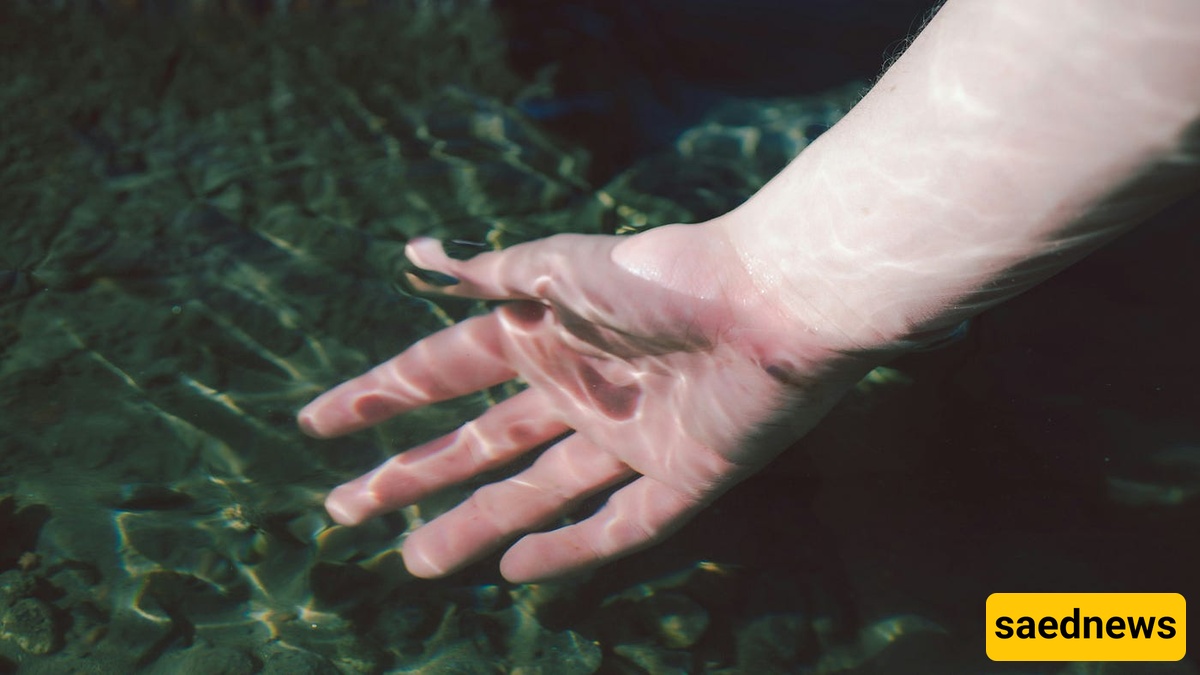
According to SaedNews, the next time you climb out of a bath, swimming pool or long shower and notice that your fingertips look like tiny prunes, you are seeing one of the body's more unusual automatic responses.
For years, the simplest explanation seemed obvious: your skin had absorbed water and swollen. But research has shown that the story is considerably more complicated. The wrinkling is an active physiological response involving the nervous system and blood vessels beneath the skin.
And there is an even more intriguing possibility: those wrinkles may actually make your hands better at dealing with water.
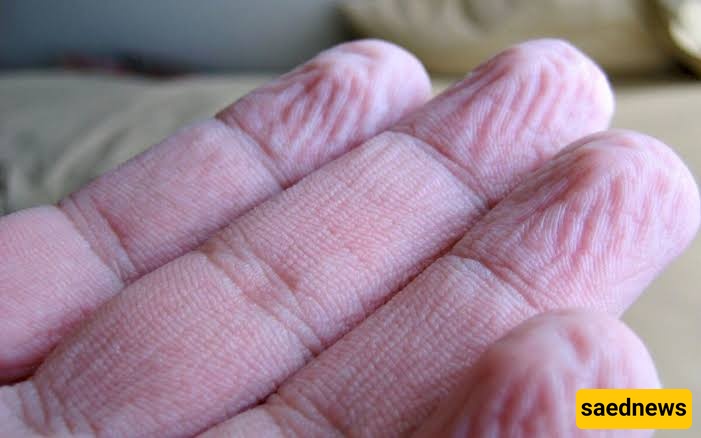
The skin on the fingertips, palms and soles behaves differently from much of the body's skin. After prolonged immersion, these areas develop pronounced folds, while ordinary water exposure does not make your entire body wrinkle in the same way.
Studies have found that water-immersion wrinkling depends on intact sympathetic nerve function. When the relevant nerve pathways are damaged, the normal wrinkling response can disappear. That observation was an important clue that the phenomenon was not simply passive swelling caused by water.
Research in the early 2000s provided stronger evidence for the mechanism: blood flow in the digits falls as the skin wrinkles, indicating that blood vessels beneath the fingertips constrict. In other words, the skin is not merely becoming saturated and expanding; the tissue underneath is changing its volume and pulling the surface into folds.
The response involves the sympathetic branch of the autonomic nervous system—the system responsible for many functions you do not consciously control.
The precise chain of events is complex, but researchers have proposed that prolonged water exposure changes the environment around the sweat ducts in the skin. Signals involving the nerves then contribute to sympathetic activity, which causes small blood vessels in the fingertips to constrict. As the underlying tissue volume decreases, the skin above it buckles into the familiar grooves.
This explains one of the strangest clues about the phenomenon: if the wrinkling were simply caused by water entering the skin, damage to a nerve should not necessarily stop it. Yet studies of nerve damage and replanted fingers have shown that normal autonomic innervation is important for the response.
Once scientists established that the process was actively controlled by the body, another question became difficult to ignore: why does the body do this?
One influential hypothesis is that the grooves help channel water away from the contact surface of the fingertips. The idea is somewhat similar to the tread on a tire: grooves can provide pathways for water to move away, potentially improving contact with a wet surface.
The hypothesis became more interesting when researchers tested whether wrinkling actually changes performance.
In a 2013 study published in Biology Letters, volunteers handled objects in wet and dry conditions with wrinkled and unwrinkled fingers. Wrinkled fingers allowed participants to handle submerged objects more quickly, while the advantage did not appear when manipulating dry objects. The researchers interpreted the findings as evidence that water-induced wrinkling may be an adaptation for handling objects in wet environments.
A later 2021 study added another piece to the puzzle. It found that people with water-induced finger wrinkles needed less grip force when holding a wet object, bringing the required force closer to what was needed for a dry object. The result suggests that the wrinkles may improve the efficiency—not merely the speed—of gripping in wet conditions.
The idea that pruney fingers evolved specifically to help our ancestors gather food from streams or move safely across wet surfaces is appealing. It also fits the fact that toes can wrinkle in water.
But there is an important distinction between evidence that wrinkles can improve wet-object handling and proof that natural selection created the response specifically for that purpose.
The experimental findings support the grip hypothesis, but the evolutionary history remains harder to establish. Even scientific discussions of the phenomenon have noted that more research is needed to determine exactly how the trait evolved and how widespread comparable responses are among other animals.
That uncertainty makes the story more interesting, not less. A useful function has been demonstrated under experimental conditions, while the deeper evolutionary explanation remains a scientific question.
The phenomenon has another surprising application.
Because water-induced wrinkling depends on sympathetic nerve function, clinicians have used finger-wrinkling tests as a simple way of assessing aspects of peripheral autonomic function. A reduced or absent response can be associated with impaired nerve function, although such testing is a clinical tool rather than something that can diagnose a condition by itself.
This is a striking example of how an apparently trivial everyday observation can become medically useful. The same wrinkles that appear after washing dishes can provide information about how part of the nervous system is functioning.
Recent research has added a new question to the story: why do your wrinkles tend to appear in such similar patterns every time?
A 2025 study examined the topography of water-induced fingertip wrinkles and found that corresponding wrinkles showed consistent orientations when the same fingers were tested at different times. The researchers suggested that the underlying vascular architecture may help determine the recurring pattern.
That does not mean your wet fingertips are already proven to be a new form of fingerprint identification. The researchers themselves described longer-term questions that remain unanswered, including whether these patterns stay stable over much longer periods.
Still, it adds a remarkable detail to an ordinary experience: your fingers may not simply wrinkle randomly. The structures beneath the skin appear to influence where those folds form.
The short answer is that they appear to wrinkle because water exposure triggers a nervous-system response that constricts blood vessels beneath the skin.
The longer answer is more fascinating. The response changes the shape of the fingertip, and experiments suggest that the resulting grooves can make it easier or more efficient to handle wet objects. Researchers continue to investigate exactly why this response evolved, how the wrinkle patterns are determined, and what else they might tell us about the body's nervous and vascular systems.
So the next time your fingers become pruney in the bath, you are not simply looking at waterlogged skin. You are watching your nervous system, blood vessels and skin work together to produce a temporary change in the body's surface—and possibly one that gives your hands a small advantage when everything around them gets wet.