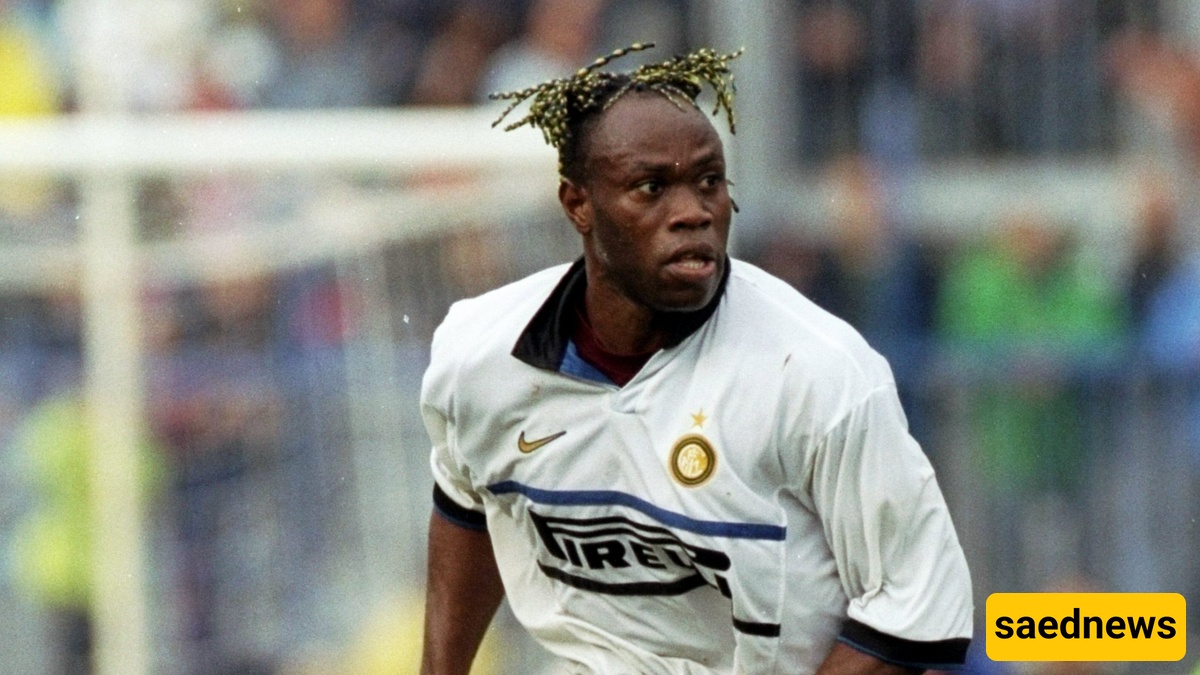
SAEDNEWS: Former Nigeria defender Taribo West has revisited his brief spell at AC Milan with a striking claim about Paolo Maldini and Alessandro Costacurta. West says he deserved a bigger role but was repeatedly pushed aside, while also alleging that Milan officials gave him misleading reasons for not renewing his contract.

According to SaedNews: Taribo West has reopened one of the most controversial chapters of his playing career with a claim that is certain to attract attention from football fans. The former Nigeria international says he was better than Paolo Maldini and Alessandro Costacurta during his time at AC Milan, but believes the club’s hierarchy never gave him a genuine chance to establish himself in the starting lineup.
West’s comments concern his 1998-99 season at Milan, a short spell that ultimately ended with the defender leaving the club and later joining Inter. Looking back, however, he clearly believes the problem was not his ability on the pitch.
According to West, AC Milan coach Alberto Zaccheroni consistently placed his trust in Maldini and Costacurta. The Nigerian defender claims that when an injury to Maldini finally opened the door for him, he took his opportunity and performed well enough to receive praise.
But, in his telling of events, the opportunity did not last.
West says he was soon back on the bench, despite having impressed when given the chance. He claims he was subsequently told that Maldini occupied a uniquely protected position within the team.
The former defender described Maldini as effectively being treated like a “godfather” at the club, arguing that nobody could replace him in the starting lineup.
It was a situation West says he struggled to understand. From his perspective, a strong performance should have been enough to earn continued opportunities. Instead, he believes the club’s established hierarchy ultimately mattered more.
The story did not end with his frustration at being left out of the team.
West also recalled speaking to Massimo Moratti, the Inter president with whom he says he always maintained a very good relationship. According to West, he discussed the situation with Moratti after joining Inter, and claims that the Italian businessman confirmed that such dynamics could exist at certain clubs.
West’s most serious allegations concern the way he says Milan handled his departure.
The Nigerian claims that club officials told him a series of things in an effort to persuade him to leave. Among the claims he recalls is that he had a heart problem, something he strongly disputes.
West argued that his performances on the field contradicted that explanation. He says he was capable of playing four consecutive matches and still being the best player on the pitch.
Despite his confidence in his physical condition and ability, West says Milan ultimately decided against extending his contract at the end of the season.
His account paints a picture of a player who believed he had demonstrated enough to earn a more permanent role, only to find himself on the outside of a defensive hierarchy dominated by established names.
There is an important distinction between West’s recollection and established fact: his claims represent his own account of what happened during that period. The allegations about what Milan officials told him and the reasons behind his limited opportunities are presented by West rather than independently established in the material available.
Still, his comments offer an unusual glimpse into the pressures and internal dynamics that can surround elite football clubs.
Maldini, in particular, was already an iconic figure at Milan during the period West describes. Costacurta was another hugely experienced defender, making competition for defensive places extremely demanding.
West, however, does not frame his experience simply as a sporting battle for selection. His comments suggest he believed the decision had been shaped by factors beyond performances and training.
His brief Milan chapter was followed by a move across the city to Inter, giving him the chance to continue his career at another of Italy’s major clubs.
The contrast between the two experiences appears to have stayed with him. Even years later, West remains convinced that he could have played a much larger role at Milan had he been given the same level of trust afforded to the club’s established stars.
His recollections are particularly striking because they combine personal disappointment with an extraordinary assessment of his own ability. Saying he was better than Maldini and Costacurta is an exceptionally bold claim given the reputations of the two Italian defenders.
Yet that confidence is central to West’s version of the story.
He remembers a period in which an injury finally gave him a chance, believes he performed strongly enough to justify keeping his place, and says he was nevertheless returned to the substitutes’ bench.
For football fans, that raises an enduring question: how much of a player's career is determined purely by performances, and how much can hierarchy, reputation and a coach's trust influence opportunities?
West's story offers one former player's emphatic answer.
Whether readers agree with his assessment of himself against Maldini and Costacurta, his recollection has revived a fascinating episode from his time in Italian football. His claims about Milan's treatment of him, his conversation with Moratti and the reasons he says were given for his departure add another layer to a career that eventually took him from Milan to Inter.
More than two decades later, West clearly has not forgotten how that chapter ended. And his latest comments ensure that his version of the story will once again become part of the football conversation.