SAEDNEWS: For years, visitors to Central and South American rainforests have reported a tree that seems to “walk” on its stilt-like roots. The “walking palm,” Socratea exorrhiza, gained attention in the 1980s when anthropologists John H. Bodley and F. C. Benson described this unusual behavior in a scientific study.
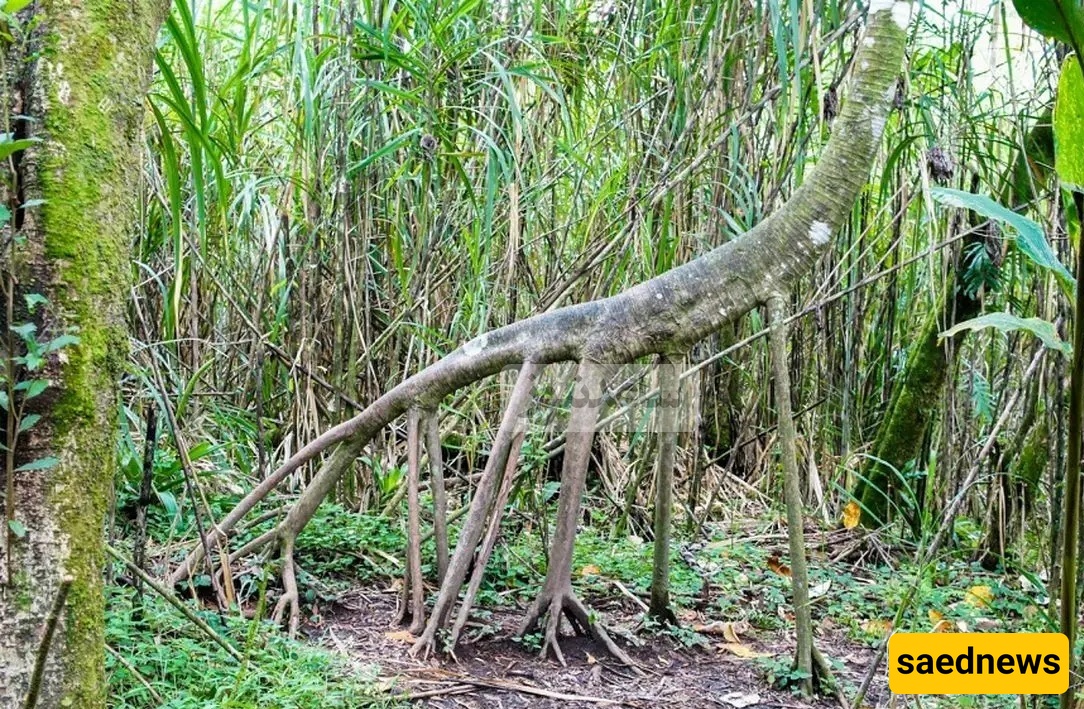
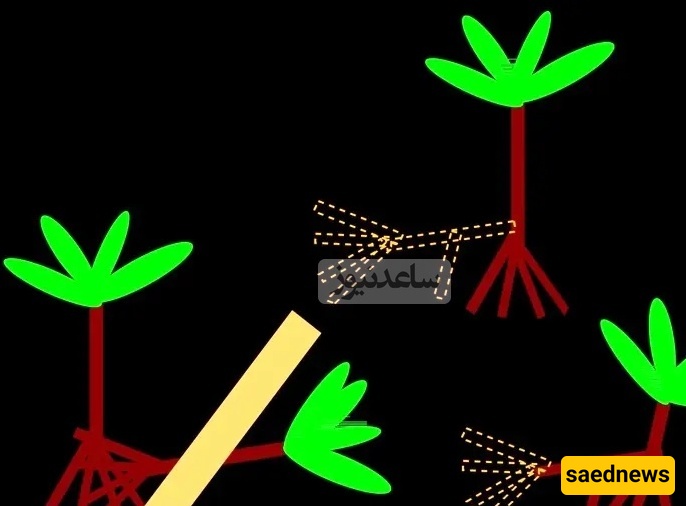
According to Saed News Society Service, as reported by Badley and Benson, when some of these palms in eastern Peru are toppled by falling trees or branches, they are said to be able to straighten themselves again and “walk” out from under obstacles—meaning they gradually move away from their original germination site. It has been claimed that these palms use around a dozen roots emerging from their elevated trunk to move through the forest in search of sunlight.
According to Faradeed, these roots can sometimes be located several meters above the ground. As Badley explained decades ago, when older roots break or rot, new “legs” may extend toward slightly farther patches of soil.
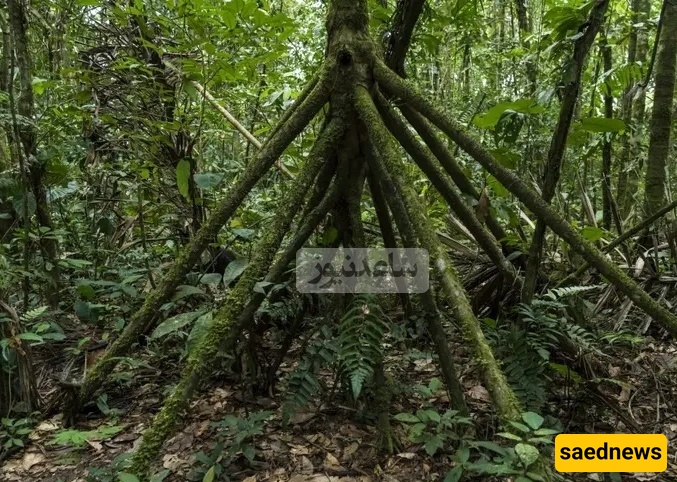
Even today, guides in Latin American rainforests often tell tourists that walking palms can move up to 20 meters per year.
However, despite some scientists suggesting there may be a grain of truth in the story, the idea of a “walking” tree appears to be more myth than reality. When the evidence is examined, the claim lacks solid support.
In 2005, tropical ecologist and palm specialist Gerardo Avalos published a study showing that the so-called walking palm does not actually move from its original point of germination. Avalos and his colleagues acknowledged that when the palm is knocked over, it can rapidly grow new roots to regain stability, but this does not amount to any meaningful relocation of the tree.
Avalos explains that the walking palm remains anchored to its original growth site, although like many rainforest plants, it can slowly adjust its growth toward light.
He admits that the idea of a tree that literally walks is “attractive and fascinating,” but emphasizes that it is nothing more than a myth. In a 2009 correspondence with Benjamin Radford of Skeptical Inquirer, Avalos noted that forming the large network of supporting roots takes a very long time, while light conditions in rainforest canopies change constantly as gaps open and close.
According to him, the idea that a walking palm could move fast enough to reach these light gaps is not realistic. Another study published in 2007 reached the same conclusion.
An image often associated with this species shows how the “walking palm” can develop new roots after being toppled and re-establish itself in a new position.
However, one key question remains: if these palms do not walk, why do they have such unusual stilt-like roots?
In the 1960s, scientists suggested these structures evolved as an adaptation to flooding, but there is little convincing evidence for this hypothesis. More recent research suggests that in dense rainforests, stilt roots help palms gain height and stability without investing energy into thickening their trunks, allowing them to better access light above the canopy.
Ultimately, although the story of a walking tree will likely continue to be told, current evidence indicates that the palm does not actually walk at all.