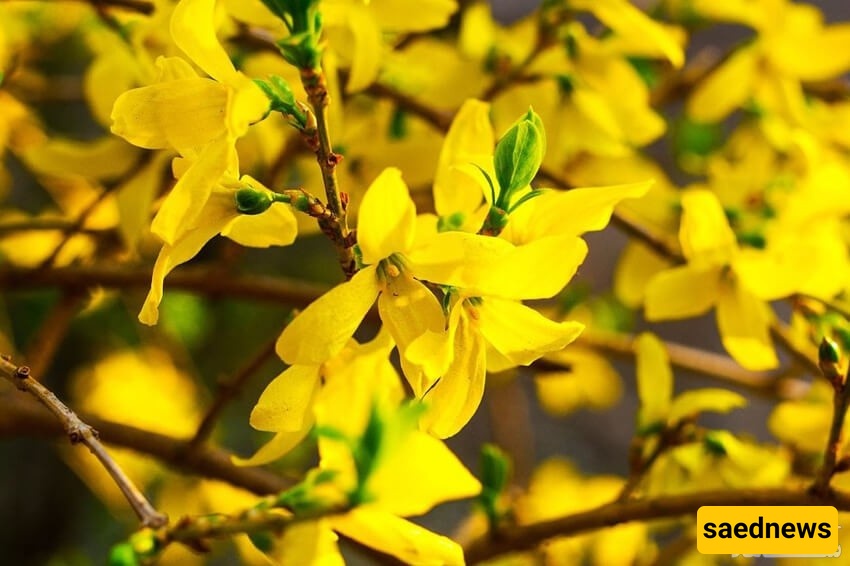
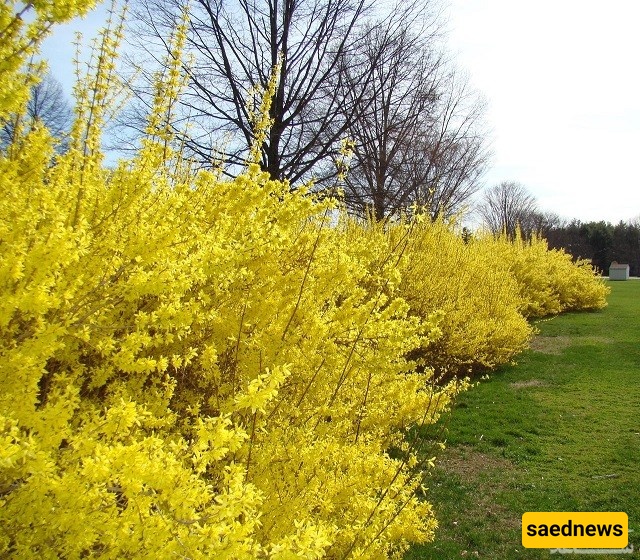
SAEDNEWS: Forsythia is a beautiful, hardy shrub that produces small yellow flowers on its branches in spring, giving gardens a striking and vibrant appearance. It blooms first, and after the flowers fade, its green leaves begin to grow. This attractive shrub comes in various different varieties.
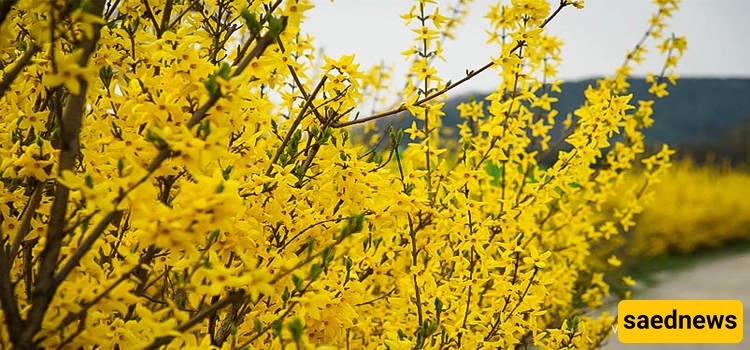
َAccording to Saednews, Forsythia (commonly called yellow jasmine) is a fast-growing deciduous shrub that typically grows 30–60 cm per year. It can reach a height of 2.4 to 6 meters with a spread of about 2.7 meters. It is widely grown for its bright spring flowers and its ability to form hedges or stand as a solitary ornamental plant.
If left unpruned, it develops a more natural and attractive arching shape. When planted in rows, regular pruning is needed to maintain a neat hedge form. It is also suitable for bright indoor spaces during winter, where it may bloom early.
Plant type: Shrub
Height: 2.4–6 m
Spread: ~2.7 m
Foliage color: Green-yellow / golden tones
Seasonal interest: Spring flowering, autumn foliage color
Flowers: Bright yellow blooms on older wood
Special features: Low maintenance, drought tolerant, suitable for cut flowers
Uses: Hedges, ground cover, slope stabilization, erosion control, privacy screens
Forsythia prefers full sun but can tolerate partial shade. At least 6 hours of direct sunlight daily is recommended for optimal flowering. Insufficient light reduces bloom production.
Watering depends on soil type:
In well-draining soil (sand + compost mix), watering every other day in summer is usually sufficient.
In heavier garden soil, daily watering may be required during hot seasons.
Avoid sudden changes in irrigation systems (e.g., switching from flood irrigation to drip irrigation abruptly), as this may stress the plant and cause leaf drop.
The plant grows best in moist, fertile, and well-draining soil. Suitable mixes include:
Compost + sand
Manure + garden soil
Waterlogged or swampy soils are not suitable. Adding mulch helps retain moisture and reduce weed growth.
Forsythia is highly heat-tolerant but flowers best in cooler weather. Cooler temperatures increase flower longevity. It does not require special indoor cultivation; in fact, it is not suitable for long-term indoor pot growth.
Forsythia can be propagated in several ways:
Root suckers: Division in spring
Softwood or hardwood cuttings:
Late autumn: hardwood cuttings (~12 cm)
Late spring: softwood cuttings
Layering: Bending a branch to the soil, wounding it slightly, and covering it until roots develop
Seeds: Possible but slow and less common
Pruning is essential for maintaining shape and encouraging flowering.
Best time: Immediately after flowering
Avoid late summer or autumn pruning, as flowers form on old wood and pruning at this time reduces next season’s blooms.
Light pruning maintains natural arching shape, which improves flowering performance.
For mature shrubs:
Remove 1/4 to 1/3 of older stems near the base annually.
For very old shrubs:
Cut back hard (to about 10 cm from ground level) to rejuvenate growth.
Regular pruning also improves airflow and light penetration inside the shrub.
Forsythia is a hardy, fast-growing shrub that requires minimal care once established. With proper sunlight, moderate watering, and annual pruning, it produces abundant golden blooms each spring.