SAEDNEWS: In this article, we’ll show you how to make a delicious and delightful Mikado pastry that you can easily prepare at home.
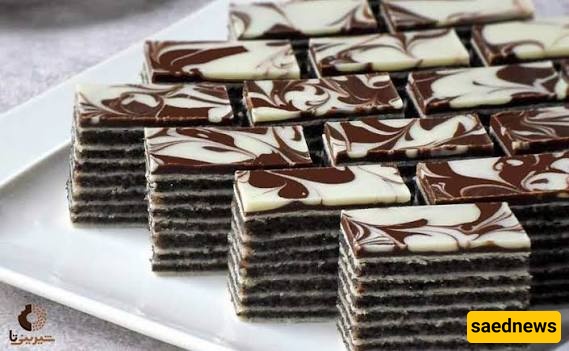
According to Saednews, Mikado pastry is a delicious, nostalgic dessert that holds a special place in many Iranian homes. With its crisp texture and sweet flavor, it is a popular treat for gatherings, parties, and afternoon snacks.
This guide explains how to prepare Mikado pastry step by step, making it easy to recreate this traditional Persian sweet at home.
1 cup all-purpose flour
1 cup chickpea flour
⅔ cup solid shortening
1 cup powdered sugar
100 g butter
3 tablespoons cocoa powder
1 tablespoon ground cardamom
6 sheets of wafer pastry
1 package white chocolate
Vegetable oil, as needed
Begin by placing the all-purpose flour and chickpea flour in a pan over low heat. Stir continuously for about 20 minutes, until the raw flour smell disappears. Turn off the heat.
Add the solid shortening and stir well. Then add the cocoa powder and vanilla, mixing until everything is thoroughly combined. Sift the powdered sugar into the pan and stir again. If the mixture seems too thick, gradually add a small amount of vegetable oil.
Continue mixing until the filling becomes smooth and spreadable.
Tip 1: Add the vegetable oil gradually, as adding too much can make the filling excessively runny.
Tip 2: If the filling becomes too thin, add a little toasted flour to thicken it.
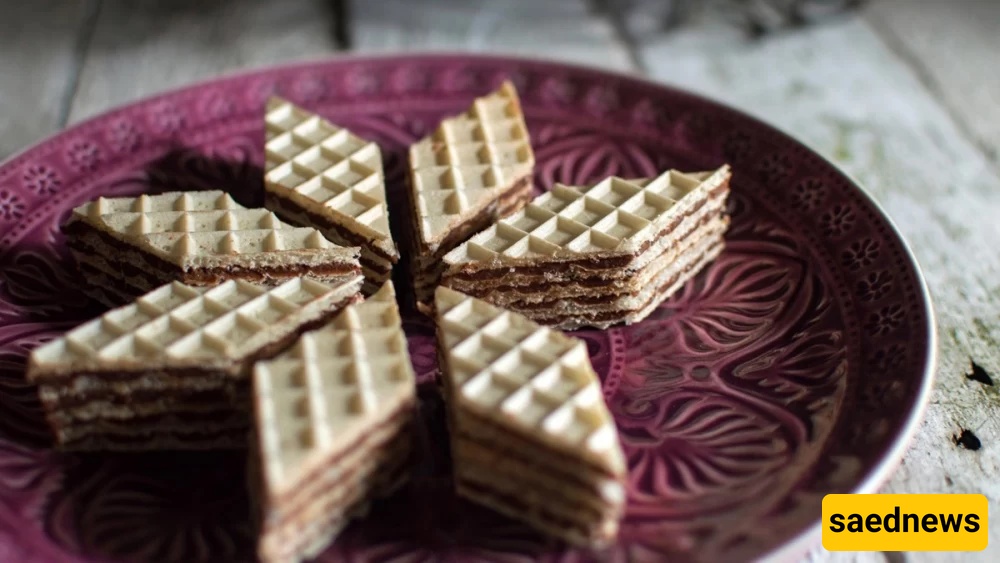
Place one sheet of Mikado wafer on your work surface. Spread an even layer of the chocolate filling over the wafer, then place another wafer sheet on top.
Repeat the process, alternating wafer sheets and filling, until you have used the desired number of layers. Finish with the final wafer sheet.
If you want plain white Mikado pastry, you do not need to add chocolate sauce to the top layer.
Place a tray or another flat, heavy object over the layered pastry to press the layers together. Refrigerate for about one hour.
Remove the pastry from the refrigerator and cut it into your preferred shapes and sizes. Garnish with ground pistachios and shredded coconut if desired.
Important: Do not spread the filling while it is piping hot, as this can make the wafers soft. Allow the filling to cool slightly before assembling the layers.
White Mikado pastry can be served either plain or covered with white chocolate.
Melt the white chocolate using a double-boiler method. Cover half of the pastries with the melted white chocolate while leaving the other half plain.
You can also prepare a chocolate sauce and spread it over the pastries. For decoration, drizzle melted white chocolate in diagonal lines across the surface.
Because Mikado pastry has a texture similar to a wafer, it is a convenient dry sweet that can be enjoyed by people of different ages and dietary preferences.
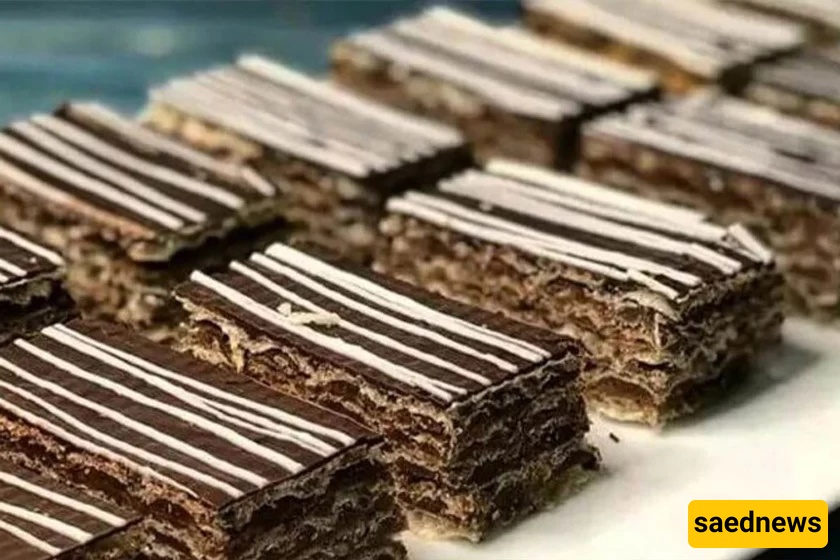
Mikado, also known as Mishka, can be prepared in several flavors for parties and special occasions. Saffron, date syrup, and tahini are some delicious alternatives to the traditional cocoa flavor.
To make flavored Mikado pastry, sift and toast the flours in a pan until their raw smell disappears. Add the butter and solid shortening and stir until the mixture becomes smooth and spreadable.
Instead of cocoa powder, use brewed saffron, milk and tahini, or date syrup according to your preferred flavor. Assemble the pastry in layers, then cut and decorate it as desired.
For a different presentation, Mikado pastry can also be shaped into rolls.
The appearance of Mikado pastry depends greatly on making clean, even cuts.
Before assembling the layers, use a sharp knife to trim the uneven edges of the first wafer sheet. This creates straight, neat edges.
Once the filling has been spread between the wafer layers, use a sharp serrated knife to cut the pastry into squares, diamonds, rectangles, or any shape you prefer.
For cleaner cuts, press the knife straight down through the layers in one motion rather than moving it up and down. Wipe the knife clean after each cut.
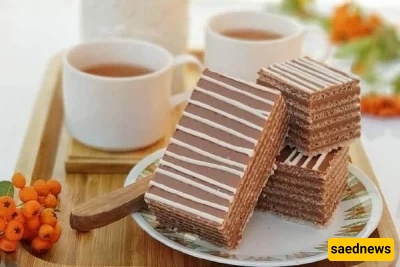
Mikado pastry is easy to customize, especially for beginners. Nuts can significantly change its aroma and flavor.
Depending on your taste, you can add hazelnuts, walnuts, or peanuts to the recipe.
Chopped nuts can be mixed directly into the filling, while finely ground nuts can be used as a topping.
Another option is to replace the Mikado filling with halva and serve the pastry at memorial or religious gatherings.
Mikado pastry is traditionally made with wafer or Mikado sheets, which give it its characteristic crisp, wafer-like texture.
If you are unable to use wafer sheets, vanilla biscuits can be used as an alternative.
The recipe is also flexible when it comes to sweetness. You can increase or decrease the amount of sugar according to your taste, and butter and shortening can be substituted for one another.
Mikado pastry can easily be adjusted according to your dietary preferences. The amount of sugar can be reduced, or alternatives such as honey, tahini, and grape molasses can be used instead.
You can customize the recipe to create a lighter version while maintaining the characteristic layered texture of this traditional Persian treat.
Keeping the layers firmly attached is one of the most important parts of making Mikado pastry.
When stacking the wafer sheets and filling, gently press the layers together by hand. If the layers still fail to adhere properly, check for the following possible causes:
The chocolate filling is too thin.
Too much solid shortening was used.
The filling was not spread evenly across the wafer sheets.
The Mikado filling became too cold before assembly.