SAEDNEWS: Interesting Facts About the Moon You Probably Didn’t Know
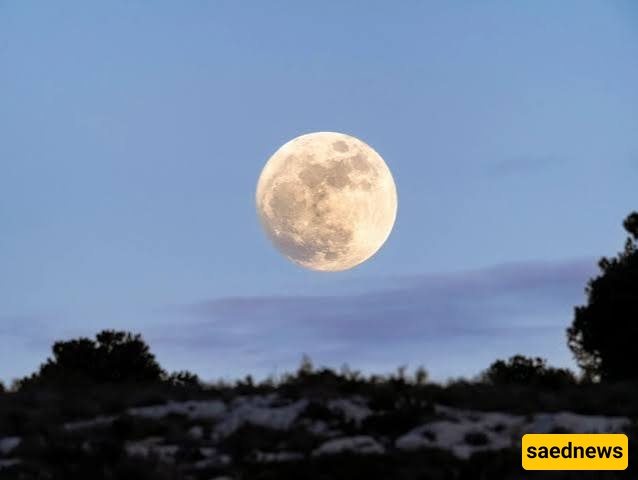
According to Saednews, The far side of the Moon is the hemisphere that permanently faces away from Earth. The side visible from Earth is known as the near side. Although the far side cannot normally be seen from Earth, modern space missions have allowed scientists to study it in detail.
The Moon is Earth's only natural satellite. It reflects sunlight and provides some illumination during Earth's nights. It is the fifth-largest natural satellite in the Solar System, with a diameter of approximately 3,476 kilometers.
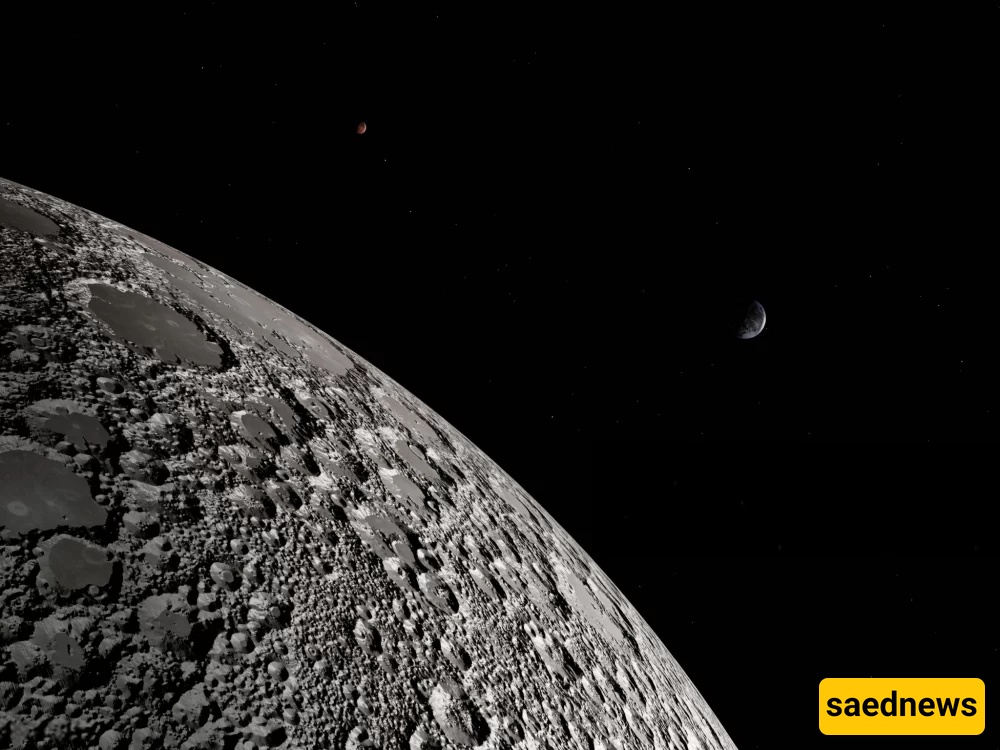
The Moon has virtually no atmosphere and its surface is covered with impact craters formed by collisions with asteroids and other space rocks. Its surface area is approximately 37.93 million square kilometers, which is smaller than the area of Asia.
In terms of mass and volume, the Moon ranks among the larger natural bodies in the Solar System. Its diameter is about one-quarter that of Earth, and it is unusually large compared with the planet it orbits. The Moon's density is roughly four-fifths that of Earth.
Throughout history, people have relied on the Moon's regular cycles to measure time, particularly for agricultural purposes. Travelers and sailors also used moonlight and the Moon's position for navigation. The Moon has played an important role in the mythology of many civilizations, and some cultures even worshipped it as a deity.
The Moon's gravity is responsible for much of the tides in Earth's oceans. Its gravitational influence also helps stabilize Earth's rotational axis. Without the Moon, Earth's axial tilt could vary much more dramatically, potentially causing major changes in the planet's climate and seasons.
Unlike Earth, the Moon does not have a living ecosystem on its surface. There are no naturally occurring forests, animals, or agricultural systems that could support farming or livestock.
Another major difference is that the Moon's surface is much more exposed to cosmic radiation and solar storms because it lacks Earth's protective atmosphere and magnetic environment.
Although the Moon has essentially no atmosphere, scientists have discovered water ice in permanently shadowed regions, particularly near the lunar poles. Researchers believe some of this water may have been delivered by comets and other objects that struck the Moon over its history.
The Moon is also slowly moving away from Earth. Its average distance increases by roughly 4 centimeters per year. Over hundreds of millions of years, this gradual change will significantly increase the distance between Earth and the Moon.
It is often said that people on Earth can see only half of the Moon. This is not quite correct.
Because of the Moon's elliptical orbit and its slight movements relative to Earth, a phenomenon called libration allows observers to see different portions of its surface over time. As a result, approximately 59% of the Moon's surface can eventually be observed from Earth.
The remaining portion, however, can never be directly seen from Earth.
For many decades, scientists believed that the Moon was completely dry. More recent research has shown that water molecules and water ice do exist on the Moon.
The lunar poles are particularly important because some deep craters never receive direct sunlight. Temperatures in these permanently shadowed areas can remain extremely low, allowing water ice to survive for long periods.
Solar wind may also contribute to the presence of hydrogen on the lunar surface. Protons carried by the solar wind interact with materials on the Moon and can contribute to the formation of hydrogen-containing compounds, including water.
Astronauts who visited the Moon noticed that shadows appeared much darker than they do on Earth.
On Earth, our atmosphere scatters sunlight, allowing some light to reach areas that are not directly illuminated. The Moon has no substantial atmosphere to produce this effect. As a result, areas blocked from direct sunlight can appear extremely dark, while sunlit surfaces can appear intensely bright.
The Moon takes about 27.3 days to complete one orbit around Earth relative to the distant stars. This is known as its sidereal orbital period.
However, the time between two successive new moons is about 29.53 days. This period is called the synodic month and corresponds more closely to the lunar cycle observed from Earth.
The Moon does not have a conventional atmosphere like Earth's. Instead, it has an extremely thin exosphere, which is far too sparse to provide meaningful protection from radiation or to support ordinary sound transmission.
Because there is essentially no atmosphere to carry sound waves, sound cannot travel through the lunar environment as it does on Earth. The sky also appears black even during the lunar daytime because there is no atmosphere to scatter sunlight and create a blue sky.
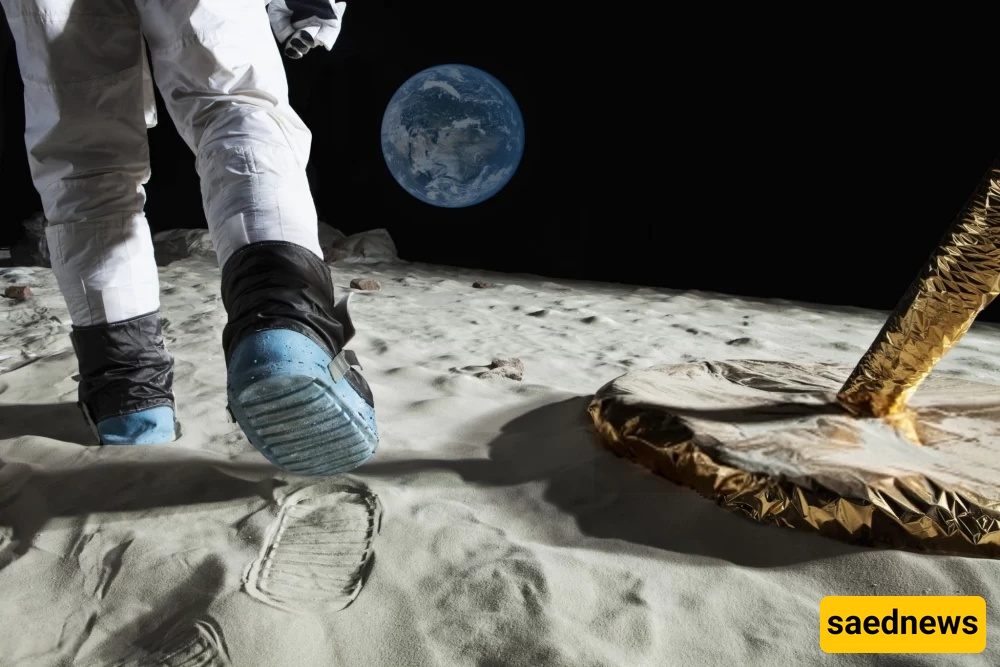
The idea of a separate lunar time system has been discussed by space agencies and scientists as lunar exploration becomes more advanced. A standardized system for keeping time on the Moon is particularly important for future missions, navigation, communication, and coordination between spacecraft.
It is sometimes claimed that the Moon already has an established calendar divided into lunar "days" and named after astronauts. However, these claims should be treated cautiously: there is no universally adopted lunar calendar equivalent to the one described in the original article.
The Moon contains a small memorial known as the Fallen Astronaut. During the Apollo 15 mission, astronauts placed a small aluminum sculpture on the lunar surface to commemorate astronauts and cosmonauts who had died while contributing to space exploration.
A plaque was placed alongside it listing the names of people who had died in the pursuit of spaceflight. Among those commemorated are members of the Apollo 1 crew, who died in a spacecraft fire during a ground test, as well as Soviet cosmonauts who lost their lives during space missions.
The memorial serves as a reminder that lunar exploration was achieved through extraordinary scientific and human effort—and sometimes at a tremendous cost.