SAEDNEWS: Astronomers studying a remarkably bright “little red dot” observed by the James Webb Space Telescope suggest it may be a massive black hole surrounded by a star-like cocoon of hot hydrogen gas.
According to SaedNews: When NASA’s James Webb Space Telescope began observing the early universe in 2022, it revealed an unfamiliar population of objects that astronomers called “little red dots.” Their nature has remained uncertain, but a new study suggests they could represent a previously unknown type of celestial object: black hole stars.
The research, published August 12 in Nature, focuses on an exceptionally bright object called MoM-BH*-1. The team says it appears to contain a huge black hole surrounded by hot gas whose glow resembles that of a star.
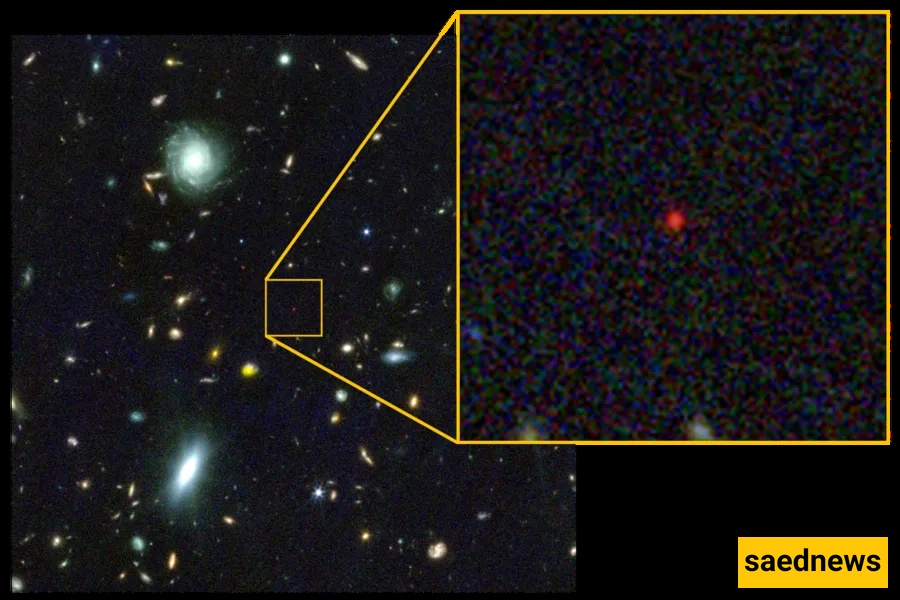
“It is a very special thing to find an object with no comparison,” says study co-author Rohan Naidu, an astronomer at the University of Hawaii. He describes MoM-BH*-1 as “one in a billion.”
The object is being seen as it existed 660 million years after the Big Bang, which occurred roughly 13.8 billion years ago. Its light took billions of years to reach JWST, and the universe’s expansion stretched those light waves toward the red end of the spectrum, allowing astronomers to estimate how long the light had traveled.
Researchers encountered MoM-BH*-1 during the Mirage or Miracle (MoM) survey, which was designed to locate galaxies from the universe’s earliest era. The object stood out because it was the reddest and brightest little red dot in the survey, prompting additional observations.
Its unusual appearance also created a puzzle. Red light commonly indicates dust surrounding an astronomical object, but the observations suggested MoM-BH*-1 contains very little dust. It was intensely bright across much of the spectrum, yet its light disappeared at a particular wavelength. This feature, known as a Balmer break, can indicate dense gas absorbing light from a star forming in a dust-free setting.
However, the Balmer break measured in MoM-BH*-1 was stronger than anything previously seen in a star. Its brightness was also too great to be explained by nuclear fusion, the process that powers stars.
The object therefore appeared to combine two normally distinct signatures. Naidu told the Guardian that it radiates energy typically associated with black holes while simultaneously displaying characteristics traditionally linked to stars.
To investigate, the researchers used computer simulations to model what could produce the unusual combination. Their analysis indicates that MoM-BH*-1 contains a black hole with a mass roughly 100,000 times that of the Sun. Around it is a thick hydrogen-gas envelope resembling a stellar cocoon and extending to roughly the scale of the solar system.
Astronomers Dominik Schleicher of Sapienza University of Rome and Rodrigo Herrera-Camus of the University of Concepción, who were not involved in the study, wrote in an accompanying Nature commentary that the object’s red color can be explained by gas, with dust making only a negligible contribution. They said the discovery offers an important clue to understanding little red dots.
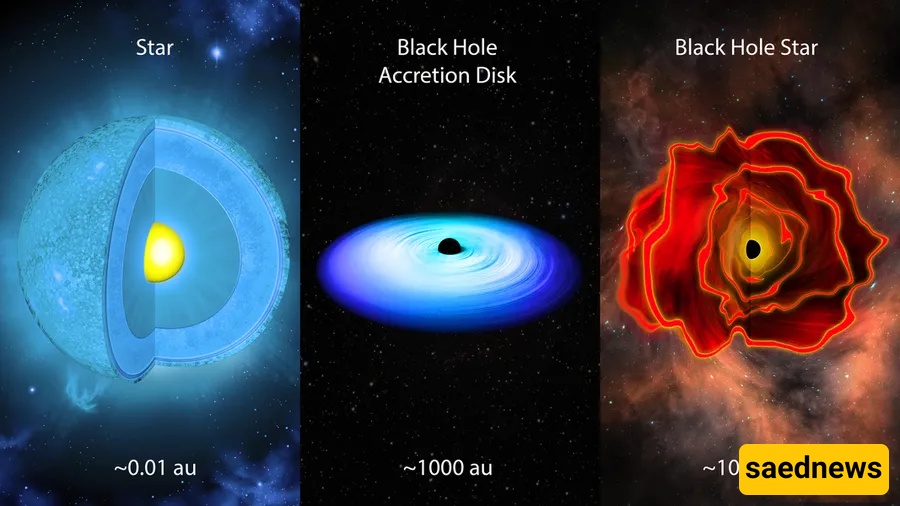
Naidu says each of these crimson objects could be consistent with a black hole star embedded within an ordinary early galaxy. What makes MoM-BH*-1 unusual, he adds, is that the black hole star appears to overwhelm the light from its host galaxy almost completely, leaving astronomers to see essentially the light of the black hole star itself.