SAEDNEWS: Astronomers using the W. M. Keck Observatory on Maunakea, Hawaiʻi Island, have discovered the third known galaxy that appears to lack dark matter. The galaxy is part of a mysterious linear structure that may have formed during a violent collision between galaxies.
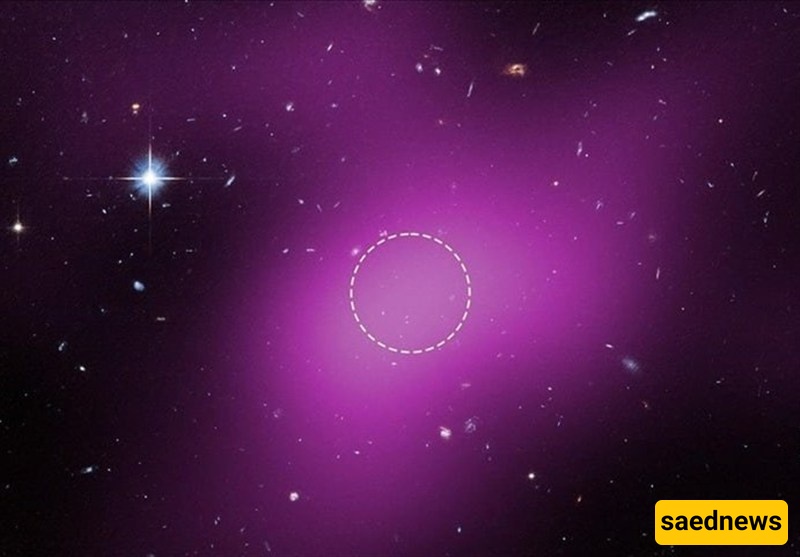
According to Saednews, Astronomers have discovered a third galaxy that appears to contain little or no dark matter, strengthening evidence for a rare cosmic process that can separate ordinary matter from dark matter. The finding offers researchers a valuable opportunity to investigate one of the universe’s greatest mysteries.
The galaxy, designated DF9, joins two previously identified galaxies, DF2 and DF4, which surprised scientists because they seemed to be almost entirely devoid of dark matter. New observations reveal that DF9 shares the same unusual characteristic and lies along the same narrow chain of faint, diffuse galaxies extending through space.
According to lead author Michael Keim, nearly all known galaxies are dominated by dark matter, making DF2, DF4, and DF9 remarkable exceptions. The new evidence suggests that these galaxies were created together during a violent event that separated ordinary matter from dark matter.
Researchers from Yale University have been at the forefront of studying dark matter-deficient galaxies since the original discovery of DF2 and DF4 by astronomer Pieter van Dokkum and his collaborators. Observations from the W. M. Keck Observatory helped confirm the unusual nature of these systems.
The discovery of DF9 further supports the idea that all three galaxies originated from the same dramatic event, most likely a high-speed collision between galaxies. Such a phenomenon has never been observed before and could significantly reshape current theories of galaxy formation.
Scientists propose that the collision stripped large amounts of gas away from the surrounding dark matter. This gas may then have condensed to form new galaxies composed almost entirely of ordinary matter.
Van Dokkum explained that the findings provide strong evidence that dark matter behaves as a real physical substance rather than being an effect produced by alternative theories of gravity. This is especially important for dwarf galaxies, where debates about the nature of dark matter are particularly intense.
To study DF9, the research team used the Keck Cosmic Web Imager (KCWI), an advanced instrument at the Keck Observatory. By examining light emitted at different wavelengths, the scientists measured the motions of stars within the galaxy and calculated its mass.
Their analysis showed that DF9 has a total mass of roughly 100 million times that of the Sun, a value that can be fully explained by the galaxy’s visible matter alone. If DF9 contained the amount of dark matter typically found in galaxies of similar size, it would be expected to be approximately 100 times more massive.
Keim noted that the exceptional precision of KCWI made it possible to measure DF9’s extremely low mass accurately enough to demonstrate the apparent absence of dark matter.
Future observations using both current and next-generation observatories will allow researchers to search for gas that may have remained after the proposed collision and to better determine the gas content of these unusual galaxies. Such studies could provide further insights into the relationship between ordinary matter and dark matter and help explain how these rare galaxies formed.