Saed News: Tens of thousands of years ago, we were not the only humans on Earth. In the cold plains of Europe, more robust, stronger beings with larger brains than ours ruled, whom we today call “Neanderthals”; a civilization that, contrary to popular belief, was not savage, but created art and fell in love alongside us.
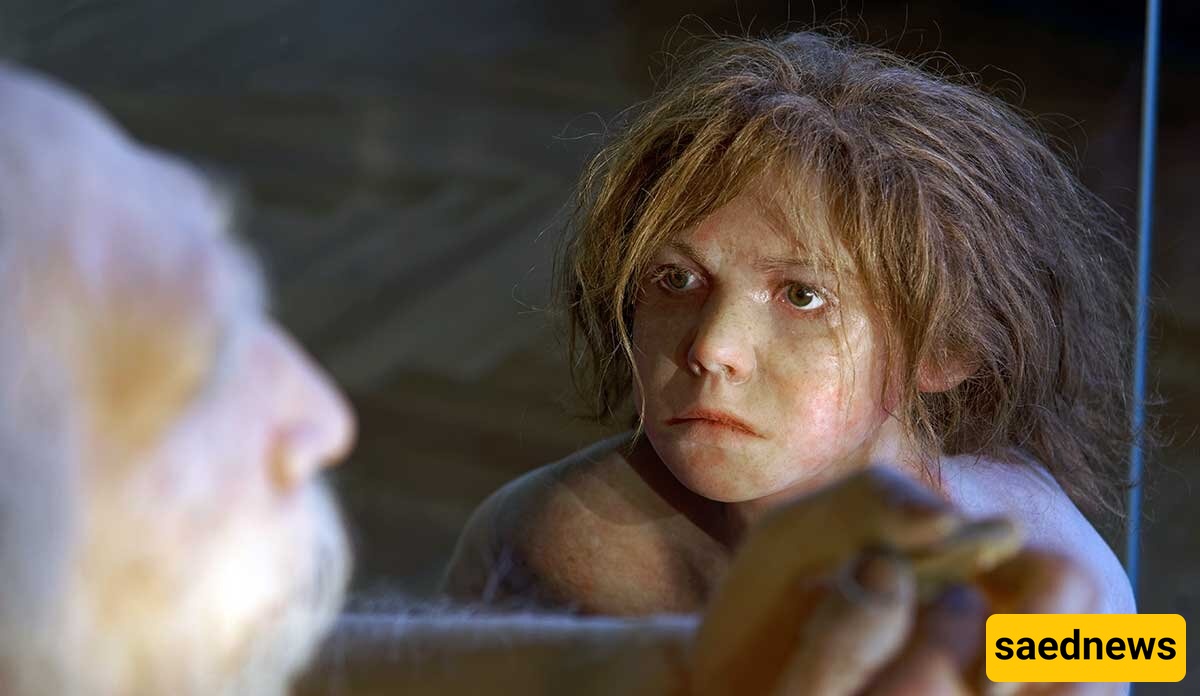
According to SAEDNEWS, Imagine living in a world where two completely different human species, with two entirely distinct survival strategies, stand face to face in the same geography. One short, broad-shouldered and equipped with a sturdy body for close combat with woolly rhinoceroses; and the other tall, agile, and built for long-distance running across the African plains. This is not fantasy; this is the reality of Earth during the Ice Age.
At a simple glance at the skeletal structure of the two different human species, clear structural differences appear. Neanderthals had elongated skulls, shorter foreheads, prominent brow ridges, and larger teeth. Their noses were wider and longer; an evolutionary masterpiece for warming and humidifying the dry and frozen air of the Ice Age and delivering enough oxygen to a body with extremely high metabolism. A Neanderthal needed about 5,000 calories per day, almost equivalent to a cyclist in the Tour de France!
In contrast, Homo sapiens had a slimmer, more elongated body and a narrower rib cage, perfectly designed for endurance running in the heat of Africa. While Neanderthals even had slightly larger brain volumes than us, their bodies were short and “barrel-shaped” to retain heat, similar to the structure seen in modern Inuit populations.
Environmental conditions and body structure made the hunting strategies of these two species completely different. Neanderthals were bold, confrontational hunters. They used ambush tactics and attacked massive animals such as bison, wild horses, and even mammoths with heavy spears in close combat. For this reason, their skeletons are full of fractures and severe injuries.
According to TheCollector, contrary to old stereotypes, Neanderthals were capable of abstract thinking and creativity. The FOXP2 gene, which is a key factor in speech and language ability in modern humans, has also been found in Neanderthal DNA; meaning they likely communicated with each other.
In the “La Pasiega” cave in Spain, ladder-like cave paintings have been found dating back 64,800 years, a time when Homo sapiens had not yet reached Europe! Also, in a cave in France, circular structures made of stalagmites dating back 175,000 years were discovered, indicating the oldest human-made structure.
Perhaps the most beautiful part of the Neanderthal story is the evidence of compassion and care among them. In Shanidar Cave in Iraqi Kurdistan, a skeleton named “Nanda” was discovered, who died between the ages of 30 and 45. Studies showed that in youth he had lost one eye due to a severe facial injury, suffered a broken leg and spine, and his right arm was amputated. This means members of the group cared for him, fed him, and treated his injuries. Also, the discovery of pollen around his burial site supports the idea of ritual and respectful burial of the dead.
Neanderthals lived in small, isolated, and closed groups. In contrast, small communities meant less exchange of knowledge. But Homo sapiens lived in larger, interconnected networks; which allowed rapid transfer of technology, learning of new skills, and explosive population growth. Neanderthals ultimately dissolved into the vast population and widespread communication networks of humans.