Saed News: Turkey’s Foreign Minister, supporting Pakistan’s efforts to mediate between Iran and the United States, stated that both sides are seeking a positive outcome and that a potential agreement between Tehran and Washington is closer than ever before.
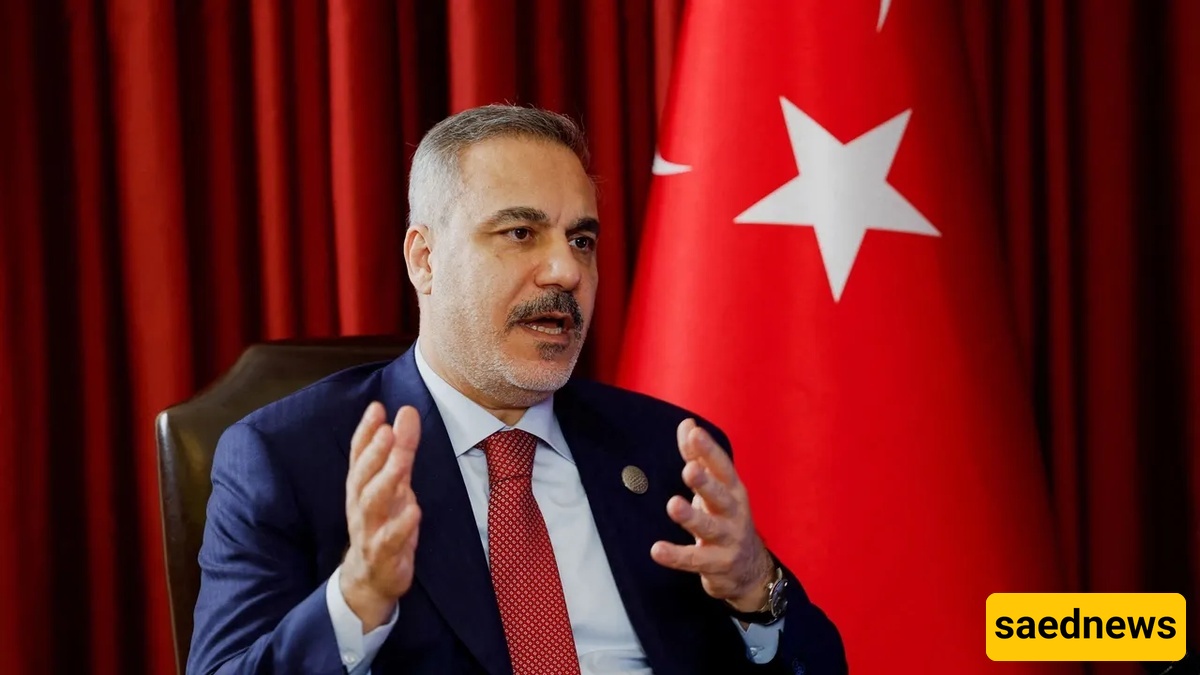
According to SAEDNEWS, Turkish Foreign Minister Hakan Fidan said that Ankara supports mediation efforts by Pakistan and several regional countries between Iran and the United States. He noted that both parties are determined to reach an agreement and are now closer to a result than at any previous point. According to Fidan, current talks are focused on reopening the Strait of Hormuz, and the parties have agreed on a general framework for continuing negotiations. He emphasized that any disruption in the Strait of Hormuz has far-reaching consequences for energy security, food security, and the global economy, making the issue a higher priority for Turkey than Iran’s nuclear file. He also expressed hope that an agreement between Tehran and Washington would pave the way for progress in the Gaza peace initiative and broader regional cooperation.
Hakan Fidan, Turkey’s Foreign Minister, announced that Ankara, alongside several regional countries including Qatar, supports Pakistan’s efforts to mediate between Iran and the United States.
Speaking about the Iran–U.S. negotiations, Fidan said: “Both sides want to achieve a positive outcome. An agreement is closer than ever.”
Referring to the ceasefire involving Iran, the United States, and Israel, he added that discussions are currently focused on the Strait of Hormuz, a strategic waterway for global oil trade that has faced disruptions since late February.
The Turkish foreign minister stated that the parties have agreed on a general framework under which negotiations on the nuclear issue would begin once a final agreement is reached regarding the reopening of the Strait of Hormuz.
Fidan stressed that the practical closure of the Strait has placed considerable pressure on both Iran and the United States while also creating significant international consequences.
He stated that reopening the Strait of Hormuz is a higher priority for Turkey than Iran’s nuclear program.
“The international consequences of this situation, including its effects on energy security, food security, and rising prices, are extremely significant. This issue has now taken precedence over nuclear-related matters,” he said.
Fidan also expressed the view that if Iran and the United States reach an agreement to end hostilities, discussions on a peace plan for the Gaza Strip could advance more rapidly.
Addressing Turkey’s relations with Israel, he noted that the two sides have maintained diplomatic relations since 1949 and that bilateral trade had reached $10 billion before the Gaza war.
He added that when Turkey suspended trade with Israel, it clearly stated that Israel must stop the killing of Palestinians and allow Gaza residents access to essential needs such as food, shelter, medicine, and water.
“If these conditions are met, we can return to normal relations. We support the implementation of a two-state solution,” Fidan said.
He also rejected statements by some Israeli politicians regarding Turkey, arguing that Israel consistently seeks an external adversary to advance its regional objectives.
Referring to Israel’s actions in Gaza, the West Bank, Syria, and Lebanon, he said that the international community must prevent Israel from further destabilizing the regional and global order.
Fidan further discussed a proposal for a “regional cooperation platform,” emphasizing that countries in the region should commit themselves to respecting each other’s territorial integrity, sovereignty, and security.
He described the current situation as a “golden opportunity” for regional cooperation and said that Pakistan, Turkey, Saudi Arabia, Egypt, and the Gulf states could form part of such a framework, adding that “when conditions normalize, perhaps Iran could also join.”
He also stated that Israel could eventually become part of this regional framework if it recognizes a Palestinian state based on the 1967 borders.