SAEDNEWS: Iranian Foreign Minister Seyed Abbas Araghchi says psychological warfare targeting Iranian society is part of a broader conflict but has failed to achieve its objectives, adding that Tehran is prepared for all scenarios.
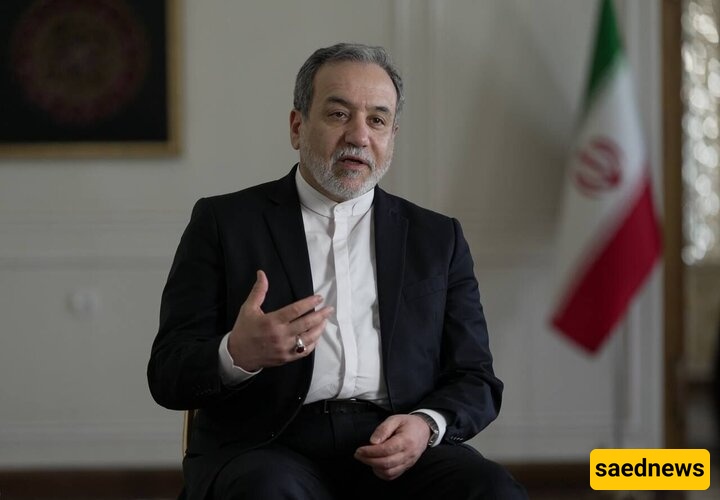
In an interview with Al Jazeera, Abbas Araghchi stated that the United States and Israel are fully aware that past military confrontations, particularly the 12-day war, failed to achieve their intended objectives.
He emphasized that Iran remains fully prepared to defend itself under any circumstances, noting that both the armed forces and the Iranian people are ready to protect the nation. At the same time, he stressed that preparedness should not be interpreted as a desire for war.
Araghchi highlighted that diplomacy has always been Iran’s priority, citing diplomatic efforts, including talks held in New York, as part of this approach. He added that excessive demands from the United States and several European countries—especially concerning the snapback mechanism—hindered progress.
The foreign minister said Iran is ready for all possible scenarios, with ongoing security assessments. However, he warned that repeating past failed military experiences should be avoided if rational decision-making prevails. He pointed to events in Gaza as evidence of the lack of limits on the actions of Iran’s adversaries.
Addressing Iran’s nuclear program, Araghchi said it has no military solution. He noted that while facilities or equipment could be damaged, knowledge and technology cannot be destroyed by bombing. He also stressed that assassinations of scientists cannot eliminate the will of a nation, adding that years of threats, sanctions, and even military attacks have failed to produce results.
He acknowledged that Iran’s nuclear facilities have sustained serious damage during aerial attacks but emphasized that this does not constitute the destruction of Iran’s nuclear program. According to Araghchi, Iran’s nuclear technology is indigenous and can be rebuilt, and the determination of the Iranian people remains intact.
Regarding Iran’s strike on a US base in Qatar, Araghchi clarified that Iran did not attack Qatar itself but targeted a US military facility. He stressed that Iran maintains friendly relations with neighboring countries and that, in any conflict with the United States, Iran’s response would focus on US military bases regardless of location. He added that Iran expressed solidarity with Qatar at the time and that he personally communicated this position to the foreign ministers of Persian Gulf Cooperation Council member states, reiterating that Iran’s dispute is with the United States, not regional neighbors.
Araghchi also highlighted deep mistrust toward Washington, saying the United States has never been a reliable negotiating partner. While this mistrust does not prevent Iran from pursuing diplomatic avenues, past experiences have significantly undermined confidence in negotiations with the US. He cited the Leader of the Islamic Revolution’s view that talks with Washington represent a dead end.
The Iranian foreign minister criticized moves by three European countries at the UN Security Council to reinstate sanctions, describing the effort as a serious blow to diplomacy. He argued that, just as military action failed to resolve the issue, additional sanctions would only complicate the situation further.
On cooperation with the International Atomic Energy Agency (IAEA), Araghchi explained that it was inevitably suspended after attacks on nuclear facilities, as no framework existed for inspecting bombed sites. He noted that Iran later reached a new agreement with the IAEA in good faith, signed in Cairo, but the step was rendered ineffective by the activation of the snapback mechanism, prompting Tehran to reconsider the nature of its cooperation.
In the final part of the interview, Araghchi described remarks by the US president about Iran as interference in the country’s internal affairs, asserting that Iran’s strength and status are matters solely for the Iranian people. He said national unity during the recent war demonstrated that Iranians determine their own destiny.
Araghchi concluded that a peaceful, negotiated solution remains possible, provided there is mutual respect and recognition of the rights of the Iranian people. He recommended that the US president return to diplomacy, noting that it may not yet be too late.