Saed News: This stunning satellite image reveals golden streaks surrounding “Spirit Lake” in Ghana, a lake that was formed about one million years ago following the devastating impact of an asteroid striking Earth.
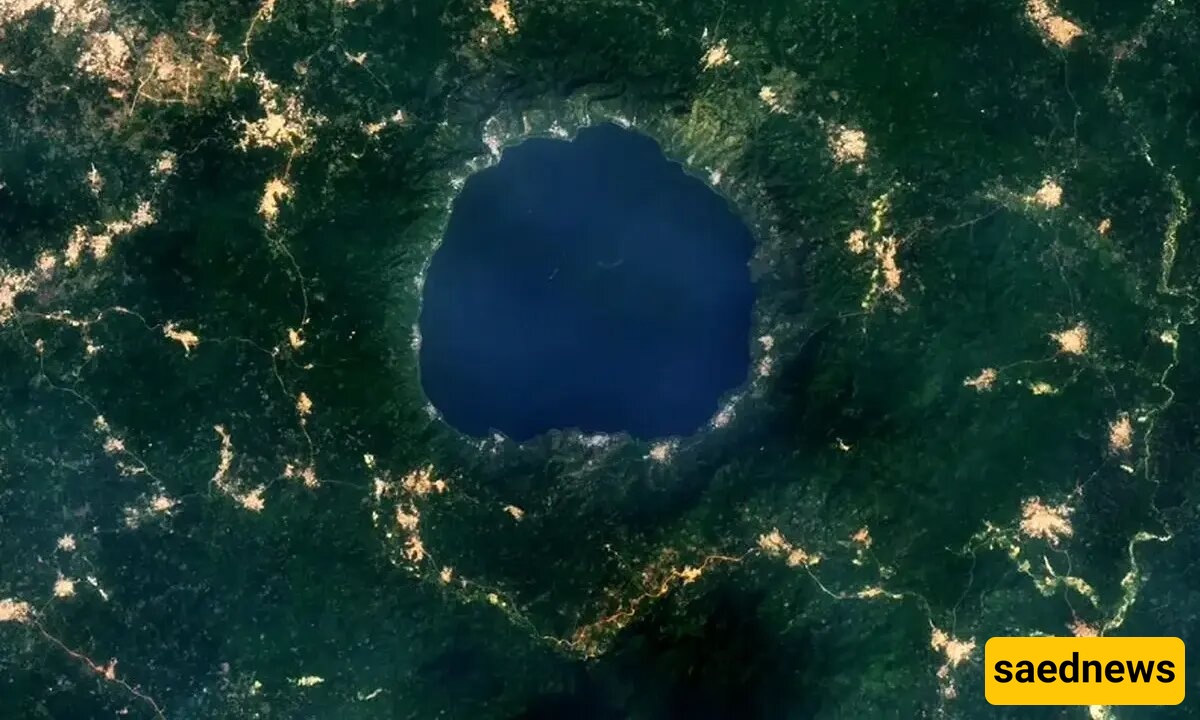
According to SAEDNEWS, citing Faradeed, Lake Bosomtwe covers an area of about 19 square kilometers. Located southeast of Kumasi, Ghana’s second-largest city, it is the country’s only natural lake. This nearly circular body of water reaches a depth of approximately 70 meters at its deepest point.
For the indigenous Ashanti people, the lake is a sacred place. Their mythology tells of a hunter named Akora Bompe who was pursuing a wounded antelope when he entered a magical pond that suddenly expanded into the present-day lake. The site is also believed to be where spirits bid farewell to Earth before entering the afterlife.
From a scientific perspective, however, the lake formed about one million years ago when a meteorite roughly one kilometer wide struck Earth. According to the International Commission on Geoheritage, the site is “probably the best-preserved young and complex impact structure on Earth.”
Marian Selorm Sapah, a senior lecturer in Earth Sciences at the University of Ghana, says the catastrophic impact likely produced a “blinding flash of light and an enormous fireball” that destroyed life for tens of kilometers around the site. He added that if such an event occurred today, the city of Kumasi would likely be completely destroyed.
Remote-sensing studies have shown that debris ejected by the impact settled around the crater in a raised, multi-layered ring pattern known as a “rampart crater.” This indicates that the area contained significant groundwater at the time of impact.
Rampart craters are rare on Earth but are commonly found throughout the Solar System, including on Mars and moons such as Ganymede, Dione, Tethys, and Charon. As a result, studying Lake Bosomtwe can help scientists better understand how similar craters formed on other celestial bodies.
The impact did more than create the lake. The fracturing of Earth’s crust allowed mineral-rich magma to rise closer to the surface, leading to the formation of veins containing gold and other valuable elements—resources that have been mined for generations. These mining activities are responsible for the golden lines and patches visible in the satellite image.
In recent years, gold extraction has accelerated due to advances in technology. Another satellite image captured in 2024 shows a significant increase in gold mining around the lake, with more golden streaks becoming visible. In the newer image, the lake’s water also appears greener because of increased phytoplankton growth.