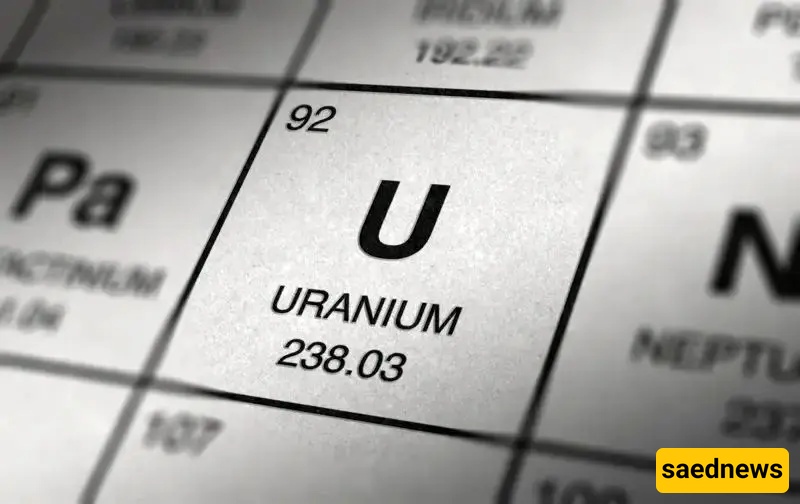
Saed News: Uranium is a heavy metallic chemical element with a silvery-white color. Its symbol in the periodic table is “U” and its atomic number is 92.
According to SAEDNEWS, based on estimates by the “Federation of American Scientists” and the “International Arms Control Association,” nine countries currently possess nuclear weapons or are believed to have them: the United States, Russia, China, France, the United Kingdom, India, Pakistan, North Korea, and Israel.
In addition to blast waves and extreme heat, nuclear weapons release radiation that can cause dangerous diseases and radioactive poisoning, with effects that continue long after the explosion.
But before uranium became a key material in nuclear weapons, how was it discovered and what are its peaceful uses?
Uranium is a heavy metallic chemical element with a silvery-white color. Its symbol in the periodic table is “U” and its atomic number is 92. It is naturally found in low concentrations in soil, rock, and water, and is commercially extracted from uranium-bearing ores such as uraninite and pitchblende.
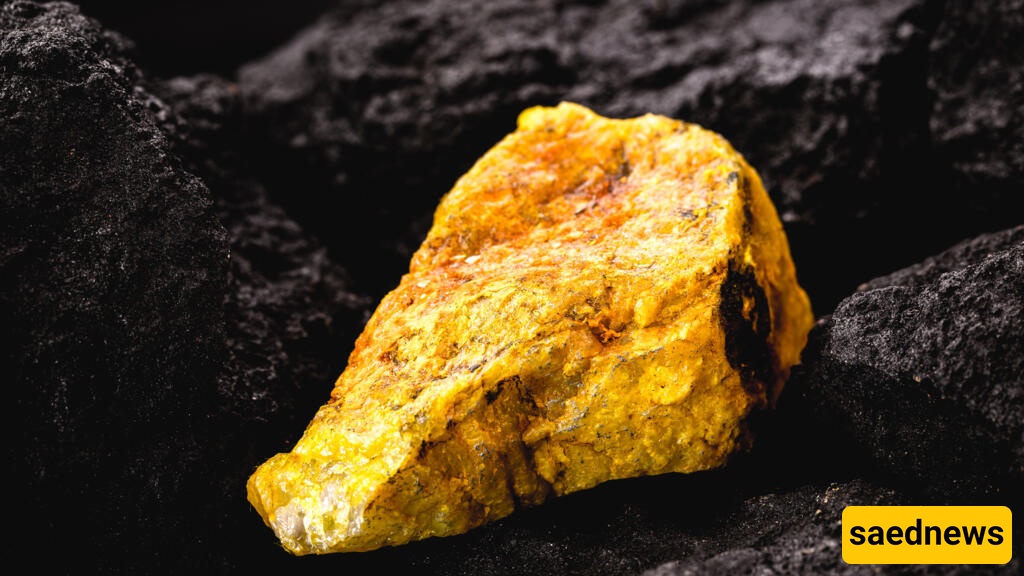
Pure uranium is a silvery-white or grayish-silver metal, but uranium ores in nature can appear yellow, brown, black, or green depending on their composition.
Uranium ore is extracted from open-pit or underground mines. After extraction, the ore is crushed and processed in specialized facilities to separate uranium from other materials. Another method, called in-situ leaching, involves injecting a solution into underground layers to dissolve uranium, which is then pumped back to the surface for processing.
According to the U.S. Department of Energy, extracted uranium is typically stored, traded, and sold in the form of uranium oxide concentrate known as “yellowcake.”
Uranium has a very high density of about 19 grams per cubic centimeter, making it about 1.7 times heavier than lead.
The World Nuclear Association notes that although uranium is not abundant in the solar system, its slow radioactive decay, along with other radioactive elements, produces a significant portion of the Earth’s internal heat, which plays a role in tectonic plate movement.
According to the same source, uranium is believed to have formed before Earth itself, during massive stellar explosions known as supernovae, and later became part of the material that formed the solar system.
Historically, uranium was mainly obtained through conventional mining and processing. Today, a large share of global production comes from in-situ leaching and is ultimately converted into “yellowcake,” the common commercial form of uranium.
Martin Heinrich Klaproth, a German chemist, was the first to identify uranium in 1789 while analyzing samples of pitchblende from silver mines in Joachimsthal, in the former kingdom of Bohemia (now part of the Czech Republic).
Klaproth did not isolate pure metallic uranium; he identified one of its compounds and named it “uran.” The name was derived from the planet Uranus, which had been discovered a few years earlier.
For years, uranium was used in glass coloring and ceramic glazes before its radioactive properties were discovered, and some of its compounds were also used in early photography.
Understanding of uranium’s radioactivity began at the end of the 19th century. In 1895, Wilhelm Röntgen discovered X-rays while experimenting with electrical discharge in a vacuum tube.
A year later, Henri Becquerel discovered that uranium salts emit invisible rays that could affect photographic plates even without light, marking the beginning of the study of natural radioactivity.
In 1898, Pierre and Marie Curie introduced the term “radioactivity” and later isolated polonium and radium from pitchblende. Radium was later used in medicine, especially for cancer treatment.
In 1900, Paul Villard discovered gamma rays, a third type of radiation with high penetration power similar to X-rays. This helped scientists better understand alpha, beta, and gamma radiation.
In the late 1930s and early 1940s, knowledge of nuclear fission developed rapidly. Scientists discovered that splitting an atomic nucleus releases enormous energy and can lead to a chain reaction under certain conditions.
During World War II, nuclear research in Britain and the United States accelerated, leading to secret projects such as the Manhattan Project, which combined large-scale scientific and industrial efforts to develop nuclear weapons.
In 1945, this resulted in the first atomic bombs. The first nuclear test, known as “Trinity,” was conducted in July in New Mexico, followed by the bombings of Hiroshima and Nagasaki in August 1945.
Today, uranium is used as fuel in commercial nuclear reactors to generate electricity. It also plays a role in producing radioactive isotopes for medical, industrial, and research applications, as well as military uses.
Low-enriched uranium is used in commercial reactors, while high-enriched uranium is used in some research reactors, naval propulsion systems, and nuclear weapons.
According to the International Atomic Energy Agency (IAEA), research reactors are used to produce neutrons for scientific, medical, and industrial applications. One of the most important uses is producing the medical isotope molybdenum-99 by irradiating uranium-235 targets in reactors.
Molybdenum-99 decays into technetium-99m, a radioactive isotope widely used in medical imaging, especially for diagnosing diseases such as cancer and heart conditions.
The IAEA states that more than 80% of annual medical imaging procedures for diseases such as cancer rely on radiopharmaceuticals, most of which are produced in nuclear research reactors.