SAEDNEWS: Agra Fort, also known as Lal Qila or the Red Fort, is located in the city of Agra, India, north of the famous Taj Mahal. This structure, which dates back to the 16th century, is considered one of the major tourist attractions of the city alongside the Taj Mahal.
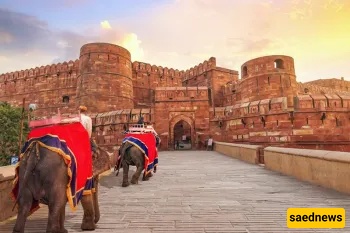
According to Saednews, Agra Fort, also known as the Red Fort of Agra, is a magnificent defensive structure in India dating back to the 16th century and the Mughal era. This historic monument contains various sections such as gardens, mosques, palaces, and marble towers, all of which are unique and highly remarkable in their design. The fort is located near the Taj Mahal and is considered to be of equal grandeur and significance to this world-famous monument. Below, we take a closer look at Agra Fort.
Learning about Agra Fort means discovering one of the most beautiful and fascinating historical monuments in India. With its Mughal architecture, it attracted the attention of many rulers throughout different eras. The fort includes several sections such as the emperor’s summer palace and important administrative and residential areas used by the royal court.
Inside the fort, there is also a small and beautiful mosque called Mina Mosque, which is associated with the imprisonment of Shah Jahan and is a notable attraction. At the fort’s entrance, deep moat-like trenches were built in the past for defensive purposes. Agra Fort should not be confused with the Red Fort in Delhi, as they are entirely different structures.
There are various accounts regarding the history of Agra Fort. According to historical narratives, the original structure dates back to the 11th century during the rule of early regional dynasties in India. At that time, Sultan Lodi is said to have resided in the fort, adding a mosque and a water well during his reign.
In 1526, the Mughals invaded India and Agra. After defeating Sultan Lodi, they captured the fort. During this period, a staircase was added to the structure. In 1555, a ruler named Hemu attempted to reclaim Agra Fort and succeeded temporarily, but in 1556 he was defeated by Emperor Akbar, who recaptured the fort.
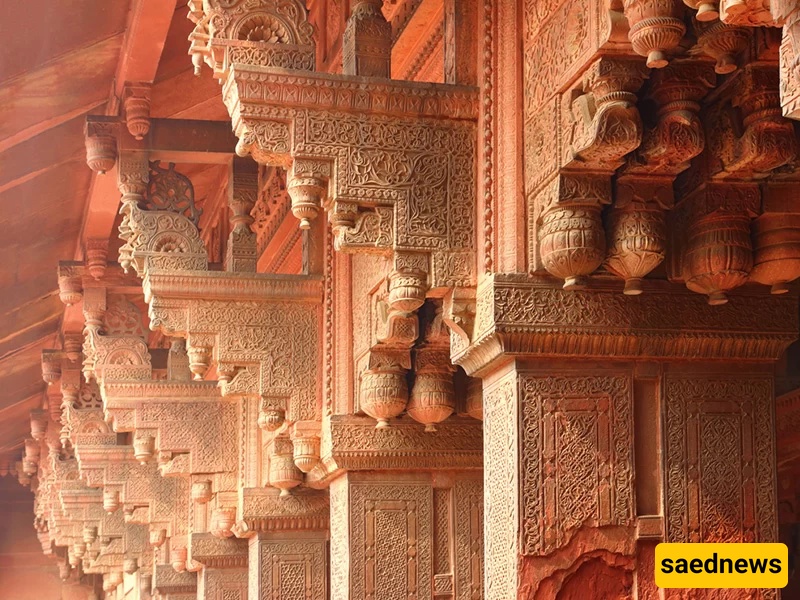
Emperor Akbar made Agra the capital of his empire and ordered the reconstruction of the heavily damaged fort. The restoration was carried out using red sandstone brought from Barauli in Rajasthan, along with marble, gold, and other precious materials.
Around 4,000 workers labored for eight years, and in 1573 the reconstruction of Agra Fort was completed. During the reign of Shah Jahan, Akbar’s grandson, several parts of the fort were modified or demolished to make way for construction connected to the Taj Mahal.
Agra Fort served as the residence of Shah Jahan and his family. In his later years, he was even imprisoned in this fort by his son Aurangzeb.
In the early 18th century, the Maratha Empire captured the fort. Over time, control of Agra Fort changed hands multiple times between rival powers.
In 1803, the British defeated the Marathas and took control of Agra Fort. Many of its decorative stones and ornaments were looted during this period.
In 1857, Indian forces fought the British in a major uprising, and Agra Fort became a key battlefield. This conflict marked the end of direct British dominance in some parts of India.
Agra Fort was designated a UNESCO World Heritage Site in 1983 and remains one of the most important tourist attractions in India today.
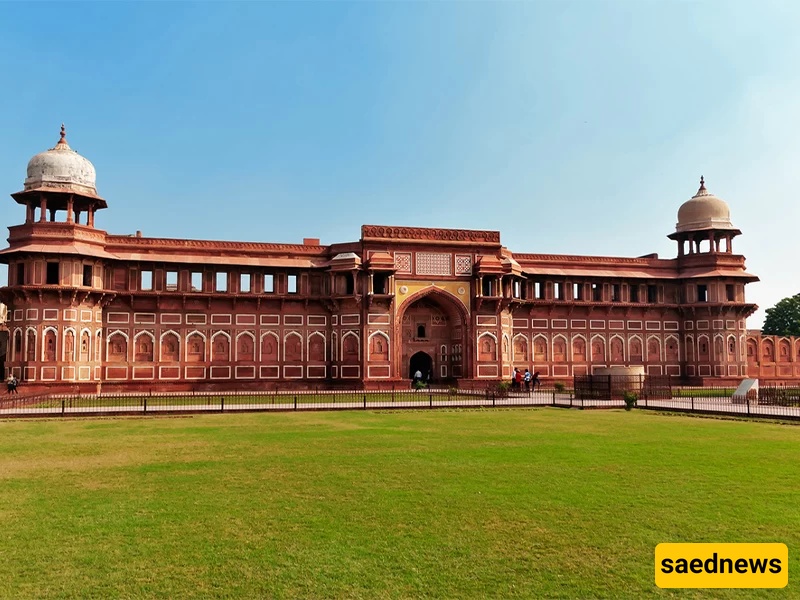
The architecture of Agra Fort reflects the preferences of Emperor Akbar. The use of red sandstone gives the fort its distinctive color, which is why it is called the “Red Fort of Agra.”
The design combines Persian garden-inspired architecture with Indian artistic elements. Alongside Islamic geometric and floral patterns, motifs such as elephants, dragons, and birds are also used in decoration.
The fort is semi-circular in shape and surrounded by double defensive walls, some reaching up to 21 meters in height. It has four main gates: Delhi Gate, Lahore Gate (Amar Singh Gate), Hathi Pol (Elephant Gate), and Akbar Gate.
Among these, the Delhi and Lahore Gates were built for enhanced security. The Akbar Gate is considered the most magnificent, decorated with intricate designs and gold elements. The Hathi Pol Gate, guarded by stone elephant statues, served as an internal and highly secure entrance.
Today, tourists primarily enter through the Amar Singh Gate, a winding southern gate designed to confuse invaders.
Inside the fort, visitors are guided to an elegant hall known as Diwan-i-Aam, where the emperor would address public matters.
Nearby is the Mina Mosque, built for the royal women. There was also a women’s market in this area in earlier times. It is believed that the legendary Peacock Throne of Shah Jahan, adorned with the Koh-i-Noor diamond, was once placed in the Diwan-i-Aam.
On the riverside stands the Sheesh Mahal (Glass Palace), decorated with intricate mirror work, used by the emperor for changing clothes.
The eastern section contains the Khas Mahal, which blends Islamic and Indian architectural styles and features white marble decorated with paintings.
Other notable structures include the Musamman Burj and the Jahangir Palace, which reflect a mix of red sandstone and white marble architecture.
Over time, Agra Fort underwent many additions and destructions. During the Mughal era, several buildings were added, but many were demolished during British rule to construct military barracks.
Some historical features, such as the central fountain and the summer pavilion, have not survived to the present day.
Agra Fort remains one of India’s most visited heritage sites. Its proximity to the Taj Mahal makes it a key stop for tourists exploring Mughal history and architecture in Agra.