SAEDNEWS: A survey published by Israel’s Kan broadcaster says nearly one in five Israelis have seriously considered leaving the country over the past two years, while new research cited by the broadcaster points to record levels of emigration and a growing concern over the loss of highly educated professionals.

According to SaedNews: Nearly one in five Israelis say they have seriously considered leaving Israel during the past two years, according to a survey published by Israel’s Kan public broadcaster—a finding that has placed renewed attention on what Israeli media describe as a growing wave of “reverse migration.”
The survey, conducted by Kan and released Monday, offers a striking picture of how emigration has entered the calculations of a significant portion of the Israeli public.
According to the results, about 20% of respondents said they had seriously thought about leaving during the previous two years. The figure does not necessarily mean that all of those people have made concrete plans to depart, but it indicates that emigration has become a serious consideration for a sizable share of respondents.
Another finding adds a social dimension to the trend: roughly one-third of Israelis surveyed said they personally know at least one person who has left Israel during the same period.
That means the issue is not necessarily perceived as something distant or abstract. For a substantial number of respondents, emigration is reportedly something they have encountered within their own circle of family, friends, colleagues or acquaintances.
The survey also points to a political factor that could influence future decisions.
A considerable number of respondents said they are waiting for the results of the upcoming October election before deciding whether to leave. Twelve percent said the election outcome would have a major impact on their decision, while another 20% said they were still uncertain about whether the political result would affect their plans.
The findings suggest that, for some Israelis considering emigration, the question is not simply whether to leave but when to make that decision.
The political environment therefore appears to be closely linked, at least for some respondents, to their calculations about their future.
The survey also asked Israelis whether they were worried about a broader wave of emigration. Forty-one percent answered yes, indicating that concerns over large-scale departures extend beyond those who are personally considering leaving. Another 13% selected “I don’t know.”
Together, those figures present a picture of a society where the possibility of people leaving has become a visible subject of concern.
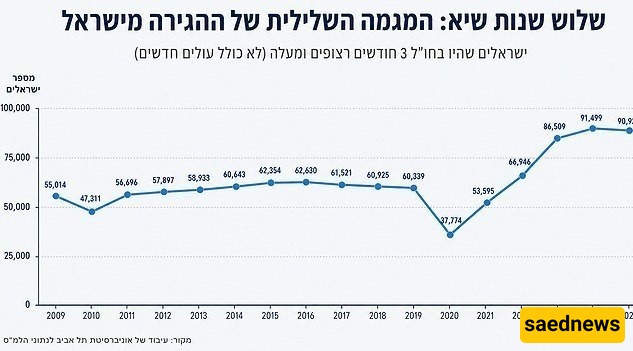
Kan’s report went beyond the survey itself and cited research from Tel Aviv University published the previous week. According to the broadcaster’s account of that research, more than 268,509 Israelis left Israel between 2023 and 2025, a level described as a record for recent years.
The report further stated that 90,000 Israelis definitively left during the most recent year alone.
Those figures, if sustained, would make the scale of emigration one of the more significant demographic issues highlighted in the report.
The research was led by Itay Ater, a professor at Tel Aviv University. According to the account cited by Kan, Ater said recent years had witnessed a major jump in reverse migration, particularly following the October 7 attack and the period that followed.
One of the most consequential aspects of the research, as presented by the broadcaster, concerns the professional backgrounds of some of those leaving.
Ater said many of the people departing have high levels of education and work in fields such as medicine and engineering. He also pointed to departures among figures from the business community.
That element gives the migration debate an economic and professional dimension. The issue is not simply about how many people leave, but also about who is leaving and what skills or professional experience they take with them.
Doctors and engineers represent highly trained sections of the workforce, while business figures can play important roles in investment and economic activity. The departure of people from these sectors can therefore become part of a broader discussion about the long-term consequences of sustained emigration.
At the same time, the figures and interpretations cited in the report should be understood within their stated context. The survey measures what respondents say they have considered or experienced, while the university research addresses recorded migration. Neither category automatically means that every person who has considered leaving will ultimately depart.
Still, the combination of the survey and the research produces a notable picture.
Nearly 20% say they have seriously considered leaving. One-third say they know someone who has already left. Forty-one percent say they are concerned about a broader migration wave. And a significant group appears to be waiting for the outcome of the upcoming election before making a decision.
These figures help explain why the issue has attracted attention in Israeli media.
Migration decisions are often shaped by multiple factors, and the survey itself does not establish a single reason why respondents are considering leaving. But the timing of the findings, together with the research figures cited by Kan, has placed the issue firmly in the public conversation.
The political dimension is particularly notable. For the respondents who say the October election could influence their decision, the outcome may become a turning point in determining whether they remain or seek opportunities elsewhere.
Meanwhile, the concern expressed by 41% of respondents indicates that the issue has moved beyond individual choices. It has become something a much broader segment of the population is watching.
The most striking message from the report, therefore, may not be any single percentage. It is the convergence of several indicators: a significant number considering departure, many people personally knowing someone who has already left, widespread concern about a broader migration wave, and research pointing to unusually high emigration figures.
The professional profile of some emigrants adds another layer to the story.
If highly educated workers in medicine and engineering and figures from the business sector continue to leave, the debate could increasingly focus on the quality as well as the quantity of migration.
For now, the survey does not establish what will happen after the election or how many people who are considering emigration will ultimately act on those intentions. But it does show that leaving has become a serious consideration for a substantial portion of respondents.
And with recent research cited by Kan pointing to more than 268,000 departures between 2023 and 2025, the issue is unlikely to disappear from the public debate soon.
The coming political period could therefore become important not only for those making immediate decisions about their future, but also for a society increasingly asking what a sustained wave of emigration could mean for its demographic, professional and economic outlook.