SAEDNEWS: China is developing a planetary-defense mission designed to deliberately strike a roughly 98-foot near-Earth asteroid at more than 5.6 miles per second—over 26 times the speed of sound at sea level.
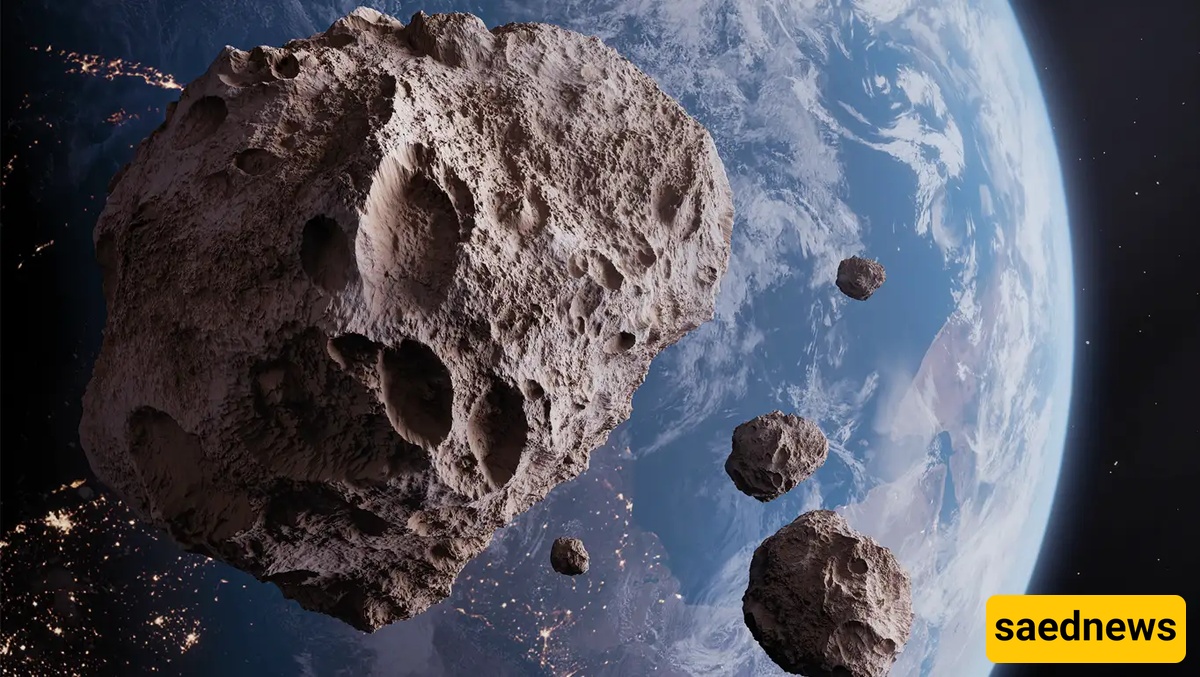
According to SaedNews: China is preparing an unusually ambitious test of planetary defense: instead of simply studying an asteroid from a distance, the country plans to send a spacecraft directly into one at a staggering speed of more than 5.6 miles per second.
That translates to more than 26 times the speed of sound at sea level.
The target is a relatively small near-Earth asteroid known as XF2612015, estimated to be about 98 feet across. First identified in 2015, the object has not been extensively studied, making the planned mission not only an impact experiment but also an opportunity to learn more about a comparatively poorly understood space rock.
The Chinese mission is being led by Li Mingtao, a senior planetary-defense scientist at the China National Space Administration. Its broader purpose is to advance technologies that could one day help protect Earth from potentially hazardous near-Earth objects.
But this is not simply an attempt to repeat NASA's famous DART mission.
China wants to take the concept further.
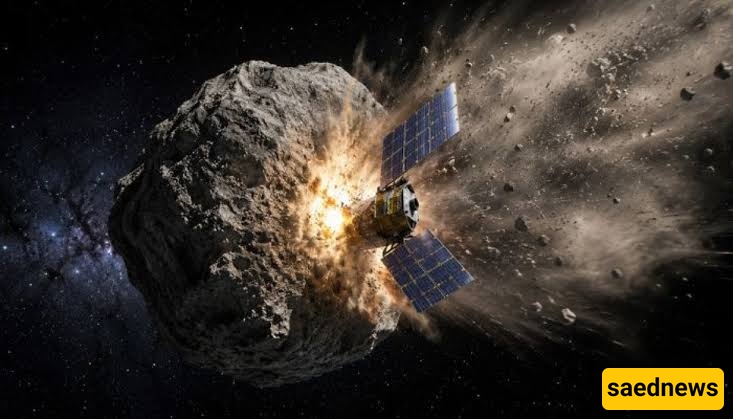
NASA's DART mission demonstrated that deliberately hitting an asteroid can change its orbit around another body. China’s planned experiment is designed around a different and more directly Earth-focused objective: changing an asteroid’s trajectory relative to Earth.
That distinction is central to the project.
The Chinese researchers say the impact could potentially do more than alter the asteroid’s path. If necessary, the collision could also disrupt the asteroid’s structure or even cause it to break apart.
That makes the mission a test of several capabilities at once.
The spacecraft is expected to approach its target at more than 5.6 miles per second. For comparison, NASA’s DART spacecraft struck its target at about 3.8 miles per second.
The difference may look small on paper, but at spacecraft speeds, even a fraction of a mile per second represents a significant change in impact energy.
And China is not planning to rely on the impactor alone.
The mission is expected to include a second spacecraft whose job will be to observe the asteroid before, during and after the collision.
That spacecraft will track changes in the asteroid’s orbit, shape and surface. It will also investigate its internal structure, giving researchers a much broader picture of what happens when a high-speed spacecraft strikes a relatively small and potentially compact asteroid.
This combined approach is different from the way NASA’s DART mission and the European Space Agency’s Hera mission were conducted.
Hera was launched separately to study the consequences of the DART impact. China, by contrast, intends to incorporate both the impact spacecraft and the observing spacecraft into the same mission.
Researchers from the China National Space Administration and the Chinese Academy of Sciences say this approach is intended to better simulate a realistic planetary-defense scenario.
The idea is not merely to prove that an asteroid can be hit.
It is to understand whether scientists can hit the right object, change its trajectory by the intended amount, measure the result accurately and establish that Earth remains safe afterward.
Those requirements form the mission’s four central objectives.
The Chinese mission will focus on four key goals: accurately hitting the asteroid, successfully changing its orbit, precisely measuring the consequences of the collision and confirming that Earth remains safe after the experiment.
Each objective presents its own challenge.
The first is simple to describe but extremely difficult to execute: the spacecraft must find and hit a relatively small target moving through space without relying on continuous real-time guidance from Earth.
Before the collision, researchers expect to obtain more information about the asteroid’s size, shape and rotation.
That information will be crucial because the object’s exact dimensions remain uncertain.
Scientists currently estimate that XF2612015 is around 98 feet wide, but the available information about it is limited.
The mission therefore has a built-in element of discovery. The spacecraft will not be approaching a perfectly mapped target with every characteristic already known.
The choice of asteroid also distinguishes the experiment from DART.
NASA’s target was a much larger asteroid, roughly 525 feet across, described as a rubble-pile body.
China’s target is significantly smaller and is believed to be a stronger, more solid object.
That difference matters because an impact does not necessarily produce the same result on every type of asteroid.
A loosely bound collection of rocks may react very differently from a more coherent body. Understanding those differences could be essential if asteroid deflection ever becomes a real emergency response tool.
China’s spacecraft will therefore be testing not only the ability to strike an asteroid but also the ability to understand how its physical characteristics affect the outcome.
Perhaps one of the most demanding parts of the experiment will be autonomous targeting.
The spacecraft must navigate toward its asteroid and make the final approach accurately enough to achieve a direct collision. At those distances and speeds, there is no practical opportunity for a human operator to manually “steer” the spacecraft into the target at the last moment.
The second spacecraft adds another layer of complexity.
Before separating, the two spacecraft are expected to launch together. One will head toward the impact, while the other will use a gravity assist from Venus to position itself for observations of the aftermath.
That means the mission is effectively combining two difficult tasks: executing an extremely precise high-speed collision and gathering useful scientific data from the event.
The planned impact could take place during an Earth close approach in 2029 or 2030, when the asteroid is expected to pass roughly 4.3 million miles from Earth.
That distance is still enormous, but the timing provides an opportunity to conduct a planetary-defense experiment under conditions relevant to Earth's relationship with near-Earth objects.
The mission is not presented as an attempt to destroy an asteroid threatening Earth.
Instead, it is a controlled technology demonstration designed to improve the ability to respond if a genuinely dangerous object were ever identified.
That distinction is important.
Planetary defense depends on knowing far more than simply how to hit a space rock. Scientists need to understand its structure, determine how much its trajectory changes, measure the consequences and ensure that any intervention does not create a new hazard.
China's planned experiment is designed to gather information across that entire chain.
A successful impact would not mean humanity had suddenly solved the asteroid-threat problem.
It would, however, provide valuable data on how high-speed impacts can alter the paths of asteroids and how different asteroid structures respond to collisions.
The mission could also reveal whether a relatively small, stronger asteroid behaves differently enough from a rubble-pile object to require a different deflection strategy.
That knowledge could become increasingly important as planetary-defense programs develop around the world.
For now, the most striking aspect of China’s plan is its simplicity: find a small asteroid, hit it at extraordinary speed, measure exactly what happened and determine whether its path changed as intended.
But behind that simple outline lies a remarkably demanding technological test.
The spacecraft must reach a moving target, operate autonomously during the critical approach, deliver a high-speed impact and then provide scientists with enough information to determine what the collision actually accomplished.
If China succeeds, the experiment could become another significant step toward a future in which humanity does not merely detect potentially dangerous asteroids—but has tested practical ways to push them away from Earth's path.
And that may be the real significance of this mission: not destroying a space rock, but learning how to make sure one never gets the chance to become a disaster.